MOSUL, Iraq: Khulud yearns to be swept away by a “prince charming,” but like many young Iraqis in the former jihadist stronghold of Mosul she worries she may never marry.
“I haven’t found a husband or a job — my life consists of household chores,” says the 24-year-old university graduate, who feels increasingly trapped in her parents’ home.
“My older sister, who is 37, already has four children... I still perhaps have a chance to find a husband, but my 29-year-old sister has much less” hope, Khulud adds, a sad smile marking the corners of her mouth.
Before the Daesh group made Mosul its self-proclaimed capital in mid-2014, Iraq’s second city was a bastion of traditionalism and conservatism. It was rare for women to hit their 20s before marrying or being engaged.
Back in government hands since July last year, the city is still scarred by nine months of brutal combat.
Reconstruction is under way, but with 21,500 homes destroyed or badly damaged, the task is overwhelming, Iraqi authorities say.
And the wait for young people to seal their nuptials is getting longer and longer. Suitors are finding it increasingly hard to save enough cash to fund a dowry and a wedding, never mind set up home with a spouse.
Mumen Abdallah also dreams of marriage.
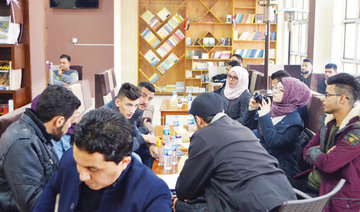
“I have a degree in economics, but this hasn’t helped me realize my dream,” says the 38-year-old, one of a crowd of men lounging on a cafe terrace.
He still hasn’t left the family home and the little cash he earns as a taxi driver is barely enough to help with the rent, in a cramped household of seven.
Manaf Khaled, a 32-year-old social worker, says a woman’s marriage prospects can depend on her employment.
“Many men prefer to marry a woman who works and contributes to household expenses,” she says.
Some couples are even relying on charity. At a function room in Mosul, hundreds of people — the guests from 10 wedding parties — tuck into a communal meal.
Mohammed Sami, a 27-year-old blacksmith who is among the grooms, says he is just happy to be here, despite not being able to afford a suit for himself or a wedding dress for his wife.
During the three years Daesh was in control of Mosul, the city was cut off from the central government in Baghdad.
Under the occupation, public sector workers went without wages. Some are still waiting to rejoin the payroll, as the security services carry out investigations in the former Daesh fiefdom.
“Unemployment and the long interruption to salaries has prevented very many young people who want to start a family from marrying,” Ashraf Ismail, who works in women’s protection, says.
In a bid to unblock the bottleneck, lawmaker Jamila Al-Obeidi has been pushing a novel proposal in Iraq’s parliament.
She wants the government “to provide five million dinars ($4,000, 3,300 euros) to every man wishing to marry, then a million dinars for each child born,” she says.
But there are strings attached. “The proposed wife must be older than the ‘normal’ marriage age, divorced, or a war widow,” she says.
While the initiative has gained the support of 70 lawmakers, it hasn’t been adopted by the government.
But if it ever became law, it might give 38-year-old Rim, who does not give her full name, a ray of hope.
“A husband may never come for me,” she says.
“When I was young, I refused many suitors so as to finish my studies and wait for the arrival of my prince charming, but now the chances of meeting him are slim,” she laments.


![]()

Marriage a distant dream for many in Iraq’s Mosul
Marriage a distant dream for many in Iraq’s Mosul
- Before the Daesh group made Mosul its self-proclaimed capital in mid-2014, Iraq’s second city was a bastion of traditionalism and conservatism. It was rare for women to hit their 20s before marrying or being engaged.
- Reconstruction is under way, but with 21,500 homes destroyed or badly damaged, the task is overwhelming, Iraqi authorities say. And the wait for young people to seal their nuptials is getting longer and longer.


Latest updates


© 2026 SAUDI RESEARCH & PUBLISHING COMPANY, All Rights Reserved And subject to Terms of Use Agreement.