Battle to free Mosul of Daesh ‘intellectual terrorism’

1 / 2
A graduate of an anti-jihadist ideology course organised by the Muslim Scholars Forum of Mosul speaks to new volunteer recruits after his ceremony in the northern Iraqi city on February 8, 2018. (AFP)
2 / 2
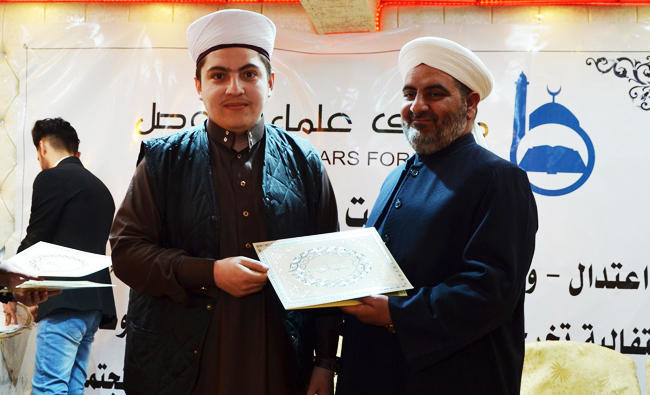
Sheikh Saleh al-Obeidi (R), head of the Muslim Scholars Forum of Mosul, hands out a certificate to a new graduate during a graduation ceremony in the northern Iraqi city, in this February 8, 2018 photo. (AFP)
Updated 17 February 2018
Follow

Battle to free Mosul of Daesh ‘intellectual terrorism’

MOSUL, Iraq: In a classroom of the University of Mosul, in the Daesh group’s former Iraqi capital, around 50 volunteers have undergone a week’s training on how to combat the terrorists’ ideology.
The ulema, or Islamic scholars, aim to set up “brigades” tasked with ridding Mosul residents of extremist ideas following the city’s recapture last July which ended three years of Daesh rule.
“Mosul must be liberated from the thinking of Daesh after having been liberated militarily,” said Mussaab Mahmud, who just completed the course, using an Arabic acronym for Daesh.
“We were deceived by Daesh ideas and now we are trying to free ourselves from its ideology,” said the 30-year-old day laborer.
The first group of volunteers came from all sectors of Mosul society, including mechanics, teachers and a sheikh.
The men aged from 25 to 45 signed up on Facebook for the course run by the Ulema Forum of Mosul, Iraq’s second largest city which was left shattered by the months-long battle to expel Daesh.
The classes are being conducted by five teachers who are experts in Islamic jurisprudence from Mosul and Tikrit, a city to the south that was also previously under brutal Daesh rule.
“The lessons are concentrated on human rights, human development, peaceful coexistence and communal peace,” the forum’s president Sheikh Saleh Al-Obeidi told AFP.
He said participants were tutored on “faith, Islamic jurisprudence and the Hadith (record of the sayings of the Prophet Muhammad) to allow them to counter the ideas of Daesh and its intellectual terrorism.”

Daesh imposed its own rigid interpretation of Islamic law on all aspects of everyday life, branding opponents “apostates” who should be killed.
Most members of religious and ethnic minorities who had lived in peace for centuries alongside Mosul’s majority Sunni Muslims fled to escape the radicals with their beatings and public executions.
Sheikh Obeidi said the brigades will go out and “combat the extremist ideas on social media and by calling on residents in their homes.”
His forum was established in 2014 in the autonomous region of Iraqi Kurdistan, to the north of Mosul, by ulema who had fled the city.
They broadcast on private television channels but residents risked the wrath of Daesh if they were caught tuning in to the forum’s programs.
Sheikh Obeidi said that the classes would expand to cover “all social groups and both sexes,” although it was still looking for permanent premises in the war-battered city.
Priority will be the children indoctrinated in Daesh-run schools where they were taught the terrorsit version of Islam and given weapons training.
“As a teacher myself, what I’ve learnt here will allow me as far as possible to erase the radical Daesh ideas instilled in pupils, because they were the worst affected and influenced,” said Ibrahim Mohammad Hamid, 27.
“I will go to the parents because the home and the family play a major role in spreading the idea of tolerance and coexistence,” he said.
Mohammad Abaiji, a 24-year-old imam, or prayer leader, said he would run seminars in the mosque for children “to spread enlightened ideas, because Islam is a religion of tolerance.”
Gazans salvage ancient books in mosque library damaged by war

Updated 17 sec ago
Follow

Gazans salvage ancient books in mosque library damaged by war

  • The Great Omari Mosque library sustained terrible damaged during the war in Gaza
  • The mosque now stands largely ruined, with its library littered with rubble and dust

GAZA CITY, Palestinian Territories: Inside the dusty shell of one of the oldest libraries in the Palestinian territories, a group of Gazan volunteers work diligently to salvage what remains of their ancient cultural heritage.
The Great Omari Mosque library sustained terrible damaged during the war in Gaza, which erupted in October 2023 and devastated swathes of the Palestinian territory, including cultural and religious sites.
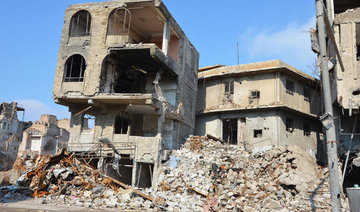
The mosque — in the old town of Gaza City — now stands largely ruined, with its library littered with rubble and dust.
“I was shocked and stunned when I saw the extent of the destruction in the library,” Haneen Al-Amsi told AFP, saying the scenes of devastation had spurred her to help launch the restoration initiative.
Amsi, who heads the Eyes on Heritage Volunteer Foundation, said the western part of the library was burned when the mosque was hit, causing irreversible damage.
“The library was estimated to contain about 20,000 books, but currently we are left with fewer than 3,000 or 4,000,” she explained.
Among the debris, volunteers hoping to restore the collection pored over charred fragments of manuscript and shards of yellowed paper.
“The library of the Great Omari Mosque is considered the third largest library in Palestine after the Al-Aqsa Mosque library and the Ahmed Pasha Al-Jazzar library,” Amsi said.
“It is an important historical library that contains original manuscripts and a diverse collection of books on jurisprudence, medicine, Islamic law, literature and various other subjects.”
Gaza’s history stretches back thousands of years, making the tiny territory a treasure trove of archaeological artefacts from past civilizations including Canaanites, Egyptians, Persians and Greeks.
But more than two years of war between Israel and Hamas took a heavy toll on Gaza’s heritage sites.
As of January 2026, the UN’s cultural agency UNESCO, had verified damage to 150 sites since the start of the war on October 7, 2023 sparked by Hamas’s attack on Israel.
These include 14 religious sites and 115 buildings of historical or artistic interest.

- ‘Represent history’ -

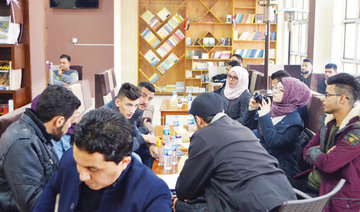
Inside one of the library’s old stone rooms, one woman used a paintbrush to dust off an old tome, while other volunteers wearing facemasks and gloves crouched on the floor to leaf through piles of books.
“The condition of the rare and historical books is deplorable due to their being left for more than 700 to 800 days,” Amsi said, talking of “immense damage and gunpowder residue” on the volumes.
An independent United Nations commission said in June 2025 that Israeli attacks on schools, religious and cultural sites in Gaza amounted to war crimes.
“Israel has obliterated Gaza’s education system and destroyed more than half of all religious and cultural sites in the Gaza Strip,” the UN Independent International Commission of Inquiry on the Occupied Palestinian Territory said in a report.
Israel rejected the commission as “an inherently biased and politicized mechanism of the Human Rights Council” and said the report was “another attempt to promote its fictitious narrative of the Gaza war.”
For Amsi, the importance of restoring the books lay in preserving crucial historic records.
“These books represent the history of the city and bear witness to historical events,” she said.