


LONDON: Palestine is set to unleash a “diplomatic onslaught” in retaliation for the massacre of unarmed civilians in Gaza.
Manuel Hassassian, Palestine’s representative in Britain, said that it was the most effective move in the wake of the killings on the Gaza border.
“Today, Palestinians are left with the option of a diplomatic onslaught,” he told Arab News.
He said Israel was guilty of human rights violations through the use of “brute force” against those protesting against the US transferring its Israeli embassy from Tel Aviv to Jerusalem on the 70th anniversary of what Palestinians call “the catastrophe” — the Nakba.
The number of Palestinians killed on Monday reached at least 58, the deadliest day of violence there since the end of the 2014 Gaza conflict.
The Palestinian Authority has recalled its Washington envoy, Husam Zomlot, and also summoned its representatives in the Czech Republic, Romania, Hungary and Austria because those countries took part in ceremonies marking the US embassy move to Jerusalem.
Palestine is urging the Human Rights Commission in Geneva to launch an investigation into the killings in Gaza.
The UN Security Council held a special session that began with a moment of silence for the Palestinians who were killed. In Geneva, the UN human rights office said that Israel has repeatedly violated international norms by using deadly live fire to repel protesters.
“Unfortunately the United States vetoed the Security Council resolution (on Gaza). Fourteen countries have condemned the practices of the Israelis,” Hassassian said.
“We want to put on as much pressure as we can internationally to get a commission of inquiry into the massacre at Gaza. We have been working on these fronts.”
The Palestinian leadership is also waiting for the ruling of the International Criminal Court on the legality of Israeli settlements on what is meant to be Palestinian territory.
“We are trying also to get more support from other international organizations and other Arab nations,” Hassassian said.
“President Abbas has always believed in non-violence. We believe a military solution is no solution, so we are exerting our most strenuous efforts through diplomatic means in order to achieve as much as we can. These are the political and diplomatic gestures that the leadership is implementing now to see what we can do at a later stage.”
By “unequivocally” supporting the move of its embassy to Jerusalem, US president Donald Trump had “discredited himself” as a broker of peace. 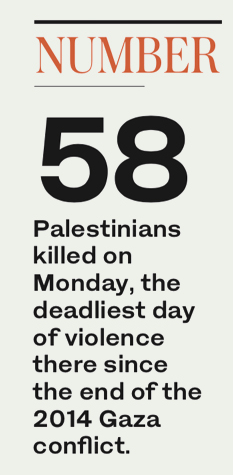
“They have chosen the wrong side of history. We don’t have any relationship with the United States,” Hassassian said, adding that Zomlot, the envoy to Washington, was already back in the West Bank.
On Wednesday, Guatemala followed the US in opening a new embassy in Jerusalem. The central American republic was also the second country after the US to recognize the state of Israel 70 years ago.
President Donald Trump recognized Jerusalem as Israel’s capital late last year, overturning decades of US policy in a move that was welcomed by Israeli Prime Minister Benjamin Netanyahu but prompted the Palestinians to cut ties with the administration.
Hassassian praised Britain and the EU for swiftly condemning Israel’s actions and opposing the US embassy relocation to Jerusalem, but four countries broke with EU policy to send representatives to the celebrations marking the transfer.
“The United Kingdom’s position has been very clear. They are against the moving of the (US) embassy to Jerusalem. Lately there have been very good, harmonious relations,” Hassassian said.
“Many of the European countries are calling in the Israeli ambassadors to give explanations and recalling their own ambassadors from Israel. Diplomatically, the situation is worsening for Israel.”
Meanwhile, Israel’s ambassador to Turkey, Eitan Naeh, left the country on Wednesday after being ordered out by Ankara in the growing crisis over the killing of Palestinians in Gaza.


