Breaking stereotypes: Pakistani weightlifter from KP wins bronze in Australia

1 / 3
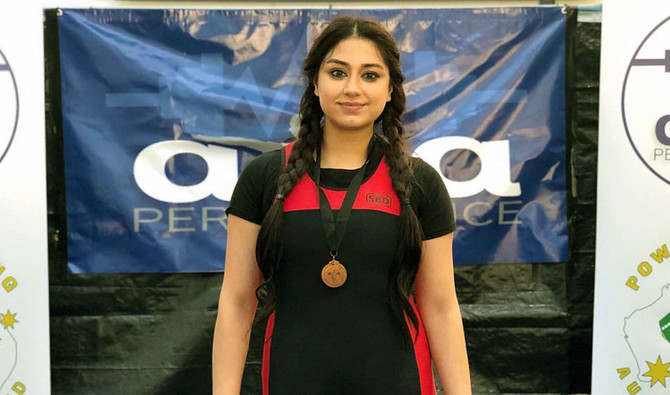
Pakistani-Australian weightlifter Maryam Nasim won a bronze medal at the Avia Powerlifting competition in Melbourne Sunday despite sustaining a back injury earlier. (Photo courtesy: Maryam Nasim)
2 / 3
Pakistani-Australian weightlifter Maryam Nasim won a bronze medal at the Avia Powerlifting competition in Melbourne Sunday despite sustaining a back injury earlier. (Photo courtesy: Maryam Nasim)
3 / 3
Pakistani-Australian weightlifter Maryam Nasim won a bronze medal at the Avia Powerlifting competition in Melbourne Sunday despite sustaining a back injury earlier. (Photo courtesy: Maryam Nasim)
Updated 14 May 2018
Follow

Breaking stereotypes: Pakistani weightlifter from KP wins bronze in Australia

  • The Pakistani-Australian weightlifter won a bronze medal at the Avia Powerlifting competition in Melbourne despite sustaining a back injury earlier
  • She said she is trying to break stereotypes about Pakistani women in general, and in Khyber Pakhtunkhwa (KP) province in particular

PESHAWAR: Maryam Nasim, an athlete from Pakistan’s conservative northwestern city of Peshawar, faced many challenges when she moved to Australia for her studies but found her new passion – powerlifting – she told Arab News.
Nasim won a bronze medal at the Avia Powerlifting competition in Melbourne on Sunday, despite having sustained a back injury earlier.
“I took part in the event although I had an injury. But still, I was able to secure the bronze medal,” she told Arab News.
Back in August 2017, she had won a silver medal in another weightlifting championship in Melbourne.
Nasim said she was trying to break stereotypes about Pakistani women in general and in Khyber Pakhtunkhwa (KP) province in particular.
After completing her early education in Peshawar, she moved to Australia where she did her bachelors in accounting at Canberra University.
She has lived in Australia for the past 10 years and currently works for one of the major Australian banks.
“I did not train as a powerlifter in Pakistan,” she said. “I did not initially think of starting powerlifting but when I reached Australia and started taking care of my fitness, I noticed during my workouts that I could lift weights and so I developed a liking for it.”
Nasim also worked as a model but had to abandon that career as her family did not approve of it. “Now my family likes my sport,” she said.
“My family’s support is one of the major reasons behind my success in weightlifting.” 
My fans on social media are also a great emotional support for me, she said. “Every day, after finishing my job, I go weightlifting.” 
She also runs a fitness blog, which is aimed to encourage people to look after themselves and their health in general.
“I want to improve the image of Muslim women, to show the international community that Pakistani women can do much and show their talent. I want to present myself as a strong Muslim woman here in Australia.”
She added that she wanted to show through her sport that Pakistani parents also allow their daughters to participate in sports and “they are not merely sitting in homes.”
Nasim added that at international level, Muslims are maligned and that she wants to dispel that bad impression about Muslims in Australia and show the positive side.
She said that now she was also trying to improve herself further. “Within two years, I see myself to be a far better athlete competing at international level.”


US military boards sanctioned oil tanker in Indian Ocean

Updated 55 min 16 sec ago
Follow

US military boards sanctioned oil tanker in Indian Ocean

  • Tanker tracking website says Aquila II departed the Venezuelan coast after US forces captured then-President Nicolás Maduro
  • Pentagon says it 'hunted' the vessel all the way from the Caribbean to the Indian Ocean

WASHINGTON: US military forces boarded a sanctioned oil tanker in the Indian Ocean after tracking the ship from the Caribbean Sea, the Pentagon said Monday.
The Pentagon’s statement on social media did not say whether the ship was connected to Venezuela, which faces US sanctions on its oil and relies on a shadow fleet of falsely flagged tankers to smuggle crude into global supply chains.
However, the Aquila II was one of at least 16 tankers that departed the Venezuelan coast last month after US forces captured then-President Nicolás Maduro, said Samir Madani, co-founder of TankerTrackers.com. He said his organization used satellite imagery and surface-level photos to document the ship’s movements.
According to data transmitted from the ship on Monday, it is not currently laden with a cargo of crude oil.


The Aquila II is a Panamanian-flagged tanker under US sanctions related to the shipment of illicit Russian oil. Owned by a company with a listed address in Hong Kong, ship tracking data shows it has spent much of the last year with its radio transponder turned off, a practice known as “running dark” commonly employed by smugglers to hide their location.
US Southern Command, which oversees Latin America, said in an email that it had nothing to add to the Pentagon’s post on X. The post said the military “conducted a right-of-visit, maritime interdiction” on the ship.
“The Aquila II was operating in defiance of President Trump’s established quarantine of sanctioned vessels in the Caribbean,” the Pentagon said. “It ran, and we followed.”
The US did not say it had seized the ship, which the US has done previously with at least seven other sanctioned oil tankers linked to Venezuela.
A Navy official, who spoke on condition of anonymity to discuss military operations, would not say what forces were used in the operation but confirmed the destroyers USS Pinckney and USS John Finn as well as the mobile base ship USS Miguel Keith were operating in the Indian Ocean.
In videos the Pentagon posted to social media, uniformed forces can be seen boarding a Navy helicopter that takes off from a ship that matches the profile of the Miguel Keith. Video and photos of the tanker shot from inside a helicopter also show a Navy destroyer sailing alongside the ship.
Since the US ouster of Maduro in a surprise nighttime raid on Jan. 3, the Trump administration has set out to control the production, refining and global distribution of Venezuela’s petroleum products. Officials in President Donald Trump’s Republican administration have made it clear they see seizing the tankers as a way to generate cash as they seek to rebuild Venezuela’s battered oil industry and restore its economy.
Trump also has been trying to restrict the flow of oil to Cuba, which faces strict economic sanctions by the US and relies heavily on oil shipments from allies like Mexico, Russia and Venezuela.
Since the Venezuela operation, Trump has said no more Venezuelan oil will go to Cuba and that the Cuban government is ready to fall. Trump also recently signed an executive order that would impose a tariff on any goods from countries that sell or provide oil to Cuba, primarily pressuring Mexico because it has acted as an oil lifeline for Cuba.