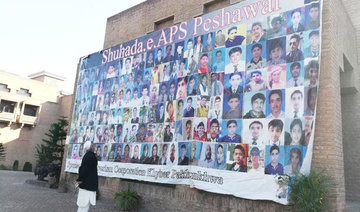
PESHAWAR: Parents whose children died in the 2014 Army Public School massacre in Peshawar have welcomed the announcement of judicial commission into the incident, saying that it offers the only ray of hope of securing an impartial inquiry.
The Taliban’s attack on Dec. 16, 2014 killed 147, including 122 students.
On 9 May, a two-member bench headed by Chief Justice Saqib Nisar ordered the setting up of a judicial commission to probe the incident and compile the report within two months.
Parents of the child victims have long been demanding a thorough inquiry to investigate who was responsible for the security and intelligence failures that allowed terrorists to attack the army-run school.
Ajun Khan, whose son Asfan, was killed in the attack, told Arab News: “Those responsible for security should be brought to justice.
“A joint inquiry was conducted by the army and police soon after the attack, but the inquiry (report) is still a secret.” He added that a meeting to lobby the provincial government, as well as an approach to the Prime Minister, had both failed to produce answers.
Falak Naz, who lost her sons Noorullah Durrani and Saifullah Durrani, said the campaign for information would continue until they had answers.
“Our question is how the terrorists came to know children were in the auditorium? The school has huge premises and the attackers reached the auditorium directly and killed the students,” she said.
Militant gunmen fired shots into the school hall where 25 pupils were sitting for a chemistry exam, only two of the pupils survived.
A senior Supreme Court lawyer, Noor Alam, said the remit of the judicial commission would be to determine responsibility.
He added that a judicial officer appointed by the Khyber Pakhtunkhwa province government would head the commission and that after the commission was set up a public appeal would be issued asking people to come forward with information about the incident.
In February this year the Peshawar High Court dismissed a petition from the APS parents for a judicial commission on the grounds that it was the mandate of the government.
The Pakistan Taliban claimed the responsibility for the attack.
The army executed at least four of the terrorists involved in the school attack after trying them in a military court.


![]()

Families of victims of army school massacre welcome judicial inquiry
Families of victims of army school massacre welcome judicial inquiry
- The Taliban attacked the school in Peshawar on Dec.16 2014, killing 147 people, including 122 students
- Chief Justice of Pakistan Justice Saqib Nisar ordered a judicial commission to probe the terror attack and compile a report within two months

Latest updates


Recommended


© 2026 SAUDI RESEARCH & PUBLISHING COMPANY, All Rights Reserved And subject to Terms of Use Agreement.