DUBAI: The Philippine economy grew by 6.8 percent in the first quarter, on par with expectations but short of the government’s growth target of between 7 percent to 8 percent for 2018.
“The Philippines remains one of the best performing economies in the region, next only to Vietnam’s 7.4 percent growth, same as China, and higher than Indonesia’s 5.1 percent,” Socioeconomic Planning Secretary Ernesto M. Pernia said during the announcement of the period’s national income accounts data.
“This is the tenth consecutive quarter that the economy was able to achieve an output expansion of 6.5 percent or better. This performance demonstrates that we have firmly laid the groundwork for reforms in some of the sectors of the economy.”
Industry led the growth among major sectors at 7.9 percent for the three-month period ended March, faster than the 6.5 percent clip last year, while the services segment expanded by 7 percent from 6.7 percent in 2017. Farm sector output, meanwhile, slowed to 1.5 percent compared with the 4.9 percent recorded in the same period of 2017.
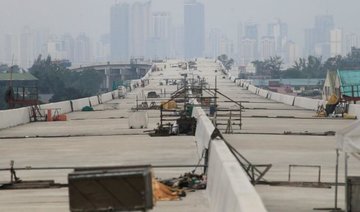
On the expenditure side, household spending slowed to 5.6 percent from the 5.9 percent recorded in the first quarter of 2017. Meanwhile government spending grew 13.6 percent from an almost standstill 0.1 percent scenario last year, spurred by the Duterte administration’s focus on the Build! Build! Build! Program.
“The upbeat performance in public construction, government consumption, and capital formation indicates that our reform efforts are bearing fruit and infrastructure development is accelerating, as planned,” Pernia said.
Ruben Carlo O. Asuncion, Chief Economist at Union Bank of the Philippines’ corporate research unit, agreed with the chief government planner’s observations on the first quarter growth data.
“I expected a growth of 6.9 percent due to strong government spending and investments. This actual print of 6.8 percent is good and is within our expectations,” Asuncion told Arab News, considering the continued push for more infrastructure spending and with the strong macroeconomic fundamentals.
Michael L. Ricafort, head of the economics and industry research division at Rizal Commercial Banking Corporation, said record foreign direct investments in recent years, especially those in the manufacturing sector, have contributed to the GDP growth for the quarter.
“Continued growth in electronic exports and imports since the start of 2018 may have supported the pick-up in manufacturing/industry,” he said. “The Philippine GDP growth target remains achievable with higher government spending especially on infrastructure (and) continued growth in overall investments,” among other drivers.
Asuncion, meanwhile, agreed with the government’s announcement that inflation has been a drag on the first quarter growth, adding “if inflation was more favorable, growth would have touched the government’s target of 7 percent to 8 percent.”
Consumer prices rose on average 3.8 percent in the first quarter, the highest quarterly average since 2014, as the Philippine tax reform law, higher oil prices and a weaker peso caused inflationary pressures. Average inflation in the first quarter of 2017 was at 3.2 percent.
“So, inflation is the spoiler, that is why we really need to focus on inflation especially because it is the number one concern expressed by Filipinos in surveys,” Pernia said.
“But even as we face challenges, we remain hopeful that at least the lower end of the full year GDP growth target range of between 7 percent and 8 percent is doable. Domestic demand is expected to increase in view of the recently approved tax reform package, which is deemed to boost income and consumption of tax payers. However, we need to boost investor and consumer confidence to sustain this growth.”
“For consumers, we need to address sources of rising inflation, even if the uptick brought by the temporary effects of TRAIN are expected to gradually ease this year,” he said.