LONDON: The oil price hit about $77 per barrel, up almost 3 percent on the day — its highest since November 2014 and almost $10 higher than a month ago — as markets reacted to US President Donald Trump’s decision to re-impose sanctions on Tehran.
Benchmark Brent crude has been on an upward trajectory for several weeks as speculation mounted that Trump would terminate the landmark 2015 accord that resulted in a lifting of US and EU sanctions in return for a halt to Iran’s nuclear weapons program.
Trump has broken with his European allies who continue to support the agreement, but precisely what punitive measures the Americans will take against EU countries that continue to import Tehran’s oil is less than clear. 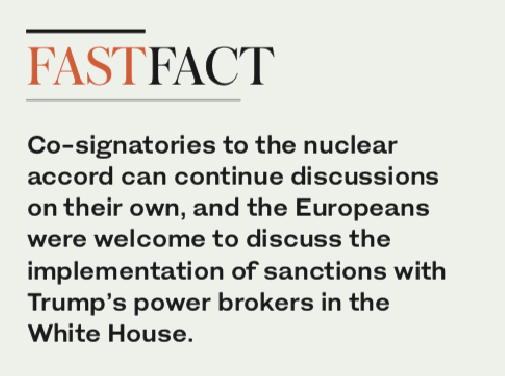
Jon Rigby, an energy analyst at UBS in London, said: “The global reach of the US should not be underestimated, and companies’ concerns of running foul of sanctions are very real.
“As such, a material decline in Iranian oil production may not be the immediate result, but a significant obstacle to further expansion seems a likely outcome.”
Trump has indicated “waivers” for those countries and companies that significantly cut their dependence on Iranian crude, but by how much and how long they have to comply before they find themselves on the receiving end of punitive measures from Washington remains uncertain.
Looking at the future direction of the oil price, Ken Odeluga, a market analyst at City Index in London said: “Probabilities will continue to point Brent crude oil futures to $80. (But a number of factors) strongly advise against attempts to chase oil above $80 in a straight line.”
UBS said: “The presence of political risk in oil prices is ‘situation normal’ and we’d argue the past 2-3 years where it has not obviously been an influence are the outlier.”
Richard Robinson, manager of the Ashburton Global Energy Fund said the worst-case scenario, involving strict adherence to and policing of sanctions, could see as much as 700,000 barrels per day (bpd) removed from the market. A less disciplined approach, with ambiguous US guidance, could remove less than 200,000 bpd, he suggested.
 “Europe currently imports between 500-600,000 bpd of Iranian crude and it is expected this number will drop by approximately 60 percent,” said Robinson.
Iranian barrels can be easily substituted for Iraqi crudes, he added.
There are also questions about supply dynamics, with traders suggesting that US shale could fill any gap left by Iran, thereby dampening price inflation.
Late Tuesday, the US Energy Information Administration said US crude output could reach 12 million bpd by the fourth quarter of 2019, nearly 500,000 bpd above previous estimates.
Saudi Arabia, the world’s largest oil exporter, has said it will take all necessary measures to prevent supply shortages following the US withdrawal from the Iran nuclear deal. “The Kingdom will work with major oil producers within and outside OPEC, and with major consumers as well to limit the impact of any shortages in supplies,” the Saudi Energy Ministry said on Wednesday.
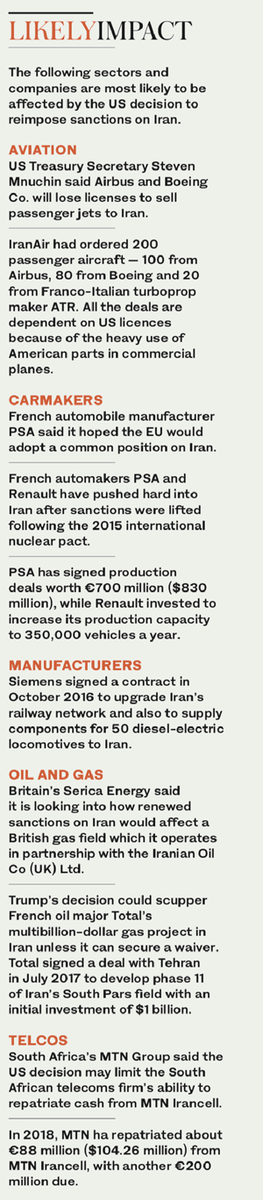
A number of energy deals are up in the air. Late last year, BP agreed to sell three North Sea gas fields to Iran’s Serica Energy for $400 million, but it is now unclear whether that will go ahead. Total signed a deal with Tehran in July 2017 to develop phase 11 of Iran’s South Pars field with an initial investment of $1 billion, marking the first major Western energy investment in Iran since the lifting of sanctions. That arrangement is expected to unravel, with Reuters reporting a Chinese company could step in as a substitute for the French giant.
Outside energy, Boeing and Airbus will lose contracts worth $39 billion to replenish Iran’s fleet of commercial planes, according to Steven Mnuchin, US treasury secretary.
Monica Malik, the chief economist at Abu Dhabi Commercial Bank, said: “We believe that the main potential impact on Iranian oil exports will come from sanctions on foreign banks transacting with the Central Bank of Iran. US exemptions will only be given to countries that substantially reduce their imports of Iranian crude.”
However, Malik believes the unilateral decision by the US should result in a more contained reduction of Iranian exports than that seen in 2012-2015, when an EU oil import ban was also in place.

US crude imports from Iran are negligible; Asian and European countries are the main purchasers.
Malik said: “We see China and India still potentially importing Iranian crude, as was the case during the previous sanctions period. Iran is expected to offer considerable price discounts to encourage China and India to import its crude.”
Thus, the market is currently forecasting a more contained fall in Iranian crude exports in the range of 300-500,000 bpd — much less than the 1.2 million bpd cuts seen in mid-2013,” she said.
Robinson pointed to a rise in geopolitical tension and hence risk. “The Iranian regime must either focus its holed budget domestically, to emphasize survival, handing over regional influence to the Saudis. If it continues to spend on regional conflicts, it risks another revolution at home,” he said.
Meanwhile, there are question marks over whether the current output agreement between OPEC and its allies to keep a lid on production will hold.
Not only will there be dwindling supplies from Iran, but also a supply slump from crisis-ridden Venezuela, where production has fallen more precipitously than anyone anticipated, said the International Energy Agency.
Nevertheless, Trump has left several doors open for continued dialogue between the US and Iran. Co-signatories to the nuclear accord can continue discussions on their own, and the Europeans were welcome to discuss the implementation of sanctions with Trump’s power brokers in the White House, according to American media.