

Trump threatens ‘severe consequences’ if Iran resumes nuclear program

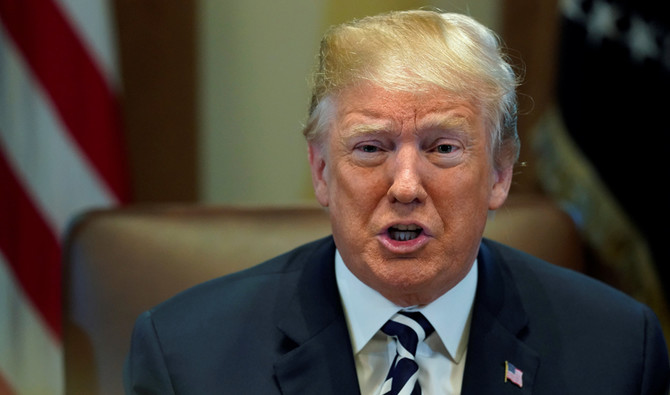
US President Donald Trump holds a cabinet meeting at the White House in Washington, U.S. May 9, 2018. (Reuters)
Updated 10 May 2018
Follow

Trump threatens ‘severe consequences’ if Iran resumes nuclear program

WASHINGTON: US President Donald Trump warned of “very severe consequences” if Iran resumes its nuclear program, one day after pulling out of a landmark multilateral nuclear accord.
Asked how he would respond if Tehran restarted its nuclear efforts, Trump threatened that “Iran will find out.”
“I would advise Iran not to start their nuclear program; I would advise them very strongly,” the US president told reporters at the White House. “If they do, there will be very severe consequences.”
Trump’s move undercut more than a decade and a half of diplomacy by Britain, China, France, Germany, Iran, Russia and past US administration, which had resulted in the deal that lifted sanctions on Iran in exchange for limits on its nuclear program.
Iranian President Hassan Rouhani had warned his country could resume uranium enrichment “without limit” but would refrain from doing so for now.
Other world powers have vowed to uphold the landmark deal, which places restrictions on Iran’s nuclear program and subjects it to international inspections.
US withdrawal, however, puts at risk billions of dollars of foreign investment in Iran and is likely to sharpen tensions in the Middle East.
In announcing the US pullout Tuesday, Trump dismissed the accord as an “embarrassment” that was “defective at its core” and called for a “new and lasting deal.”


Indonesia’s first woman president awarded honorary doctorate by Princess Nourah University

Updated 10 February 2026
Follow

Indonesia’s first woman president awarded honorary doctorate by Princess Nourah University

  • Megawati was recognized for her leadership and contributions to social, legal affairs
  • She has received 10 other honorary degrees from Indonesian and foreign institutions

JAKARTA: Megawati Sukarnoputri, who served as Indonesia’s fifth president and was the country’s only female head of state to date, has been awarded an honorary doctorate by Princess Nourah bint Abdulrahman University in Riyadh, becoming the first foreign national to receive the title.

Megawati, the eldest daughter of Indonesia’s first President Sukarno and chairwoman of the country’s largest political party, the PDIP, served as president from 2001 to 2004.

The 79-year-old was awarded an honorary doctorate in organizational and legal affairs in Riyadh on Monday during a ceremony overseen by Princess Nourah University’s acting president, Dr. Fawzia bint Sulaiman Al-Amro.

“This recognition was given in appreciation of her efforts during her presidency, her significant contributions to social, organizational, and legal fields, and her role in strengthening institutional leadership in Indonesia,” the university said in a statement.

This is Megawati’s 11th honorary doctorate. She has received similar degrees from Indonesian and foreign universities, including the Moscow State Institute of International Relations in 2003 and the Soka University of Japan in 2020.

She has also been awarded the title of honorary professor by several institutions, including by the Seoul Institute of the Arts in 2022.

“We gather at the Princess Nourah bint Abdulrahman University, a university that stands as a symbol of women’s progress in education, knowledge and public service … To see so many intelligent women, I feel very proud,” Megawati said in her acceptance speech.

“Women’s empowerment is not a threat to any values, culture or tradition. It is actually a condition for nations that believe in their future … A great nation is one that is able to harness all of its human potential. A strong nation is one that does not allow half of its social power to be left on the sidelines of history.”

Megawati is the longest-serving political leader in Indonesia. Indonesia’s first direct presidential elections took place during her presidency, consolidating the country’s transition to democracy after the downfall of its longtime dictator Suharto in 1998.