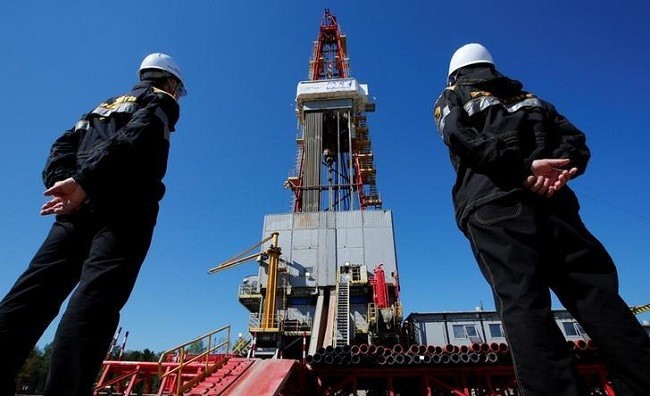
Oil prices jump after US walks away from Iran nuclear deal

All key crude oil futures contracts saw traded volumes soar as speculators took on new positions in the hope of profiting from rising prices. (Reuters)
Updated 09 May 2018
Follow

Oil prices jump after US walks away from Iran nuclear deal

  • Brent crude oil futures rise above $77, highest since 2014
  • US sanctions likely to cut Iran oil supplies

LONDON: Oil prices rose more than 3 percent on Wednesday to 3-1/2 year highs, after US President Trump abandoned a nuclear deal with Iran and announced the “highest level” of sanctions against the OPEC member.
Ignoring pleas by allies, Trump on Tuesday pulled out of an international deal with Iran that was agreed in 2015, a move that raises the risk of conflict in the Middle East and casts uncertainty over oil supplies in an already tight market.
Brent crude oil touched its highest since November 2014 at $77.20 a barrel. The benchmark contract was up $1.90 a barrel, or more than 2.5 percent, at $76.75 by 1335 GMT.
US light crude was up $1.70 a barrel, or almost 2.5 percent, at $70.76, near highs also last seen in late 2014.
In China, the biggest single buyer of Iranian oil, Shanghai crude futures hit their strongest in dollar terms since they were launched.
“Iran’s exports of oil to Asia and Europe will almost certainly decline later this year and into 2019 as some nations seek alternatives in order to avoid trouble with Washington and as sanctions start to bite,” said Sukrit Vijayakar, director of energy consultancy Trifecta.
Iran re-emerged as a major oil exporter in 2016 after international sanctions against it were lifted in return for curbs on its nuclear program, with its April exports standing above 2.6 million barrels per day (bpd).
That made Iran the third-biggest exporter of crude within OPEC countries, behind Saudi Arabia and Iraq.
Walking away from the deal means the United States will likely re-impose sanctions against Iran after 180 days, unless some other agreement is reached before then.
Analysts’ estimates of the possible reduction in Iranian crude supplies as a result of any new US sanctions range from as little as 200,000 bpd to as much as 1 million bpd, with most impact from 2019 as sanctions take time to be imposed.
Several refiners in Asia said on Wednesday they were seeking alternatives to Iranian supplies.
A number of countries have already cut reliance on Iranian oil, as well as other “traditional” sources of supply, due to surge in cheaper US crude exports.
All key crude oil futures contracts saw traded volumes jump as investors took new positions and refiners hedged to protect themselves from higher feedstock prices.
Saudi Arabia said it would work with other producers to lessen the impact of any shortage in oil supplies. The country has been leading efforts since 2017 to withhold production to prop up prices.


First EU–Saudi roundtable on critical raw materials reflects shared policy commitment

Updated 16 January 2026
Follow

First EU–Saudi roundtable on critical raw materials reflects shared policy commitment

RIYADH: The EU–Saudi Arabia Business and Investment Dialogue on Advancing Critical Raw Materials Value Chains, held in Riyadh as part of the Future Minerals Forum, brought together senior policymakers, industry leaders, and investors to advance strategic cooperation across critical raw materials value chains.

Organized under a Team Europe approach by the EU–GCC Cooperation on Green Transition Project, in coordination with the EU Delegation to Saudi Arabia, the European Chamber of Commerce in the Kingdom and in close cooperation with FMF, the dialogue provided a high-level platform to explore European actions under the EU Critical Raw Materials Act and ResourceEU alongside the Kingdom’s aspirations for minerals, industrial, and investment priorities.

This is in line with Saudi Vision 2030 and broader regional ambitions across the GCC, MENA, and Africa.

ResourceEU is the EU’s new strategic action plan, launched in late 2025, to secure a reliable supply of critical raw materials like lithium, rare earths, and cobalt, reducing dependency on single suppliers, such as China, by boosting domestic extraction, processing, recycling, stockpiling, and strategic partnerships with resource-rich nations.

The first ever EU–Saudi roundtable on critical raw materials was opened by the bloc’s Ambassador to the Kingdom, Christophe Farnaud, together with Saudi Deputy Minister for Mining Development Turki Al-Babtain, turning policy alignment into concrete cooperation.

Farnaud underlined the central role of international cooperation in the implementation of the EU’s critical raw materials policy framework.

“As the European Union advances the implementation of its Critical Raw Materials policy, international cooperation is indispensable to building secure, diversified, and sustainable value chains. Saudi Arabia is a key partner in this effort. This dialogue reflects our shared commitment to translate policy alignment into concrete business and investment cooperation that supports the green and digital transitions,” said the ambassador.

Discussions focused on strengthening resilient, diversified, and responsible CRM supply chains that are essential to the green and digital transitions.

Participants explored concrete opportunities for EU–Saudi cooperation across the full value chain, including exploration, mining, and processing and refining, as well as recycling, downstream manufacturing, and the mobilization of private investment and sustainable finance, underpinned by high environmental, social, and governance standards.

From the Saudi side, the dialogue was framed as a key contribution to the Kingdom’s industrial transformation and long-term economic diversification agenda under Vision 2030, with a strong focus on responsible resource development and global market integration.

“Developing globally competitive mineral hubs and sustainable value chains is a central pillar of Saudi Vision 2030 and the Kingdom’s industrial transformation. Our engagement with the European Union through this dialogue to strengthen upstream and downstream integration, attract high-quality investment, and advance responsible mining and processing. Enhanced cooperation with the EU, capitalizing on the demand dynamics of the EU Critical Raw Materials Act, will be key to delivering long-term value for both sides,” said Al-Babtain.

Valere Moutarlier, deputy director-general for European industry decarbonization, and directorate-general for the internal market, industry, entrepreneurship and SMEs at European Commission, said the EU Critical Raw Materials Act and ResourceEU provided a clear framework to strengthen Europe’s resilience while deepening its cooperation with international partners.

“Cooperation with Saudi Arabia is essential to advancing secure, sustainable, and diversified critical raw materials value chains. Dialogues such as this play a key role in translating policy ambitions into concrete industrial and investment cooperation,” she added.