

Cinema licensing body wants KSA to attract producers from all over the Arab world

1 / 2
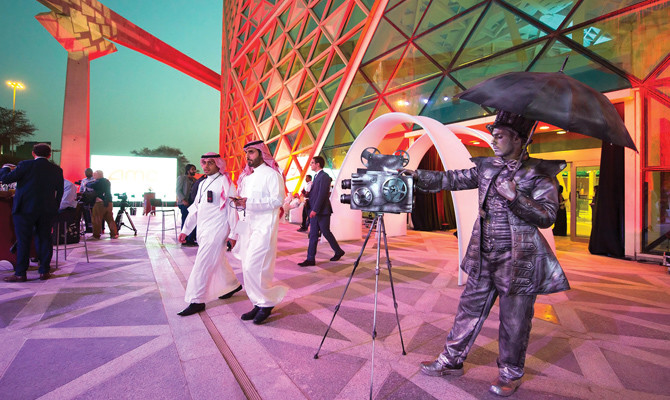
As both regional and international film distributors are interested in entering the Saudi market, the commission is urged to set the guidelines when selecting movie premieres. (Reuters)
2 / 2
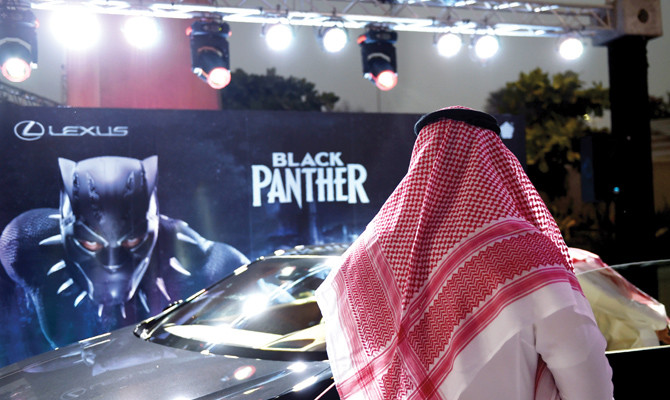
File photo showing a cinema in Riyadh where the Black Panther was being shown last month. (SPA)
Updated 07 May 2018
Follow

Cinema licensing body wants KSA to attract producers from all over the Arab world

  • Movie screenings returned to the Kingdom on April 18 with the gala premiere of “Black Panther” in Riyadh, and one man in the audience was watching more closely than most.
  • Local film production will be “at the heart of the cinema industry” and a key way to reach out to the world to showcase Saudi identity, culture and talent,, says General Commission for Audiovisual Media chief.

DHAHRAN: Movie screenings returned to the Kingdom on April 18 with the gala premiere of “Black Panther” in Riyadh, and one man in the audience was watching more closely than most.

Reda Alhaidar, the president of the General Commission for Audiovisual Media (GCAM), is in charge of the authority that grants licenses to cinemas now that a 30-year ban has been lifted as part of a bundle of decrees that fall with the Vision 2030 plan of Crown Prince Mohammed bin Salman.

Alhaidar discussed the role of the commission, its future plans and the local filmmaking industry in an exclusive interview with Arab News.

The new cinemas will not just be about Hollywood blockbusters, he said, assuring those in the local film industry that there will be a place for them too.

“In GCAM, we are developing a local content production framework to ensure locally produced movies,” said Alhaidar. 

“We have a plan to reinvest part of the revenue generated from the tickets in promoting local production.”

Local film production will be “at the heart of the cinema industry” and a key way to reach out to the world to showcase Saudi identity, culture and talent, he said. “We have a pool of talented people in the country and people living abroad and planning to come back, and who can support growing the film production sector.”

According to Alhaidar, both regional and international film distributors are interested in entering the Saudi market. 

Therefore, to ease this process, the role of the commission will be to set the guidelines when selecting movie premieres. 

“In GCAM, we develop regulations and guidelines for the sector, to provide licenses to interested and eligible investors, to censor and classify films for appropriate audiences to ensure they are aligned with the Kingdom’s customs and traditions, and to monitor the sector to ensure there are no violations,” Alhaidar said.

Asked whether the Saudi audience can expect a national Oscar-like event that celebrates local movies, Alhaidar said that the commission is open to all options and that one of its aims is to transform the country into a “production hub where producers from all over the Arab world would be genuinely keen to be based in Saudi Arabia.”


Japanese researchers hope to restore coral from Saudi-made structures

Updated 10 sec ago
Follow

Japanese researchers hope to restore coral from Saudi-made structures

  • Coral skeletons made for Saudi Pavilion at Japan expo last year
  • Results of Japanese study to be revealed at Riyadh Expo 2030

TOKYO: Japanese universities are seeking to restore coral reefs and marine ecosystems after receiving artificial structures that Saudi Arabia made and showcased at last year’s Osaka-Kansai Expo.

The coral skeletons were donated to the University of the Ryukyus in Okinawa and Kansai University in Osaka Prefecture, Kyodo News reported at the weekend.

The structures are made from calcium carbonate, a material on which corals are believed to grow more easily compared to artificial alternatives such as concrete or metal.

The skeletal structures were created using 3-D printers, with one piece produced a day during the expo, and displayed across an entire wall in the Saudi Arabia Pavilion, which had an area focusing on sustainable marine environments.

Coral reefs serve as habitats for much marine life, but over 40 percent of the world’s 892 species face possible extinction, according to the International Union for Conservation of Nature.

The University of the Ryukyus, which received about 150 of the artificial coral skeletons, will place them in waters off the eastern coast of Okinawa’s main island and then examine their impact on the ecosystem.

Kansai University has placed theirs in the sea around Kagoshima Prefecture’s Yoron Island to observe their growth after transplanting coral polyps onto the structures.

The results of the research are expected to be revealed at the Riyadh Expo in 2030.

“I had never imagined that Japan and Saudi Arabia would cooperate on coral research,” said Masato Ueda, a professor specializing in regenerative medicine at Kansai University.

Ueda said he wants to demonstrate to children that “humanity is attempting to restore the environment.”