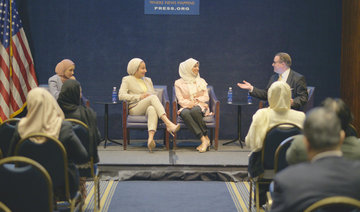
4 things you didn’t know about Saudi women’s rights

Saudi women attend the Kingdom’s first jazz festival in Riyadh last month. (EPA)
Updated 26 April 2018
Follow

4 things you didn’t know about Saudi women’s rights

  • Since the launch of Saudi Vision 2030, the Saudi Justice ministry has addressed all flaws in the system that prevented women from living their lives securely and free from unnecessary hassles
  • No marriage agreement is accepted unless a woman provides a written approval, even if her guardian is her father

JEDDAH: Despite the great steps taken by the Saudi Ministry of Justice to give women a freer and more secure life, many Saudi women still do not have enough knowledge of their rights. 

Therefore, the ministry has started a campaign in cities all over the Kingdom to spread awareness among women of their legal rights. A female-only staff runs public exhibitions to enlighten them about how they are protected in different areas so they can lead their lives in a better way.

“We are using every possible channel to communicate with women to enlighten them about their rights, support them in all aspects to assure their ability to enjoy a secure rightful life,” said Majed Alkhamis, head of media and communication at the Ministry of Justice.

Since the launch of Saudi Vision 2030, the ministry has addressed all flaws in the system that prevented women from living their lives securely and free from unnecessary hassles. Despite all the obstacles, the ministry has succeeded in several areas.

A wife’s rights

The system not only grants the woman the right to sue her husband or ex-husband for alimony or acknowledgment of paternity, but it also allows any women legally living on Saudi soil, regardless of her citizenship or religion, to prosecute her current or former husband even if he is outside Saudi Arabia at the time of the lawsuit. Moreover, the new systems now support divorced women to a whole new level. For example, the system gives priority to a woman’s alimony over her husband’s personal debts.

Marriage agreements

No marriage agreement is accepted unless a woman provides a written approval, even if her guardian is her father. This arrangement grants a woman the freedom to accept a marriage proposal without any influence or coercion. In addition, if a woman is not happy with her marriage, she is free to leave the house of marriage and walk out of the agreement with no law to force her to come back. If she chooses to abandon the marriage her right to alimony will be dropped, but she is still entitled to custody of the children.

No delays

The Ministry of Justice has designed a full female service within its courthouses. 

These services include advisory people who provide free consultations on everything. In addition, these departments support women at all stages up until the execution of any court order to avoid delays and procrastination.

Speedy justice

The law emphasizes the speedy execution of justice in women-related cases.


The founding economy: A blueprint for stability in the First Saudi State

Updated 23 February 2026
Follow

The founding economy: A blueprint for stability in the First Saudi State

  • The establishment of the First Saudi State created a secure environment that facilitated the arrival of caravans, secured vast trade routes, and revived commerce across the Arabian Peninsula

RIYADH: The economy during the founding stage of the First Saudi State served as a fundamental pillar in building the nation, consolidating its influence, and ensuring its stability. This early economic growth was inextricably linked to achieving security, unifying regions, and organizing society—factors that directly stimulated trade, stabilized markets, and enhanced the foundations of daily life in Diriyah and its surrounding areas.
According to Dr. Abdullah Al-Saleh Al-Othaimeen's "Diriyah: Origins and Development during the First Saudi State," published by the King Abdulaziz Foundation for Research and Archives (Darah), the founding economy stands as a historical model reflecting the reciprocal relationship between political stability and early economic prosperity.

Beyond its political and intellectual prominence, Diriyah emerged as a vibrant economic hub. (SPA)

The establishment of the First Saudi State created a secure environment that facilitated the arrival of caravans, secured vast trade routes, and revived commerce across the Arabian Peninsula.
Beyond its political and intellectual prominence, Diriyah emerged as a vibrant economic hub. Its active markets attracted merchants and students from across the region, all of whom benefited from the state-provided stability. The local society relied on diverse activities for its livelihood, including trade, agriculture, and livestock breeding, with horses and camels playing crucial roles in transportation, commerce, and securing roads.
The social and administrative organization upon which the state was founded ensured the continuous availability of goods and sustained market stability. Ultimately, the close relationship between public security and economic growth during this founding phase solidified Diriyah's position as a premier political and commercial center in the Arabian Peninsula.