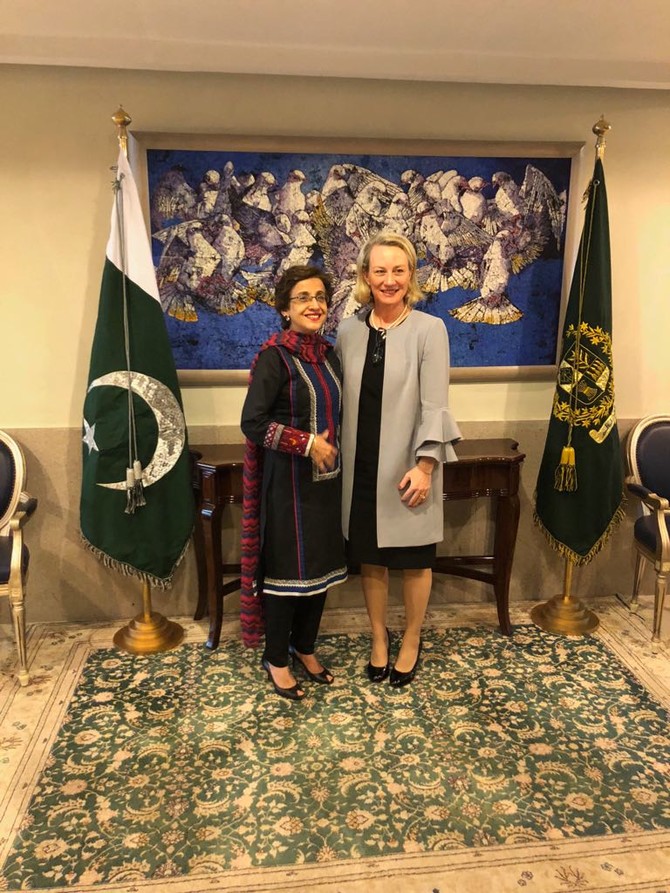
ISLAMABAD: Alice G. Wells, the US principal deputy assistant secretary for South and Central Asia, arrived in Islamabad on April 23 to continue talks amid strained relations between the two long-time allies.
The latest trip follows her visit from March 28 to April 3, during which she met several senior federal ministers, UN representatives, National Security Adviser Nasser Janjua, and Army Chief General Qamar Javed Bajwa. She also went to Karachi to meet provincial officials in Sindh.
When she arrived for this followup, she was greeted by Foreign Secretary Tehmina Janjua.
During the previous visit, discussions were held about Washington’s South Asia strategy, unveiled last year, “Pakistan’s stated commitment to eliminate all terrorist groups present within its borders,” and a “shared interest in building economic and commercial ties that benefit both nations” according to the US Embassy.
In the aftermath of the Tashkent conference on Afghanistan, Wells also noted the growing international consensus on the way forward to achieving peace in that country, and the meaningful role that Pakistan, partnering with the United States, could play in achieving that peaceful resolution.
Her latest visit is a follow-up to a series of clashes between the United States and Pakistan over growing differences that threaten decades-old relations between the countries.
The latest row erupted last week after Washington imposed “reciprocal” travel restrictions on Pakistani envoys in the US. After days of speculation, Pakistan’s Ministry of Foreign Affairs last week confirmed that US authorities had informed it that from May 1, 2018, Pakistani diplomats would be restricted in how far they can travel within the United States without official permission.
Foreign-relations expert Qamar Cheema said that “relations are on a slippery slope” and the travel restrictions will probably take center stage in this week’s meetings between Wells and Pakistani officials.
Washington remains unhappy that its efforts to stabilize Afghanistan are being hindered by Islamabad’s feeble approach to dealing with the Haqqani network of insurgents, which the US says operates from Pakistan, an assertion Islamabad has rejected as it reiterates its commitment to combating all forms of terrorism, said Cheema.
“There are concerns on Pakistan’s long-term strategy to counter terror financing, stop the rise of ISIS recruits and its activity, and its assistance with talks and negotiations with the Taliban,” Cheema added.
The latest travel restrictions are in response to Islamabad’s already imposed curbs on US diplomats, which stems from a trust deficit and a number of damaging incidents. These include the US Navy SEAL raid of 2011 that killed Osama Bin Laden in Abbottabad, which was carried out without Pakistan’s prior knowledge.
The Trump administration had warned Pakistan of “punitive measures”. The United States Bureau of Industry and Security, which works under the Department of Commerce, has placed sanctions on seven Pakistani firms purportedly engaged in nuclear trade, a move that damaged Pakistan’s attempt to join the Nuclear Suppliers Group.
A move co-sponsored by the US in February, meanwhile, convinced the Financial Action Task Force to place Pakistan back on its “gray list” of “jurisdictions with deficient anti-money laundering regimes.”
In January, Trump accused Islamabad of taking billions from America and in return giving “nothing but lies and deceit,” and sheltering terrorists. The US withheld $255 million from about $1 billion in assistance. The same month, Washington placed Pakistan on its “special watch list for severe violations of religious freedom.”
“Relations are hanging by a single thread and could free-fall anytime,” Cheema said, but added that the continuation of constructive interaction from both sides at least shows “the belief that cooperation and engagement is the only way forward for peace in the region.”


![]()
![]()

Senior US Diplomat arrives in Pakistan amid frosty relations
Senior US Diplomat arrives in Pakistan amid frosty relations
- The relationship between Pakistan and the United States is on a ‘slippery slope’ according to foreign-relations expert
- Travel restrictions on diplomats likely to top the agenda
Related
Latest updates





© 2026 SAUDI RESEARCH & PUBLISHING COMPANY, All Rights Reserved And subject to Terms of Use Agreement.