Pakistan cannot be a strategic US ally: Experts

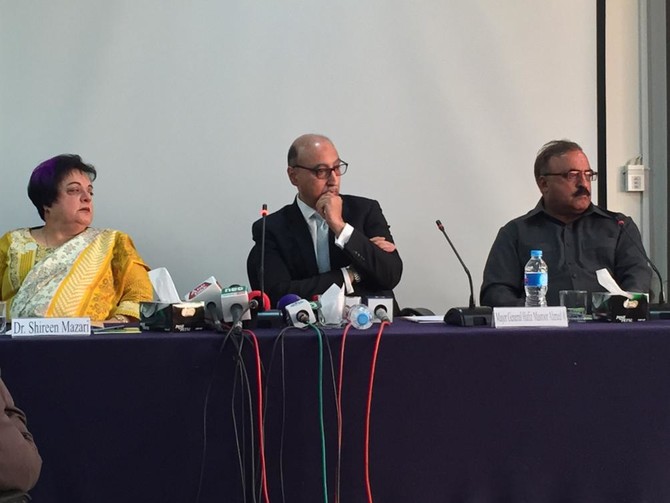
Ambassador (retd) Abdul Basit flanked by PTI lawmaker Dr. Shireen Mazari and Major General (retd) Hafiz Masroor Ahmed speak at a seminar, “United States’ South Asia Policy: Challenges for Pakistan,” here in Islamabad. (AN photo)
Updated 19 March 2018
Follow

Pakistan cannot be a strategic US ally: Experts

ISLAMABAD: Pakistan cannot be a strategic ally of the US as the latter’s interests in South Asia contradict Pakistan’s national interests, defense and security experts said on Monday at a seminar in Islamabad organized by the Sustainable Development Policy Institute (SDPI).
Pakistan’s relationship with the US is transactional, and Islamabad mistook it as strategic, said Abdul Basit, president of the Islamabad Policy Research Institute.
US interests in South Asia “are totally in contradiction to the national interests of Pakistan,” and “we don’t have any foreign policy to deal with the challenges,” he added.
A lack of convergence of interests, and of economic cooperation, are the major contributing factors to the relationship’s poor history, he said.
“We need to formulate proactive diplomacy and behave as a mature nation instead of just reacting to international developments,” he said. “During the last four years, we have lost our space in US diplomacy.”
Dr. Shireen Mazari, a lawmaker with Pakistan Tehreek-e-Insaf and director general of the Strategic Studies Institute Islamabad, said Pakistan miscalculated its relationship with the US.
“Pakistan has been acting against its own interests in the region just to serve the US, and this should come to an end now,” she said.
The rise of India as a regional power, the isolation of Iran and the containment of China are the major US interests in South Asia, she added.
“Our national interests did not converge with the interests of the US,” Mazari said, adding that America can never be a natural strategic ally to Pakistan.
Security analyst Imtiaz Gul said the relationship remains hostage to fundamental differences. “Pakistan needs to work out some fundamental changes in its foreign policy to normalize relations with the US,” he added.
Pakistan should capitalize on its geostrategic importance and redefine its relationship with the US and India for regional peace and stability, he said.
Hafiz Masroor Ahmed, vice president of the Center for Global and Strategic Studies, said Indian influence in Afghanistan poses a danger to Pakistan.
Islamabad should not be a hostage to US interests in the region, as peace talks in Afghanistan with the Taliban were sabotaged by Washington, he added. “All our institutions should formulate a joint strategy to deal with the US,” he said.
Shakeel Ahmad, director of research uptake and business development at the SDPI, said the Trump administration “has brought a mix of change and continuity in the country’s foreign and security policies, including those in South Asia, and we need to understand that for a better relationship.”


Dense toxic fog shrouds Delhi as air quality hits severe levels

Updated 12 sec ago
Follow

Dense toxic fog shrouds Delhi as air quality hits severe levels

  • Danish badminton star withdraws from India Open due to Delhi’s air pollution
  • Air quality worst since the peak winter smog season in November last year

NEW DELHI: Residents of Delhi woke up to hazardous air quality on Sunday as a thick blanket of toxic smog and fog engulfed the Indian capital region, pushing air pollution into “severe” levels for the first time this year.

Home to 30 million people, Delhi has not recorded a single “clean air” day since September 2023, with Air Quality Index readings hitting high above the 50 score throughout the past two years.

On the AQI scale from 0 to 500, good air quality is represented by levels below 50, while levels above 300 are dangerous.

Based on Central Pollution Control Board data, the overall AQI was around 439–444, with several stations across Delhi reaching almost 500 — the worst since the peak winter smog season in early November.

The air quality is so bad that a Danish badminton star, Anders Antonsen, withdrew from the ongoing India Open, saying the city was not fit to host the tournament. Antonsen, who is the discipline’s No. 3, said in an Instagram story that the decision was due to “extreme pollution.”

While the athlete chose to pay a $5,000 fine rather than spend a few days in Delhi, its residents are left with little choice but to endure its toxic air.

“To protect myself, I use an N90 mask and drink lots of water. Still, in the first week of January, the smog impacted me with a bad throat and cold, hitting me badly. You are always exposed and risk your health,” said Akriti Chaudhary, a student activist in Delhi.

“The situation is worse for those people who live in the industrial area of Delhi and don’t have the luxury of green cover. They suffer a lot. Different parts of the population suffer differently, but the fact is that all suffer one way or another.”

For Dr. D. Raghunandan, a climate expert and member of a newly launched citizen initiative, SSANS, which acts as a pressure group to urge the government to act to improve air quality, the pollution has already become unavoidable.

“You just have to live with it. There is no way you can avoid it. Like 90 percent of Delhi’s population can’t escape it. Those who have a lot of money can stay indoors with air purifiers,” he said.

“We are concerned that not much is being done to contain the problem. What little is being done is cosmetic. You just have a few small water guns going around the city on tempos and spraying water.”

He compared Delhi’s problem to what China’s capital faced before.

“Look at the way the badminton event has panned out. Gradually, the pollution will start hitting. Ten years ago, Beijing was worse than Delhi in air pollution. And many large companies and corporations decided to leave Beijing,” Raghunandan told Arab News.

“Do you think those guys are going to stay in Delhi? If the pollution stays like this, they’ll move out.”