Lebanon evicting Syrian refugees from towns, says rights group

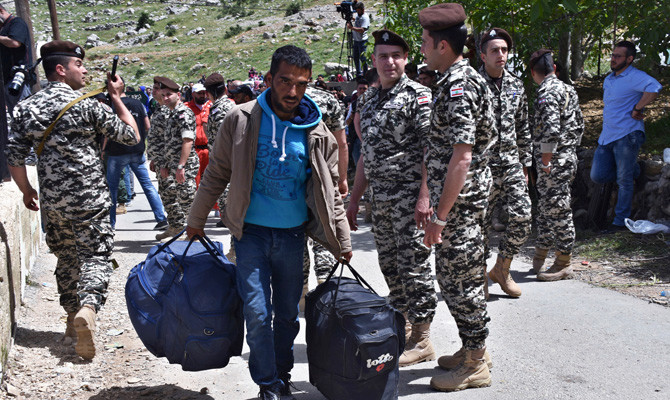
In this April, 18, 2018 file photo, a Syrian displaced man who fled the war in Syria carries his belongings past Lebanese soldiers as he prepares to return to his village of Beit Jinn in Syria, near the Lebanese-Syrian border, in Shebaa, southern Lebanon. (AP Photo/Ziad Choufi)
Updated 21 April 2018
Follow

Lebanon evicting Syrian refugees from towns, says rights group

  • Human Rights Watch said it has documented evictions in 13 towns and villages putting more than 3,600 Syrians on the streets since 2017
  • Evictions said to be instigated by landlords, municipal authorities, and the military intelligence services for a variety of reasons

BEIRUT: Local officials in Lebanon are throwing Syrian out of their towns in a violation of their rights as refugees and residents, a human rights group said in a new report released Friday.
Human Rights Watch said it has documented evictions in 13 towns and villages putting more than 3,600 Syrians on the streets since 2017. It says another 7,000 Syrians were forced to abandon a camp near a military base during that time.
The rights group said it was a worrying trend ahead of an international donors’ summit in Belgium to support Lebanon and other countries neighboring war-torn Syria.
Lebanese politicians say their country is straining under the weight of hosting nearly one million Syrian refugees. The tiny Mediterranean country has the highest per capita refugee population in the world: roughly one in five people are refugees, including some 175,000 Palestinians.
Syrians face numerous barriers to employment, education, and housing in Lebanon, with many forced to live under the radar because Lebanon ordered the UN’s refugee commission to halt refugee registrations in 2015.
But anti-Syrian rhetoric has ticked up in recent months as parliamentary elections loom in May.
Local officials in several municipalities have ordered Syrians out en masse, posting eviction notices on their doors, and sometimes sending the police to physically intimidate the refugees if they do not comply, said Human Rights Watch.
The evictions do not appear to have the formal support of the national government. Human Rights Watch called on national authorities to step in and stop the evictions.
“Right now, Syrian refugees do not have the guarantee that they are safe in their homes,” said Bassam Khawaja, a Lebanon researcher for Human Rights Watch.
The UN’s refugee agency said in a March report it had documented 13,700 Syrian refugee evictions in 2017. It said evictions were instigated by landlords, municipal authorities, and the military intelligence services for a variety of reasons, including security, social tensions, and failure to pay rent.
Human Rights Watch says another 42,000 refugees are at risk for eviction.


Israel to permit 10,000 Palestinian worshippers to Al-Aqsa in Ramadan

Updated 2 sec ago
Follow

Israel to permit 10,000 Palestinian worshippers to Al-Aqsa in Ramadan

  • Israel announced it would allow 10,000 Palestinian worshippers to attend weekly prayers at the Al-Aqsa Mosque in east Jerusalem during the holy month of Ramadan, which began Wednesday
JERUSALEM: Israel announced it would allow 10,000 Palestinian worshippers to attend weekly prayers at the Al-Aqsa Mosque in east Jerusalem during the holy month of Ramadan, which began Wednesday.
Israeli authorities also imposed restrictions on entry to the mosque compound, permitting access only to men aged 55 and older, women aged 50 and older, and children up to age 12.
“Ten thousand Palestinian worshippers will be permitted to enter the Temple Mount for Friday prayers throughout the month of Ramadan, subject to obtaining a dedicated daily permit in advance,” COGAT, the Israeli defense ministry agency responsible for Palestinian civilian affairs in occupied territory said in a statement.
“Entry for men will be permitted from age 55, for women from age 50, and for children up to age 12 when accompanied by a first-degree relative.”
During Ramadan, hundreds of thousands of Palestinians traditionally attend prayers at Al?Aqsa, Islam’s third?holiest site, located in east Jerusalem, which Israel captured in 1967 and later annexed in a move that is not internationally recognized.
The Palestinian Jerusalem Governorate said this week that Israeli authorities had prevented the Islamic Waqf — the Jordanian?run body that administers the site — from carrying out routine preparations ahead of Ramadan, including installing shade structures and setting up temporary medical clinics.
A senior imam of the Al-Aqsa Mosque, Sheikh Muhammad Al-Abbasi, told AFP that he, too, had been barred from entering the compound.
“I have been barred from the mosque for a week, and the order can be renewed,” he said.
Abbasi said he was not informed of the reason for the ban, which came into effect from Monday.
Under long?standing arrangements, Jews may visit the Al?Aqsa compound — which they revere as the site of the first and second Jewish temples — but they are not permitted to pray there.
Israel says it is committed to upholding this status quo, though Palestinians fear it is being eroded.
In recent years, a growing number of Jewish ultranationalists have challenged the prayer ban, including far?right politician Itamar Ben?Gvir, who prayed at the site while serving as national security minister in 2024 and 2025.