

Saudi Arabia ready to send troops to Syria

1 / 3
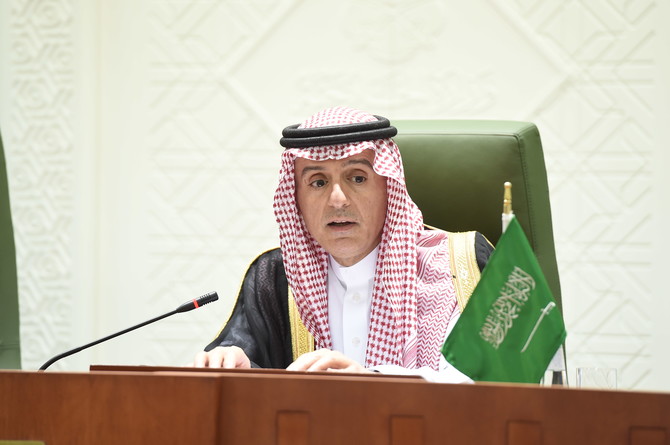
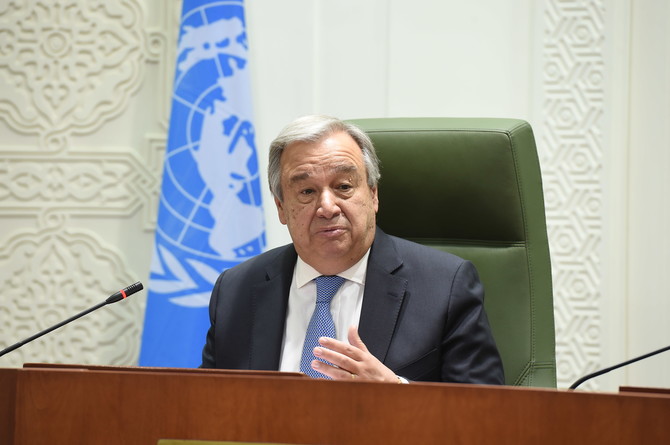
Photo showing Saudi Arabia’s Foreign Minister Adel Al-Jubeir, and United Nations Secretary-General Antonio Guterres, Riyadh, Saudi Arabia, April 17, 2018. (AN Photo: Bashir Saleh)
2 / 3
Photo showing Saudi Arabia’s Foreign Minister Adel Al-Jubeir at joint press conference with United Nations Secretary-General Antonio Guterres, Riyadh, Saudi Arabia, April 17, 2018. (AN Photo: Bashir Saleh)
3 / 3
Photo showing United Nations Secretary-General Antonio Guterres at a joint press conference with Saudi Arabia’s Foreign Minister Adel Al-Jubeir, Riyadh, Saudi Arabia, April 17, 2018. (AN Photo: Bashir Saleh)
Updated 18 April 2018
Follow

Saudi Arabia ready to send troops to Syria

  • Saudi Arabia is in talks with the Trump administration about sending forces to Syria
  • Iran backed Houthi militia violated international law by attacking Bab Al-Mandab maritime traffic

RIYADH: Saudi Arabia is ready, willing and able to deploy troops in support of any US-led effort to stabilize Syria, Foreign Minister Adel Al-Jubeir reaffirmed on Tuesday.

“We are in discussions with the US, and have been since the beginning of the Syrian crisis, about sending forces into Syria,” Al-Jubeir said.

The Wall Street Journal reported on Monday that US President Donald Trump’s administration was seeking to assemble an Arab force, including troops from Saudi Arabia and the UAE, to help restore stability in Syria.

Saudi Arabia’s offer of help was “not new,” Al-Jubeir said at a press conference in Riyadh with UN secretary-general Antonio Guterres. “We made a proposal to the Obama administration that if the US were to send forces ... then Saudi Arabia would consider along with other countries sending forces as part of this contingent.”

Riyadh has suggested that it could help counter-terrorism operations in some other theaters of conflict as part of a wider Muslim alliance. For example, a Saudi-backed Islamic military coalition will provide logistical, intelligence and training to a new West African counter-terrorism force, Al-Jubeir said in December.

Guterres told Arab News there was no military solution to the Syrian conflict. “It is crucial that Syrians find a solution, free of foreign domination,” he said.

On the issue of Palestine, Guterres said there should be a strong mutual commitment to a two-state solution. “There is no Plan B. We need to make sure that Palestinians have that right as well as the Israelis, and the two must live in stability.” 

Commenting on the Yemen situation, Al-Jubeir said: “A political solution in Yemen is up to Houthis who have turned Yemen into a base for Iran. This is not a war desired by the Kingdom, but it was imposed on it. The only solution in Yemen is a political one. The reason for not reaching a resolution is the stubbornness of the Houthis because of Iran’s support.

“The Houthis have launched 119 Iranian missiles toward Saudi Arabia. The Houthis are using young children on their missions, laying siege to villages and not allowing aid to come in. They sell this aid to finance their war. Everything they are doing is terrorism.”

Meanwhile international investigators finally entered the Damascus suburb of Douma on Tuesday after days of delay and warnings by Western powers that crucial evidence related to a chemical gas attack had probably been removed.

More than 40 people died in the attack on April 7, and Western powers have blamed the Assad regime. In response, the US, France and Britain launched missile strikes on Saturday targeting the regime’s chemical weapons facilities.

The regime “would try its best to destroy any evidence that might show its involvement in the attack,” Yahya Al-Aridi, spokesman for the Syrian opposition, told Arab News.

“Immediately after the attack, we saw on television Russian soldiers and officers visiting the site. I don’t think the Russians would be happy if any evidence were found, especially when they called it fabrication in the UN Security Council. So they have a fundamental interest in destroying any sort of evidence.”

Missile strikes against the sources of the chemical weapons were not enough, he said. “Syrians are being killed not only by chemical weapons. They are being killed by phosphoric bombs, by rockets and airstrikes, and by displacement.”

The world seemed reluctant to call the regime a pariah and an outlaw, and finish the job, Al-Aridi said. “They are also denying the Syrian people any means to defend themselves.”


Jeddah students get closer look at electric motorsport

Updated 24 January 2026
Follow

Jeddah students get closer look at electric motorsport

  • A PIF-linked initiative highlights technical and engineering careers behind electric racing events

JEDDAH: Students from local and international schools in Jeddah were introduced to STEM-related career pathways in electric motorsport this week, as part of an education program linked to the UIM E1 World Championship held on the Red Sea.

The sessions formed part of Driving Force Presented by the Public Investment Fund, an initiative run by Formula E and its electric racing series partners, to familiarize students aged eight to 18 with science, technology, engineering and mathematics through electric racing and sustainability-focused industries.

The sessions for students formed part of Driving Force Presented by the Public Investment Fund, an initiative run by Formula E and its electric racing series partners. (Supplied)

The programme took place alongside the 2026 E1 Jeddah GP and included workshops, school visits and trackside access designed to show how engineering, data, broadcast technology and event operations function within professional motorsport.

According to organisers, the initiative reached more than 60,000 students globally in 2025, with further expansion planned this year. 

HIGHLIGHTS

• The program took place alongside the 2026 E1 Jeddah GP and included workshops, school visits and trackside access.

• Students learned about E1 races and their technical and environmental dimensions and discussed the engineering and marine aspects of electric boats.

• According to organisers, the initiative reached more than 60,000 students globally in 2025, with further expansion planned this year. 

John Williams, managing director at E1, told Arab News: “The PIF is absolutely vital to everything we do here at the E1. They were crucial initial investment partner since the start of the championship and they continue to support us in a number of ways and more specifically around the Driving Force program.”

The sessions for students formed part of Driving Force Presented by the Public Investment Fund, an initiative run by Formula E and its electric racing series partners. (Supplied)

Elaborating more on the program, he said: “What we are doing is presenting and showing these students the available careers of science, technology, engineering and mathematics, as well as careers in sports, not only pilots but also engineers and mechanics.”

Williams added that the main key to the program was bringing a new generation to the mechanism of sport.

“We are introducing to these exciting new technologies around the race but it could be our technology on the boat or our broadcast products, as well as how to manage the event its self. There are a range of opportunities to show it to the children in addition to enjoying the excitement of the race and meeting the pilots.”

The program’s Jeddah activities began at King Abdulaziz University’s faculty of maritime studies, where students took part in a hands-on workshop focused on STEM careers in the motorsport and sustainability areas conducted by technology experts and famous water pilots such as Dani Clos, Emma Kimilainen and Patricia Pita.

Students learned about E1 races and their technical and environmental dimensions and discussed the engineering and marine aspects of electric boats.

They also enjoyed exclusive behind-the-scenes access at the E1 Jeddah GP, pilot meet-and-greets, and front-row seats to watch the RaceBird boats in action.