Djibouti: Two fighter jets took off and roared over the Djibouti-Ambouli International Airport, a sprawling complex in this tiny African nation that is quickly becoming a strategic military and shipping outpost for the world.
Not far away, a massive US flag waved over transport planes parked in front of America’s only permanent military base in Africa, Camp Lemonnier, home to about 4,000 personnel.
Djibouti, an arid Horn of Africa nation with less than 1 million inhabitants, also has become a military outpost for China, France, Italy and Japan, with that nation’s first overseas base since World War II. Other powers including Saudi Arabia have expressed interest in the key location across the Bab el-Mandeb strait from the Arabian Peninsula and on one of the world’s busiest shipping corridors.
On the chaotic streets of what has been called the “Singapore of Africa,” the jostling between the United States and China for influence is plainly seen.
Before his firing by President Donald Trump, then-Secretary of State Rex Tillerson made a point of stopping in Djibouti on his Africa visit last month and noting its importance in the fight against the Al-Qaeda-linked Al-Shabab extremist group in neighboring Somalia and the Daesh group in the region at large. The US carries out drone missions in Somalia and Yemen from Djibouti, but the military paused air operations last week after a jet crashed and a helicopter was damaged during a landing.
China’s first overseas military base, which was manned last year, is just a few miles from the US one. The head of the US Africa Command, Gen. Thomas Waldhauser, earlier this year predicted that “there will be more.”
China’s economic interest is strong as well, with Djibouti borrowing up to $957 million from the Export-Import Bank of China to finance several projects in recent years, according to the China Africa Research Initiative at Johns Hopkins University. The Chinese built a new electrified rail line that links the capital of neighboring Ethiopia, Africa’s second most populous country and one of its strongest economies, with Djibouti as the nation aims to become a global shipping power.
“We sit on two of the busiest shipping lanes in the world. We are servicing the wider region, including some of the world’s fastest-growing economies,” the chairman of the Djibouti Ports and Free Zones Authority, Aboubaker Omar Hadi, said in an interview during a recent visit by The Associated Press.
He called Djibouti, a largely Muslim nation, a model of stability in an otherwise volatile region. It is also one of the world’s fastest-growing economies, with the World Bank projecting 7 percent growth this year.
The country made headlines earlier this year when it seized control of a container terminal run by the Dubai-based DP World, one of the world’s largest port operators, in a long-running legal dispute. If China takes over the terminal’s operations, the effects on supplying the US military base could be “significant,” the US Africa Command chief has warned.
That will not happen, Hadi’s office said: “Djibouti has no plan to give Doraleh Container Port to China.” It is now managed by a fully state-owned company controlled by the ports authority, it added.
Djibouti is currently investing $15 billion in local infrastructure projects that connect the region to global trade routes, including the expansion of ports, improved road and rail links and new airports, according to official figures provided to AP.
The country’s ports now have a total handling capacity of 18 million tons per year, officials said, and the new Doraleh Multipurpose Port, a $590 million joint project between the ports authority and China Merchants Port Holdings opened in May last year, is already working at full capacity. It is a separate entity from the Doraleh Container Port.
Now officials are pursuing a new project called the Djibouti International Free Trade Zone, expected to be the largest of its kind in Africa.
“Once complete it will span an area of 4,800 hectares (11,860 acres), following a total investment of more than $3.5 billion,” the ports authority chairman said. The first phase is expected to be complete by the end of the year.
Officials hope the ambitious infrastructure projects will not only raise Djibouti’s global image but also help it pay off significant debts.
During Tillerson’s visit, Foreign Minister Mahamoud Ali Youssouf acknowledged that Djibouti’s debt totals roughly 84 percent of its GDP, most of it to China. “The burden of debt is there, we are aware of it,” he said. “But let me tell you that it is so far manageable.”
One sign of investor confidence is whether China’s commercial banks begin lending to Djibouti as well, said Jyhjong Hwang, senior research assistant at the China-Africa Research Initiative.
Djibouti’s officials anticipate that the demand for their ports will grow as more African nations expand their economies. They also dismissed concerns about a recent deal by DP World, Ethiopia and Somalia’s semi-autonomous region of Somaliland to develop and manage the Port of Berbera there, seen by some as another reason for Djibouti’s seizure of the container terminal from DP World.
“Competition will make the region more attractive. East Africa’s economies are growing fast, and there is a clear demand for Djibouti’s infrastructure to support this growth,” the ports authority chairman said.
Djibouti’s residents said local business is booming as a result of the growing international military and shipping interest, despite the country’s unemployment rate of nearly 40 percent, and construction sites and new roads dotted the city. Economic growth has attracted entrepreneurs from India, Yemen, Gulf nations and elsewhere.
“Our company provides a fleet of cars for the army bases and we are really benefiting from it,” said Nour Omar, one of Djibouti’s best-known businessmen and general manager of local import and distribution business BSH Holding. “We aim to expand our services following their demand.”

Tiny Djibouti aiming to become global military, shipping hub
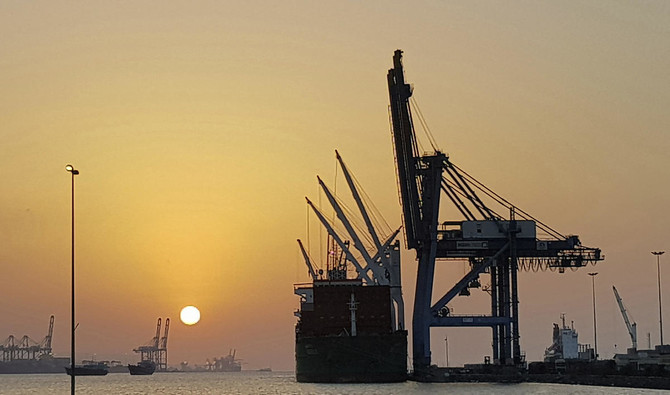
- Djibouti, an arid Horn of Africa nation with less than 1 million inhabitants, also has become a military outpost for China, France, Italy and Japan.
- On the chaotic streets of what has been called the “Singapore of Africa,” the jostling between the United States and China for influence is plainly seen.
War powers resolution fails in Senate as 2 Republicans bow to Trump pressure
WASHINGTON: Senate Republicans voted to dismiss a war powers resolution Wednesday that would have limited President Donald Trump’s ability to conduct further attacks on Venezuela after two GOP senators reversed course on supporting the legislation.
Trump put intense pressure on five Republican senators who joined with Democrats to advance the resolution last week and ultimately prevailed in heading off passage of the legislation. Two of the Republicans — Sens. Josh Hawley of Missouri and Todd Young of Indiana — flipped under the pressure.
Vice President JD Vance had to break the 50-50 deadlock in the Senate on a Republican motion to dismiss the bill.
The outcome of the high-profile vote demonstrated how Trump still has command over much of the Republican conference, yet the razor-thin vote tally also showed the growing concern on Capitol Hill over the president’s aggressive foreign policy ambitions.
Democrats forced the debate after US troops captured Venezuelan leader Nicolás Maduro in a surprise nighttime raid earlier this month
“Here we have one of the most successful attacks ever and they find a way to be against it. It’s pretty amazing. And it’s a shame,” Trump said at a speech in Michigan Tuesday. He also hurled insults at several of the Republicans who advanced the legislation, calling Sen. Rand Paul of Kentucky a “stone cold loser” and Sens. Lisa Murkowski of Alaska and Susan Collins of Maine “disasters.” Those three Republicans stuck to their support for the legislation.
Trump’s latest comments followed earlier phone calls with the senators, which they described as terse. The president’s fury underscored how the war powers vote had taken on new political significance as Trump also threatens military action to accomplish his goal of possessing Greenland.
The legislation, even if it had cleared the Senate, had virtually no chance of becoming law because it would eventually need to be signed by Trump himself. But it represented both a test of GOP loyalty to the president and a marker for how much leeway the Republican-controlled Senate is willing to give Trump to use the military abroad. Republican angst over his recent foreign policy moves — especially threats of using military force to seize Greenland from a NATO ally — is still running high in Congress.
Two Republicans reconsider
Hawley, who helped advance the war powers resolution last week, said Trump’s message during a phone call was that the legislation “really ties my hands.” The senator said he had a follow-up phone call with Secretary of State Marco Rubio Monday and was told “point blank, we’re not going to do ground troops.”
The senator added that he also received assurances that the Trump administration will follow constitutional requirements if it becomes necessary to deploy troops again to the South American country.
“We’re getting along very well with Venezuela,” Trump told reporters at a ceremony for the signing of an unrelated bill Wednesday.
As senators went to the floor for the vote Wednesday evening, Young also told reporters he was no longer in support. He said that he had extensive conversations with Rubio and received assurances that the secretary of state will appear at a public hearing before the Senate Foreign Relations Committee.
Young also shared a letter from Rubio that stated the president will “seek congressional authorization in advance (circumstances permitting)” if he engaged in “major military operations” in Venezuela.
The senators also said his efforts were also instrumental in pushing the administration to release Wednesday a 22-page Justice Department memo laying out the legal justification for the snatch-and-grab operation against Maduro.
That memo, which was heavily redacted, indicates that the administration, for now, has no plans to ramp up military operations in Venezuela.
“We were assured that there is no contingency plan to engage in any substantial and sustained operation that would amount to a constitutional war,” according to the memo signed by Assistant Attorney General Elliot Gaiser.
Trump’s shifting rationale for military intervention
Trump has used a series of legal arguments for his campaign against Maduro.
As he built up a naval force in the Caribbean and destroyed vessels that were allegedly carrying drugs from Venezuela, the Trump administration tapped wartime powers under the global war on terror by designating drug cartels as terrorist organizations.
The administration has claimed the capture of Maduro himself was actually a law enforcement operation, essentially to extradite the Venezuelan president to stand trial for charges in the US that were filed in 2020.
Paul criticized the administration for first describing its military build-up in Caribbean as a counternarcotics operation but now floating Venezuela’s vast oil reserves as a reason for maintaining pressure.
“The bait and switch has already happened,” he said.
Trump’s foreign policy worries Congress
Lawmakers, including a significant number of Republicans, have been alarmed by Trump’s recent foreign policy talk. In recent weeks, he has pledged that the US will “run” Venezuela for years to come, threatened military action to take possession of Greenland and told Iranians protesting their government that ” help is on its way.”
Senior Republicans have tried to massage the relationship between Trump and Denmark, a NATO ally that holds Greenland as a semi-autonomous territory. But Danish officials emerged from a meeting with Vance and Rubio Wednesday saying a “fundamental disagreement” over Greenland remains.
“What happened tonight is a roadmap to another endless war,” Senate Democratic leader Chuck Schumer said at a news conference following the vote.
More than half of US adults believe President Donald Trump has “gone too far” in using the US military to intervene in other countries, according to a new AP-NORC poll.
House Democrats have also filed a similar war powers resolution and can force a vote on it as soon as next week.
How Republican leaders dismissed the bill
Last week’s procedural vote on the war powers resolution was supposed to set up hours of debate and a vote on final passage. But Republican leaders began searching for a way to defuse the conflict between their members and Trump as well as move on quickly to other business.
Once Hawley and Young changed their support for the bill, Republicans were able to successfully challenge whether it was appropriate when the Trump administration has said US troops are not currently deployed in Venezuela.
“We’re not currently conducting military operations there,” said Senate Majority Leader John Thune in a floor speech. “But Democrats are taking up this bill because their anti-Trump hysteria knows no bounds.”
Democratic Sen. Tim Kaine, who has brought a series of war powers resolutions this year, accused Republicans of burying a debate about the merits of an ongoing campaign of attacks and threats against Venezuela.
“If this cause and if this legal basis were so righteous, the administration and its supporters would not be afraid to have this debate before the public and the United States Senate,” he said in a floor speech.


