

Israelis on Gaza border unmoved by Palestinian protests

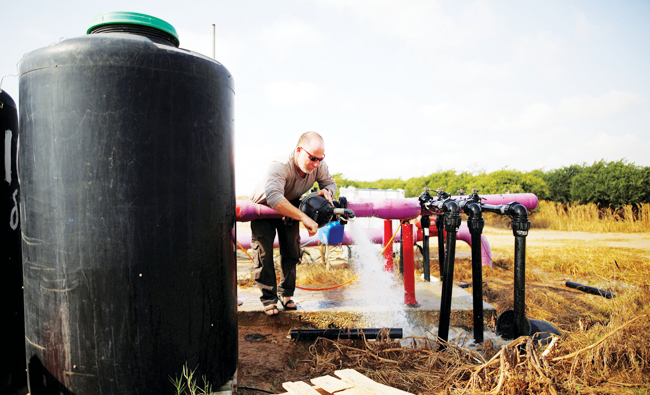
A farmer in a field in Kibbutz Nahal Oz, near the Gaza Strip border, on Sunday. Reuters
Updated 09 April 2018
Follow

Israelis on Gaza border unmoved by Palestinian protests

  • Twenty nine Palestinians have been killed since the protests began on March 30 2018
  • Israel said it is doing what is necessary to stop violent

NAHAL OZ: Hardened by years of rocket attacks from next-door Gaza, residents of this frontline Israeli village seemed unmoved on Sunday by Palestinians’ mass demonstrations at the border and Israel’s deadly response to them.
Confrontations on each of the last two Fridays have been clearly visible from Nahal Oz, a kibbutz just 800 meters from the frontier. The sounds of Arabic chants, smoke from burning tires and the cracks of gunfire from Israeli sharpshooters have wafted in across the wheat, jojoba and sunflower fields.
“I’m sorry about what is happening there. I know the situation is very, very difficult,” Israeli farmer Daniel Rahamim said about economic hardship in Gaza, the Palestinian enclave ruled by Hamas.
“But I don’t talk about a peace deal anymore. Maybe we can achieve a long-term cease-fire,” Rahimim, 63, said as he irrigated his crops. He said his 24-year-old daughter, still “traumatized by rockets” left the area after the demonstrations started.

Twenty nine Palestinians have been killed since the protests began on March 30 along the frontier of the Gaza Strip. The demonstrations have been dubbed “The Great March of Return” of refugees and their descendants to ancestral homes now in Israel.
Drawing international criticism for its use of live fire, Israel said it is doing what is necessary to stop violent protesters from damaging or breaching its fence with the blockaded enclave.
Nahal Oz, like dozens of other villages and working class towns on the Gaza periphery, has over the years been targeted by Palestinian short-range rockets and mortar bombs and faced the threat of Hamas cross-border tunnels.
As last Friday’s protest got under way, six Israeli high school students who were on a study visit to Nahal Oz, clambered up an abandoned guard tower to peer into Gaza. They watched impassively and silently as the crowds gathered.
“I don’t feel any empathy for them (Palestinians),” said Ahuva Avraham, 62, who runs the grocery. “I would be happy if we could live in peace, but they don’t want to sit and talk with us.”
Haim Jelin, a legislator from Israel’s opposition centrist Yesh Atid party, and a resident of nearby Kibbutz Beeri, agreed with the government in rejecting UN and European Union calls for an inquiry into Israel’s killing of protesters.
“When it comes to the Gaza Strip, there is no coalition and opposition,” he told Reuters in an interview on farmland 300 meters (yards) from the border fence.


International law at ‘breaking point’ amid ‘epidemic’ of conflicts: Survey

Updated 4 sec ago
Follow

International law at ‘breaking point’ amid ‘epidemic’ of conflicts: Survey

  • Gaza war highlighted as one of the most concerning areas; atrocities in Sudan also noted
  • ‘Well over’ 100,000 civilians have been killed in past 18 months amid ‘rampant impunity’

LONDON: A new survey of 23 conflicts worldwide has said more than 100,000 civilians have been killed in the past 18 months, with adherence to international humanitarian law reaching “a critical breaking point.”

The “War Watch” survey highlighted the war in Gaza as one of the most concerning areas in an “epidemic” of violence, while also noting concerning levels of atrocities in Sudan.

Taken under the auspices of the Geneva Academy of International Humanitarian Law and Human Rights, the survey covers July 2024 to the end of 2025.

Lead author Stuart Casey-Maslen said: “Atrocity crimes are being repeated because past ones were tolerated. Our actions — or inaction — will determine whether international humanitarian law vanishes altogether.”

In Gaza, local authorities say 18,592 children and 12,400 women have been killed since Israel invaded the Palestinian enclave in October 2023. 

The report said Gaza’s overall population had declined by “about 254,000 people, a 10.6 percent decline compared with pre-conflict estimates,” making it one of the most deadly conflicts in the world. It noted that despite a ceasefire being agreed late last year, civilian casualties have continued.

In Sudan, after the fall of the city of El-Fasher to the Rapid Support Forces last October, widespread reports of survivors “being gang-raped by RSF fighters” — including in the presence of relatives — were recorded in numerous instances.

The survey said: “We do not know how many civilians have been killed in the conduct of hostilities during armed conflicts in 2024 and 2025, but we do know that the number is well over 100,000 in each of the two years.”

It added that “serious violations of international humanitarian law (IHL) were wrought … on a huge scale and with rampant impunity.” 

The report said IHL and the laws of armed conflict, established after the Second World War to protect civilians, must be upheld by every state under the Geneva Conventions “in all circumstances.”

It added: “Addressing widespread impunity for serious violations of international law should be treated as a policy priority.”

The report suggested several policy ideas to reduce the number of people suffering, including arms export bans for countries “where there is a clear risk that the arms or ammunition to be delivered will be used to commit or facilitate serious violations” of IHL.

It also proposed limiting the use of drones and artificial intelligence targeting in civilian areas, as well as unguided gravity bombs or inaccurate long-range artillery.

In addition, it called for “systematic prosecution of war crimes,” saying more political and financial support need to be given to the International Criminal Court by members of the international community.