Self-styled desert republic Somaliland emerges as key player in Horn of Africa

Troops patrol the Indian Ocean port of Mogadishu. The strategically important Horn of Africa waters are vital for the GCC as they are used to transport oil from Middle Eastern producers. Ridding the Horn of extremists is a key priority for GCC states. Somaliland President Muse Bihi Abdi has said the country must make use of its strategic position. (AFP)
Updated 05 April 2018
Follow

Self-styled desert republic Somaliland emerges as key player in Horn of Africa

  • Long-overlooked Somaliland now finds itself in the center of a geopolitical struggle
  • Turkey and Iran are seeking influence in the Horn, seen as a gateway to African markets

London: The waters around it are deemed strategically vital for the GCC as they form part of the Red Sea and Bab Al-Mandeb Strait, one of the world’s busiest maritime routes — also used to transport oil from Middle Eastern producers.
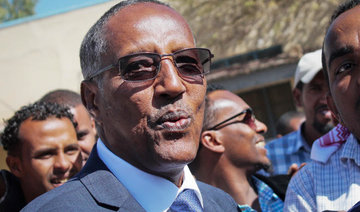
Recently elected President Muse Bihi Abdi acknowledged the strategic importance of Somaliland.
“In today’s world we should be very strategic and cooperate with who is a friend of us and resist who is exploiting us, therefore we should make use of our strategic location in the world,” President Bihi told Arab News.
His comments came as a Saudi-led military coalition thwarted an attack on a Saudi oil tanker by Houthi rebels near the Yemeni coast on Tuesday.
In the Gulf, President Bihi said, Somaliland is very close to Saudi Arabia and the UAE for a number of reasons.
“Firstly we are neighbors of Saudi Arabia and not neighbors of Qatar, second, our exports go to Saudi Arabia, third in Saudi Arabia there are two holy mosques that we have to visit, so consider all these reasons for us to be aligned with Saudi Arabia.”
The UAE, President Bihi said, is a key economic ally.
“All our imports depend on the UAE and their ports, all our flights come through the UAE. It is our bridge to the world,” he said.
In an interview with Arab News, analyst at the Arab Gulf States Institute in Washington, Taimur Khan, said that ridding the Horn of Africa of extremists was vital for the economic and military security of GCC states.
He added that the Yemen intervention had also heightened interest in the coastal territory along the Horn of Africa “to seccure military basing agreements,” said Khan.
President Bihi said: “International interest in the country has been steep in the last three years.”
Earlier this year a row broke out when UAE was banned from operating in Somalia after Dubai’s DP World reinforced its commitment to build a port at in Berbera, Somaliland.

Somalia does not recognize breakaway Somaliland which, in turn, refuses to take instructions from Mogadishu. Separately, Djibouti terminated a contract that allowed DP World to operate the Doraleh container terminal on its east coast. That made building up Berbera even more important for UAE.
According to ambassador Bashe Omar, Somaliland’s UAE representative, in 2016 the international affairs deputy of Iran’s Chamber of Commerce, Industries, Mines and Agriculture, Mohammad Reza Karbasi visited the country.
The Iranian delegation was looking at buying land to establish a logistical hub,” he said.
The Iranian delegation wanted to develop a logistical hub and use the strategic sea port for trade.
Omar said that the government had refused the proposed plan.
He added that in 2015 Turkey also sought to invest in Hargeisa International Airport.
“This was also refused because of the Turkish links with Mogadishu as well as the government support for Somalia in opposition of Somaliland,” said President Bihi.
Khan said: “The UAE, in particular, has over the past decade been involved in training and equipping federal and state security forces in Somalia, such as the Puntland Maritime Police Force, to help counter piracy and the threat of Al-Shabab and other extremist groups in the Horn of Africa that could threaten the Bab Al-Mandeb.”
But other powers such as Turkey and Iran are also seeking influence in the Horn, viewed as a gateway to fast-growing African markets. The UAE and Turkey both have offered packages to Horn countries that include not only ports and connectivity infrastructure, but security training and aid, education and job creation, that set them apart, said Khan.
President Bihi said: “According to our economic interests and our relations before their conflict, Qatar did not have any relations balanced with the relations with Saudi Arabia and the UAE.”
In 2017 the Somaliland government approved a 30-year concession for UAE ports operator DP World, along with a military base near Berbera, for the UAE armed forces.
President Bihi said that the base is a requirement to secure the expansion of the port.
“Our government is not so strong and our zone needs to be protected,” he said. “I think we need a friendly country to have a cooperation with military security.”
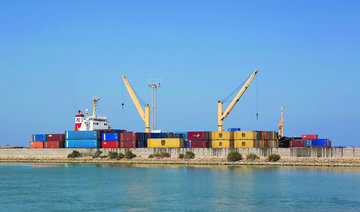
Berbera port has been developed since operations in 2017 began to receive 150,000 containers.
According to Ali Ismail Mahamoud, head of operations at DP World Berbera Port, an 800-meter greenfield container terminal expansion will be completed by 2020 allowing the port to compete with regional players in terms of capacity.

Sustainability Forum Middle East spotlights Saudi role in driving climate finance deployment

Updated 5 sec ago
Follow

Sustainability Forum Middle East spotlights Saudi role in driving climate finance deployment

MANAMA: Saudi Arabia’s growing influence over sustainable finance and climate-aligned investment was a central theme at the Sustainability Forum Middle East, as regional banks, investors, and policymakers signaled a shift from climate pledges to market execution.

The fourth edition of the forum, held in Bahrain under the theme “Advancing Alignment, Innovation, and Implementation for Energy and Climate Transformation,” brought together more than 500 participants and over 50 speakers from government, finance, energy, and industry. 

While the agenda covered climate diplomacy and national strategies, the dominant conversations this year centered on capital deployment, bankability, technology, and the commercial realities of the energy transition.

Saudi Arabia’s role in shaping that transition was repeatedly highlighted, particularly through its efforts to structure green finance instruments, integrate sustainability into Vision 2030 programs, and scale renewable energy ambitions. Global banks at the forum pointed to the kingdom as a key driver of demand for credible sustainable finance frameworks in the Gulf.

“Saudi Arabia has demonstrated clear leadership through Vision 2030 and its green financing frameworks,” Lina Osman, managing director and head of sustainable finance for the Middle East, Africa and Pakistan at Standard Chartered, told Arab News.

“The Public Investment Fund’s green bond issuance is a clear demonstration of the value of the opportunity that is available in Saudi Arabia and how Saudi Arabia is seizing that opportunity,” she added.

Osman also noted that Saudi Arabia’s target of sourcing 50 percent of its electricity from renewables represents a “true demonstration of leadership in sustainability,” adding that financing instruments will need to evolve to serve those ambitions. 

She said the bank has been customizing sustainable finance structures for Gulf Cooperation Council clients as the market becomes more sophisticated and sector-specific.

Organizations at the forum said the region has moved beyond ESG signaling and into discussions about return profiles, risk pricing, and revenue impact. 

“Financial institutions are now focused on how sustainability generates value — reducing costs, building resilience, and boosting revenue. Previously, it was mostly window dressing,” said Ian McCallum, chief sustainability officer at Bank ABC. 

Speaking to Arab News, he added that Saudi Arabia is playing a “significant role in shaping the direction of sustainable finance by continuing to strengthen ESG regulatory and disclosure requirements.”

Speakers from private markets and venture capital also pointed to Saudi Arabia as an emerging market for climate technologies that are moving from pilot phase to commercialization. 

Investors highlighted carbon removal, energy optimization, and AI-enabled climate solutions as areas where the Kingdom’s scaling capacity and demand for industrial decarbonization make deployment feasible.

Beyond finance, the forum examined how the GCC can accelerate industrial decarbonization through AI integration, carbon capture, supply chain reform, and the expansion of renewables. 

Panels explored how sovereign strategies and industrial policy are aligning across the region, with Saudi Arabia’s energy transition goals seen as an anchor for cross-border capital flows.

The event saw memorandums of understanding and multi-sector partnerships intended to translate national ambitions into deployable projects. 

Organizers said the agreements reflect a shift toward implementation, positioning the Gulf as a market where climate action is increasingly tied to competitiveness, industrial growth, and long-term economic resilience.