Somaliland ruling party wins presidential vote

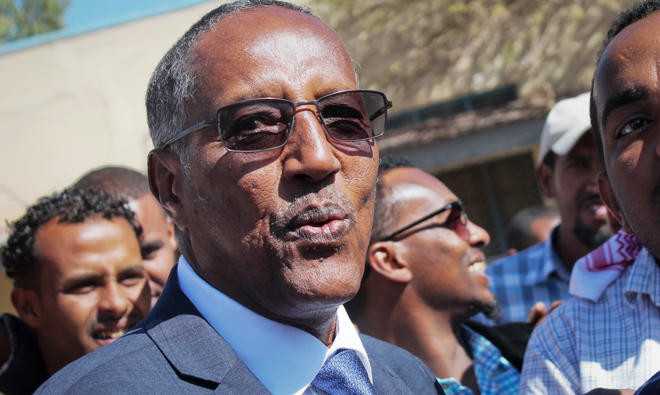
Ruling party candidate Muse Bihi Abdi speaks to the media after casting his vote in the presidential election in Hargeisa, in the semi-autonomous region of Somaliland, in Somalia. (AP)
Updated 21 November 2017
Follow

Somaliland ruling party wins presidential vote

MOGADISHU: Muse Bihi from the ruling Kulmiye party was on Tuesday declared the winner of last week’s presidential poll in the self-proclaimed state of Somaliland, election officials said.
Bihi, 69, won with 55 percent of the vote, beating Abdirahman Iro of the main opposition Waddani party, who received 41 percent. Faysal Ali Warabe, who previously ran and lost in 2010, came third with four percent.
“The tallying process of the election was concluded and Kulmiye party candidate Muse Bihi Abdi... won the election and will be the president,” said election commission chairman Abdikadir Iman Warsame.
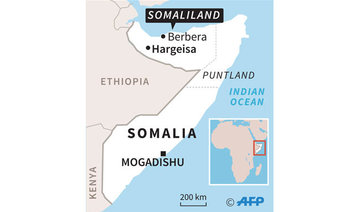
The northern territory, which declared independence from the rest of Somalia in 1991, hopes the successful conclusion of its third presidential election will bolster its democratic credentials and strengthen the case for independence from its troubled neighbor.
Bihi, a retired air force officer and former interior minister, is a well-known figure in Somaliland and has chaired the Kulmiye party (Peace, Unity and Development) since 2010. He will succeed as President Ahmed Mohamud Silaanyo, who did not seek re-election.
Elections are meant to be held every five years, but the poll was delayed for two years due to drought and technical issues.
Somaliland’s history of peaceful, credible elections and democratic transition sets it apart from anarchic southern Somalia.
Somalia — which is wracked with fighting between African Union-backed Somali forces and the Al-Qaeda aligned AL-Shabab militants — held an election in February that saw a president chosen via a limited electoral process in which handpicked clan elders selected delegates who were allowed to vote.
However Somaliland drew criticism for imposing a blackout on social media platforms such as Twitter and Facebook after voting closed on Nov. 14, to prevent interference from outside the borders of the semi-autonomous state and speculation over the outcome.
Iro had also questioned the conduct of this month’s election, claiming harassment and fraud, including the participation of underage voters.
Somaliland, a former British protectorate, won independence in 1960 but days later joined with Somalia.
In 1991, after years of bitter war with the government in Mogadishu, it declared independence from the rest of the country, and has long hoped for international recognition.


Lebanese finance minister denies any plans for a Kushner-run economic zone in the south

Updated 5 sec ago
Follow

Lebanese finance minister denies any plans for a Kushner-run economic zone in the south

  • Proposal was made by US Envoy Morgan Ortagus but was ‘killed on the spot’
  • Priority is to regain control of state in all aspects, Yassine Jaber tells Arab News

DAVOS: Lebanon’s finance minister dismissed any plans of turning Lebanon’s battered southern region into an economic zone, telling Arab News on the sidelines of the World Economic Forum’s meeting in Davos that the proposal had died “on the spot.”

Yassine Jaber explained that US Envoy to Lebanon Morgan Ortagus had proposed the idea for the region, which has faced daily airstrikes by Israel, and it was immediately dismissed.

Jaber’s comments, made to Arab News on the sidelines of the World Economic Forum in Davos, were in response to reports which appeared in Lebanese media in December which suggested that parts of southern Lebanon would be turned into an economic zone, managed by a plan proposed by Jared Kushner, US President Donald Trump’s son in law.

Meanwhile, Jaber also dismissed information which had surfaced in Davos over the past two days of a bilateral meeting between Lebanese ministers, US Middle East Envoy Steve Witkoff and Kushner.

Jaber said that the meeting on Tuesday was a gathering of “all Arab ministers of finance and foreign affairs, where they (Witkoff and Kushner) came in for a small while, and explained to the audience the idea about deciding the board of peace for Gaza.”

He stressed that it did not develop beyond that.

When asked about attracting investment and boosting the economy, Jaber said: “The reality now is that we need to reach the situation where there is stability that will allow the Lebanese army, so the (Israeli) aggression has to stop.”

Over the past few years, Lebanon has witnessed one catastrophe after another: one of the world’s worst economic meltdowns, the largest non-nuclear explosion in its capital’s port, a paralyzed parliament and a war with Israel.

A formal mechanism was put in place between Lebanon and Israel to maintain a ceasefire and the plan to disarm Hezbollah in areas below the Litani river.

But, the minister said, Israel’s next step is not always so predictable.

“They’re actually putting pressure on the whole region. So, a lot of effort is being put on that issue,” he added.

“There are still attacks in the south of the country also, so stability is a top necessity that will really succeed in pushing the economy forward and making the reforms beneficial,” he said.

Lawmakers had also enacted reforms to overhaul the banking sector, curb the cash economy and abolish bank secrecy, alongside a bank resolution framework.

Jaber also stressed that the government had recently passed a “gap law” intended to help depositors recover funds and restore the banking system’s functionality.

“One of the priorities we have is really to deal with all the losses of the war, basically reconstruction … and we have started to get loans for reconstructing the destroyed infrastructure in the attacked areas.”

As Hezbollah was battered during the war, Lebanon had a political breakthrough as the army’s general, Joseph Aoun, was inaugurated as president. His chosen prime minister was the former president of the International Court of Justice, Nawaf Salam.

This year marks the first time a solid delegation from the country makes its way to Davos, with Salam being joined by Jaber, Economy and Trade Minister Amr Bisat, and Telecoms Minister Charles Al-Hage.

“Our priority is to really regain the role of the state in all aspects, and specifically in rebuilding the institutions,” Jaber said.