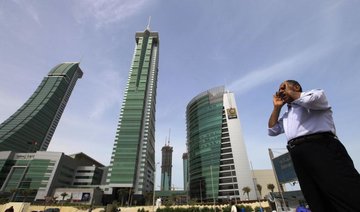
Dubai: The small island-nation of Bahrain on Wednesday announced the discovery of 80 billion barrels of shale oil, its largest oil and gas find ever.
Bahrain’s oil minister and energy executives detailed the find at a press conference, saying the tight oil was discovered in the offshore Khalij Al-Bahrain Basin, which spans some 2,000 square kilometers (770 square miles) in shallow waters off the country’s western coast.
The field also contains an estimated 14 trillion cubic feet of gas.
Oil Minister Sheikh Mohammed bin Khalifa Al Khalifa said the amount of oil that can be extracted from the Khalij Al-Bahrain Basin is still being studied.
Still, the discovery dwarfs the onshore Bahrain oil field, which produces around 45,000 barrels per day. The non-OPEC country also produces close to 160,000 barrels of oil per day from an offshore field it shares with Saudi Arabia.
The minister announced a separate discovery of gas reserves below Bahrain’s main gas reservoir, with estimates that push deep gas reserves in the region to between 10 and 20 trillion cubic feet.
Experts and officials said they expect the newly discovered oil field to be ‘on production’ within five years.
Bahrain started pumping oil in 1932, becoming the first among its Arab Gulf neighbors to produce oil.
Bahrain, which hosts the US Navy’s 5th Fleet, is not a major oil producer, but the new finds have the potential to significantly raise the country’s profile and boost its economy, which has suffered blows in recent years from lower oil prices.
The country has introduced some austerity measures to limit spending and boost revenue, including reducing some fuel subsidies and increasing taxes. Like Saudi Arabia and the United Arab Emirates, it introduced a 5 percent value-added tax this year to most goods and services.

Bahrain’s largest oil find estimated at 80 billion barrels
- Bahrain’s Minister said the quantities of oil discovery may exceed 80 billion barrels
- The area of the new oil discovery is estimated at 2000 square kilometers
Saudi investment hits 32% of GDP, non-oil fixed capital reaches 40%, minister says
RIYADH: Saudi Arabia’s investment now accounts for 32 percent of gross domestic product, with non-oil fixed capital at 40 percent, according to the minister responsible for portfolio.
Speaking during his visit to the Shoura Council, Khalid Al-Falih said that foreign direct investment is expected to grow fivefold, signaling strong Vision 2030 progress.
“Regarding cumulative performance, the Kingdom has exceeded all expectations, achieving high levels of investment,” Al-Falih said, according to a video posted on Al-Ekhbariya’s X account focused on economic matters.
The minister added: “Today, investment accounts for 32 percent of the total GDP. In terms of non-oil GDP, fixed capital represents 40 percent, compared with 41 percent in China, the highest globally.”
If we take the non-oil GDP, he said, fixed capital will make 40 percent. “China is the largest globally with 41 percent. So, we will rank second if we compare it to the non-oil economy and fourth when measured against total GDP,” Al-Falih said.
He emphasized that the Kingdom offers an investment-attractive environment, noting that when focusing on foreign direct investment rather than overall investment, Saudi Arabia ranks among the world’s highest.
The minister of investment added that FDI is expected to grow fivefold by the end of 2025, though these data require confirmation, stressing that this is “a big indicator for the success of Saudi Vision 2030.”
During his address to the session, Al-Falih emphasized that Saudi Vision 2030 prioritizes economic diversification and reducing dependence on oil, through boosting the private sector’s contribution to inclusive economic development, supporting national sectoral priorities, and driving growth in the Kingdom’s GDP.
He highlighted key initiatives enabling the private sector, including the establishment of the Ministry of Investment and the Saudi Investment Promotion Authority, the launch of the “Shareek” program, the development of the National Investment Strategy, and linking all stakeholders in the investment ecosystem.
“The Cabinet’s adoption of the National Investment Strategy, launched by Crown Prince in 2021 and implemented in 2022 as a comprehensive national framework, has played a major role in positioning investment as a driver of economic growth,” he said.
Al-Falih revealed that the ministry has identified more than 2,000 investment opportunities worth over SR1 trillion ($267 billion), noting that 346 of these opportunities have been converted into closed deals valued at over SR231 billion through the “Invest Saudi” platform.
He also highlighted the success of the regional headquarters attraction program, with licenses issued to more than 700 global companies by the end of 2025, surpassing the 2030 target of 500 companies, across diverse sectors that reinforce Saudi Arabia’s role as a regional business hub.
The minister revealed that active investment licenses have grown tenfold, rising from 6,000 in 2019 to 62,000 by the end of 2025, highlighting the role of companies in creating over one million jobs, including numerous positions for Saudi nationals.
Al-Falih noted the Kingdom’s success in attracting 20 of the world’s top 30 banks, as part of efforts to strengthen the presence of leading asset managers and international banks in support of the Saudi banking sector.
He also discussed reforms to enhance the business environment, such as the Civil Transactions Law, Companies Law, and the updated Investment Law issued in mid-2024, which contributed to Saudi Arabia moving up 15 places in the global competitiveness ranking.
The minister also announced the update of the National Investment Strategy in 2025, focusing on quality, productivity, and directing investments toward sectors with the highest economic impact, while developing financing solutions for SMEs.