20 killed in Boko Haram attack on Nigerian army base, villages

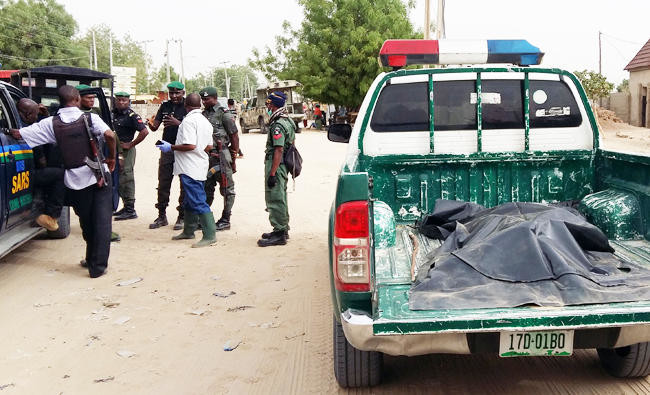
A covered-up dead body lies in the trunk of a police vehicle as members of security forces stand near the site of a suspected Boko Haram attack on the edge of Maiduguri's inner city, Nigeria on Monday. (REUTERS)
Updated 03 April 2018
Follow

20 killed in Boko Haram attack on Nigerian army base, villages

  • Boko Haram fighters attacked a military base in the Cashew Plantation area at the entrance to the city of Maiduguri with suicide bombers, mortars and guns, leading to a prolonged battle.
  • One soldier was among the dead, the army said in a statement, which added that it had killed six insurgents and “neutralized” seven suicide bombers.

KANO, NIGERIA: Boko Haram killed at least 20 people and wounded scores of others in coordinated attacks on a military camp and villages around the flashpoint northern Nigerian city of Maiduguri, which they also tried to infiltrate across a defensive trench, officials said Monday.
The brazen operation — which unfolded around the very city where Boko Haram was born — turned the spotlight on the authorities’ struggle to quell the jihadists’ nearly nine-year-old offensive.
Boko Haram fighters attacked a military base in the Cashew Plantation area at the entrance to the city with suicide bombers, mortars and guns, leading to a prolonged battle, a senior military officer in Maiduguri said.
“Eighteen Boko Haram terrorists on foot attacked the military base while seven suicide bombers targeted residents of nearby Bale Shuwar and Alikaranti villages at 8:50 p.m. (1950 GMT),” said the officer, who asked not to be identified as he was not authorized to speak about the incident.
“The terrorists fired mortars at troops,” the officer said.
Bello Dambatto, chief security officer at the State Emergency Management Agency (SEMA), told AFP that an initial death toll of 18 had risen to 20 after two people died in hospital from their wounds.
“We are not sure if the remaining 82 wounded victims will make it. Some of them are in critical condition and will require major surgery from their wounds, which are mostly from gunshots.”

One soldier was among the dead, the army said in a statement, which added that it had killed six insurgents and “neutralized” seven suicide bombers.
The attackers were trying to infiltrate into the city, said Ba’Kura Abba Ali, a militia leader in the area helping soldiers in fighting Boko Haram.
The assailants climbed up a trench that had been dug in the sand round the city to stave off Boko Haram suicide and gun attacks, and attacked troops, Ali said.
Maiduguri residents reported hearing at least five explosions and sounds of gunfire coming from the Cashew Plantation area.
“Huge blasts and sounds of gunshots were heard all over the city last night and they continued for more than an hour,” said one resident, Ibrahim Gremah.
The UN said it “strongly condemns the deadly combined attack” and, citing local sources, gave a toll of at least 34 civilians killed and 90 wounded.
Boko Haram’s nearly nine-year fight to establish a hard-line Islamic state in northeast Nigeria has claimed at least 20,000 lives and displaced more than two million people.
Hundreds of thousands are holed up in Maiduguri, the capital of Borno state, where they are living in camps or with host families.
On Friday, four girl suicide bombers aged between 13 and 18 killed two people in multiple attacks in Zawuya settlement on the outskirts of Maiduguri in the first assault since the government announced it was in cease-fire talks with Boko Haram.
The attacks highlight the challenge the government faces in striking a cease-fire agreement with the jihadist group.
In February, when more than 100 schoolgirls were returned to Dapchi after being kidnapped by Boko Haram, Nigerian President Muhammadu Buhari said his government was offering amnesty to “repentant” jihadists.

But the process is troubled by factionalism within Boko Haram, say senior security officials.
The group is divided into two factions that have competing goals and operational methods.
One, led by Abu Mus’ab Al-Barnawi and affiliated with the so-called Islamic State, is reportedly in talks with the government. The other, led by Abubakar Shekau, is notorious for suicide bombings.
“Talks have been ongoing between the government and the insurgents from the Al-Barnawi faction,” said a source, speaking on condition of anonymity.
The source said peace talks began in earnest after the July 2017 attack on an oil exploration team in Lake Chad that killed at least 69 people.
“The major headache now is extending the talks to the Shekau faction which is averse to negotiations. Dealing with them is quite problematic.”


EU leaders begin India visit ahead of ‘mother of all deals’ trade pact

Updated 3 sec ago
Follow

EU leaders begin India visit ahead of ‘mother of all deals’ trade pact

  • Antonio Luis Santos da Costa, Ursula von der Leyen are chief guests at Republic Day function
  • Access to EU market will help mitigate India’s loss of access to US following Trump’s tariffs

New Delhi: Europe’s top leaders have arrived in New Delhi to participate in Republic Day celebrations on Monday, ahead of a key EU-India Summit and the conclusion of a long-sought free trade agreement.

European Council President Antonio Luis Santos da Costa and European Commission President Ursula von der Leyen arrived in India over the weekend, invited as chief guests of the 77th Republic Day parade.

They will hold talks on Tuesday with Prime Minister Narendra Modi at the EU-India Summit, where they are expected to announce a comprehensive trade agreement after years of stalled negotiations.

Von der Leyen called it the “mother of all deals” at the World Economic Forum in Davos last week — a reference made earlier by India’s Commerce Minister Piyush Goyal — as it will create a market of 2 billion people.

“The India-EU FTA has been a long time coming as negotiations have been going on between the two for more than a decade. Some of the red lines that prevented the signing of the FTA continue to this date, but it seems that the trade negotiations have found a way around it,” said Anupam Manur, professor of economics at the Takshashila Institution.

“The main contentious issue remains the Indian government’s desire to protect the farmers and dairy producers from competition and the European Union’s strict climate-based rules and taxation. Despite this, both see enormous value in the trade deal.”

India already has free trade agreements with more than a dozen countries, including Australia, the UAE, and Japan.

The pact with the EU would be its third in less than a year, after it signed a multibillion CEPA (comprehensive economic partnership agreement) with the UK in July and another with Oman in December. A week after the Oman deal, New Delhi also concluded negotiations on a free trade agreement with New Zealand, as it races to secure strategic and trade ties with the rest of the world, after US President Donald Trump slapped it with 50 percent tariffs.

The EU is also facing tariff uncertainty. Earlier this month Trump threatened to impose new tariffs on several EU countries unless they supported his efforts to take over Greenland, which is an autonomous region of Denmark.

“The expediting factor in the trade deal is the unilateral and economically irrational trade decisions taken by their biggest trading partner, the United States,” Manur told Arab News.

Being subject to the highest tariff rates, India has been required to sign FTAs with other major economies. Access to the EU market would help mitigate the loss of access to the US.

The EU is India’s largest trading partner in goods, accounting for about $136 billion in the financial year 2024-25.

Before the tariffs, India enjoyed a $45 billion trade surplus with the US, exporting nearly $80 billion. To the EU’s 27 member states, it exports about $75 billion.

“This can be sizably increased after the FTA,” Manur said. “Purely in value terms, this would be the biggest FTA for India, surpassing the successful FTAs with the UK, Australia, Oman and the UAE.”