ABUJA: Nigeria’s government is in talks with Islamist militant group Boko Haram about a possible cease-fire and the talks have been going on for some time, Information Minister Lai Mohammed said on Sunday.
It is the first time in years the government has said it was talking to Boko Haram about a cease-fire. President Muhammadu Buhari’s government has previously said it was willing to hold talks with the group but has given no details.
Boko Haram has waged an insurgency in northeast Nigeria and neighboring countries since 2009 and aims to create an Islamic state. Tens of thousands of people have been killed, more than 2 million displaced and thousands abducted.
Mohammed made his statement in an email to Reuters outlining the background to the release of more than 100 schoolgirls freed last week by the group after being kidnapped on Feb. 19 from the northeastern town of Dapchi.
It was the biggest mass abduction since more than 270 girls were taken from the town of Chibok in 2014.
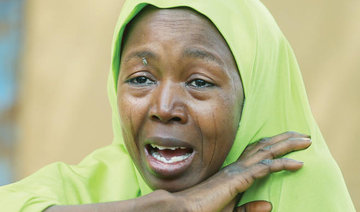
Boko Haram fighters stunned Dapchi’s residents on Wednesday when they drove into the town and released the girls, who said five of their group died in captivity and one had not been freed.
“Unknown to many, we have been in wider cessation-of-hostility talks with the insurgents for some time now,” said Mohammed. “We were able to leverage on the wider talks when the Dapchi girls were abducted.”
Mohammed said a week-long cease-fire, starting on March 19, had been agreed to enable the group to drop off the girls. Mohammed said 111 girls were taken from the school — one more than previously thought — and six remained unaccounted for.

Nigerian government says it is talking to Boko Haram about possible cease-fire
Indonesia’s first woman president awarded honorary doctorate by Princess Nourah University
- Megawati was recognized for her leadership and contributions to social, legal affairs
- She has received 10 other honorary degrees from Indonesian and foreign institutions
JAKARTA: Megawati Sukarnoputri, who served as Indonesia’s fifth president and was the country’s only female head of state to date, has been awarded an honorary doctorate by Princess Nourah bint Abdulrahman University in Riyadh, becoming the first foreign national to receive the title.
Megawati, the eldest daughter of Indonesia’s first President Sukarno and chairwoman of the country’s largest political party, the PDIP, served as president from 2001 to 2004.
The 79-year-old was awarded an honorary doctorate in organizational and legal affairs in Riyadh on Monday during a ceremony overseen by Princess Nourah University’s acting president, Dr. Fawzia bint Sulaiman Al-Amro.
“This recognition was given in appreciation of her efforts during her presidency, her significant contributions to social, organizational, and legal fields, and her role in strengthening institutional leadership in Indonesia,” the university said in a statement.
This is Megawati’s 11th honorary doctorate. She has received similar degrees from Indonesian and foreign universities, including the Moscow State Institute of International Relations in 2003 and the Soka University of Japan in 2020.
She has also been awarded the title of honorary professor by several institutions, including by the Seoul Institute of the Arts in 2022.
“We gather at the Princess Nourah bint Abdulrahman University, a university that stands as a symbol of women’s progress in education, knowledge and public service … To see so many intelligent women, I feel very proud,” Megawati said in her acceptance speech.
“Women’s empowerment is not a threat to any values, culture or tradition. It is actually a condition for nations that believe in their future … A great nation is one that is able to harness all of its human potential. A strong nation is one that does not allow half of its social power to be left on the sidelines of history.”
Megawati is the longest-serving political leader in Indonesia. Indonesia’s first direct presidential elections took place during her presidency, consolidating the country’s transition to democracy after the downfall of its longtime dictator Suharto in 1998.