

Boko Haram returns Nigerian kidnapped schoolgirls - witnesses

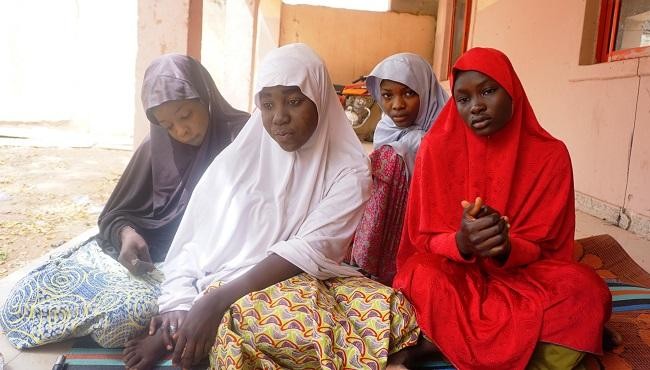
Boko Haram has released the 76 Chibok school girls kidnapped. (AFP)
Updated 21 March 2018
Follow

Boko Haram returns Nigerian kidnapped schoolgirls - witnesses

MAIDUGURI, Nigeria: A plane carrying scores of Nigerian schoolgirls freed by Boko Haram militants on Wednesday has taken off for the capital Abuja, a Reuters witness reported.
Information Minister Lai mohammed, speaking in Maiduguri, said 105 people had been rescued so far, two of whom were not students.
He said the government was still negotiating with Boko Haram to release the remaining Chibok schoolgirls, 100 of whom remain unaccounted for. “Not for one moment has there been a break in the negotiations with this armed insurgency,” he said.

Boko Haram militants rolled into Dapchi in nine vehicles in the morning and the girls were left in the center of town. As terrified residents emerged from their homes, the extremists said “this is a warning to you all,” resident Ba’ana Musa told The Associated Press.
“We did it out of pity. And don’t ever put your daughters in school again,” the extremists said. Boko Haram means “Western education is forbidden” in the Hausa language.
Nigeria’s government said 101 of the 110 schoolgirls, most of them Muslim, had been confirmed freed and that the number “would be updated after the remaining ones have been documented.”
“No ransoms were paid,” the information minister, Lai Mohammed, said in a statement. The girls were released “through back-channel efforts and with the help of some friends of the country, and it was unconditional.”
A decision against military “confrontation” was part of the agreement, he added.
Bashir Manzo, whose 16-year-old daughter was among those kidnapped during the Feb. 19 attack, confirmed that his daughter was among those freed.
“As I speak to you there is jubilation in Dapchi,” he said.
The mass abduction and the government response brought back painful memories of the 2014 attack on a boarding school in Chibok. Boko Haram militants abducted 276 girls, and about 100 of them have never returned. Some girls were forced to marry their captors, and many had children fathered by the militants.
The latest mass abduction is thought to have been carried out by a Boko Haram splinter group aligned with Daesh, one that has criticized the leader of the main Boko Haram organization for targeting civilians and has focused instead on military and Western targets.
Residents in Dapchi fled on Wednesday morning upon hearing that Boko Haram vehicles were headed toward the town.
“We fled but, from our hiding, we could see them and surprisingly, we saw our girls getting out of the vehicles,” Umar Hassan told the AP.
“They assembled the girls and talked to them for some few minutes and left without any confrontation,” said another resident, Kachallah Musa.
The girls were at the general hospital in Dapchi “and the counselors are there with them,” the information minister told reporters. As with the released Chibok schoolgirls, “they will be quarantined and be counseled before they go back to their schools.”
Their release came a day after an Amnesty International report accused the Nigerian military of failing to heed several warnings of the imminent attack last month. The military has called the report an “outright falsehood.”
Nigeria’s government celebrated the girls’ release. “GREAT NEWS from Dapchi, Yobe State. Thank God for the safe return of our sisters. Alhamdulillah!” an aide to President Muhammadu Buhari, Bashir Ahmad, said on Twitter.
UN chief launches first global, independent scientific panel on artificial intelligence

Updated 5 sec ago
Follow

UN chief launches first global, independent scientific panel on artificial intelligence

  • Secretary-General Antonio Guterres nominates 40 experts to serve on body ‘dedicated to helping close the AI knowledge gap and assess the real impacts of AI’
  • It will ‘help the world separate fact from fakes, and science from slop … at a moment when reliable, unbiased understanding of AI has never been more critical,’ he adds

NEW YORK CITY: UN Secretary-General Antonio Guterres on Wednesday formally launched what he described as the only global, independent scientific body focused on artificial intelligence, and submitted his recommendations for the experts to serve on it.

“It will be the first global, fully independent scientific body dedicated to helping close the AI knowledge gap and assess the real impacts of AI across economies and societies,” he told reporters in New York.

“And this could not be more urgent. AI is moving at the speed of light. No country can see the full picture alone.”

The Independent International Scientific Panel on Artificial Intelligence was established by the UN General Assembly through a resolution in August. Guterres said he has now submitted a list of 40 experts from all regions as his proposed candidates for the new body, which was mandated by world leaders under the UN’s Pact for the Future.

The panel is intended to provide authoritative, science-based analysis at a time when AI is developing rapidly and reshaping economies, governance and social life, but regulatory approaches remain fragmented.

Guterres underscored the need for shared understanding among countries to help develop effective safeguards, promote innovation for the common good, and strengthen international cooperation.

The UN said the panel would serve as a global reference point, helping policymakers and the public distinguish between reliable evidence and misinformation, and grounding debates on AI in independent scientific assessment.

The initiative comes amid growing concern over the societal, economic and security risks posed by unchecked technological competition.

“We need shared understandings to build effective guardrails, unlock innovation for the common good, and foster cooperation,” Guterres said.

“The panel will help the world separate fact from fakes, and science from slop. It will provide an authoritative reference point at a moment when reliable, unbiased understanding of AI has never been more critical.”

The proposed members of the panel were selected following an open global call that attracted more than 2,600 applicants, whose expertise spanned fields including machine learning, data governance, public health, cybersecurity, child development and human rights. The chosen candidates are expected to serve in a personal capacity, independent of governments, businesses or other institutions.

The panel will operate on an accelerated timeline, with its first report due in time to inform a Global Dialogue on AI Governance scheduled for July. UN officials said the findings were expected to support international efforts to build common ground on AI governance during a period of heightened geopolitical tensions and technological rivalry.

Guterres framed the initiative as part of a broader push to ensure that AI is shaped collectively, guided by scientific evidence and global solidarity, rather than allowing its development to outpace international cooperation.