

Pedaling against patriarchy: Women cyclists send message on two wheels

1 / 2
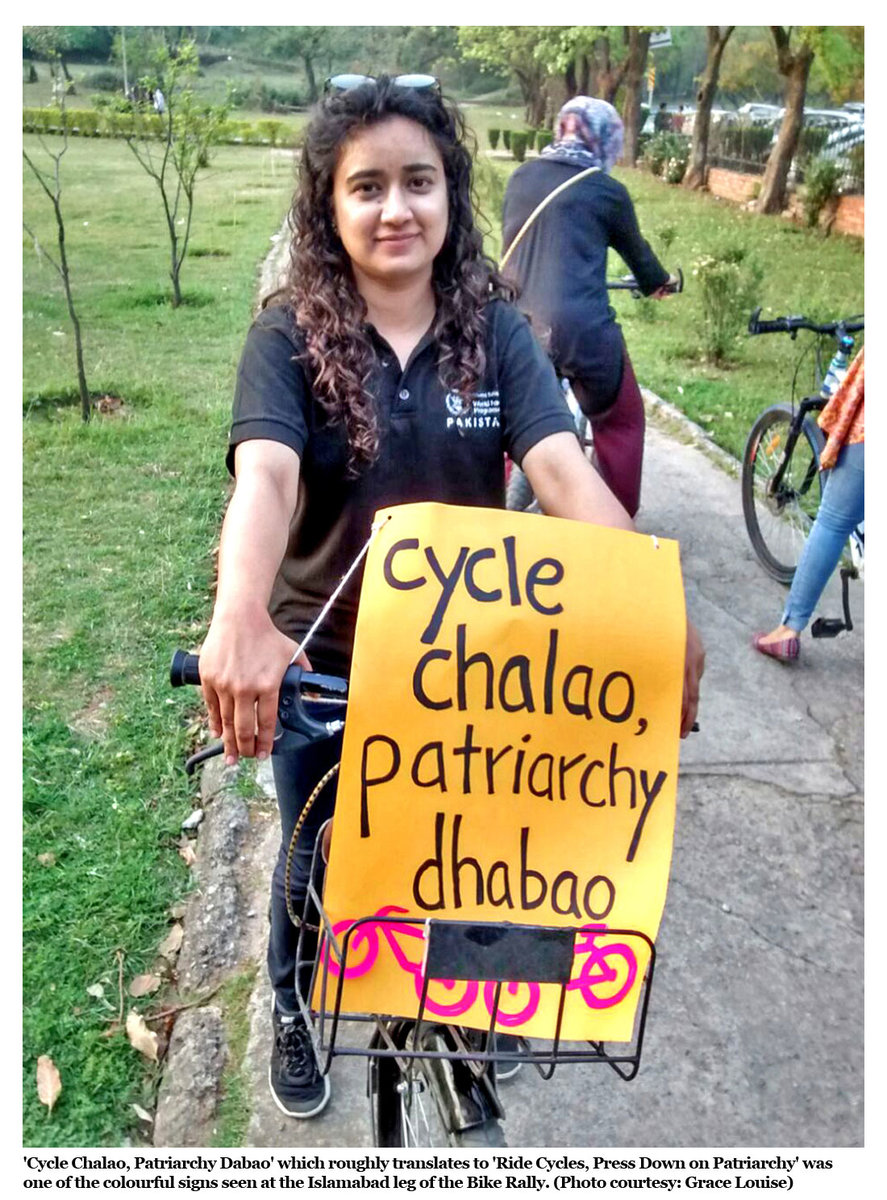
'Two Tyred of the Patriarchy' the third addition of the Girls on Bikes Rally took place across Islamabad, Lahore and Karachi. Many riders armed their wheels with signs similar to those seen at the Aurat March in early March. (Photo courtesy: Girls At Dhabas)
2 / 2
Zara Zaman Khan Afridi and Grace Louis at the meet up for the Islamabad leg of the Girls on Bikes Rally. (Photo courtesy: Grace Louise)
Updated 02 April 2018
Follow

Pedaling against patriarchy: Women cyclists send message on two wheels

ISLAMABAD: Women of Islamabad, Lahore and Karachi were on a roll, literally, when they took to two wheels for the third Girls on Bikes rally.
The rally was organized by Girls at Dhabas, an initiative started in Karachi a few years ago encouraging women to reclaim public spaces in Pakistan.
Although Pakistan’s bustling cities have no shortage of roadside chai shops, kabob houses or vendors selling paratha rolls, it is rare for women to take up seats laid by the side of the road.
There are no rules preventing women and girls from taking a seat, but a patriarchal culture that encourages women to stay at home has also led to harassment in public spaces. This has resulted in a general acceptance that female are patrons are not welcome in some places.
“The bike rally is a public intervention. It changes our streets and it changes reality,” said director Anam Abbas, who filmed the Karachi leg of the ride this year.
“However short term and symbolic it may be, at that moment there is a rupture in the constrictive male public space. It will embolden some riders to keep riding, and for the witnesses it is the vision of possibility.”
Girls on Bikes, like Girls at Dhaba, lets women know that the country’s roadside restaurants — and the roads, too — also belong to them.
“The rallies are primarily a symbolic gesture we do once a year to reach out to women who may have been inhibited in the past from cycling in public spaces,” says Meherbano Raja, an Islamabad-based member of the both groups.
After the first set of rallies organized in 2016, other independent Girls on Bikes groups were started in Karachi and Lahore, with female cycling enthusiasts getting together for monthly rides, she said.
In 2016, Lahore was the site of the first Girls on Bikes rally.
Group member Shmyla Khan said: “For several women, it was their first experience navigating the chaotic traffic from the vantage point of a cyclist. Some participants said they enjoyed chatting with pedestrians, motorcyclists and rickshaw-wallas as they drove along. Cars full of families waved enthusiastically, took pictures and one child even gave us a high-five.”
Zara Peerzada, who joined the Lahore leg, said: “It was amazing — everyone was positive, patient and helpful.
“Our route took us around the heart of the city. Cycling through so much traffic was a little unnerving, but it did not feel uncomfortable or unnatural — and that was empowering. Just seeing so many women having a good time together outside, in public spaces, felt great.”
In Islamabad, more than 70 women joined the ride.

Grace Louise, an avid cyclist who has not biked since moving to Islamabad, found the ride heartening.
“It felt fun, supportive and inspiring, particularly the teenage girls who were so assertive and angry about sexual harassment and the importance of claiming space,” she said.
Another participant, Zara Zaman Khan Afridi, said: “People were surprised, but took an interest in what we were doing because we were screaming, ‘humari sarkeh, humara shehr, (our streets, our city).”
However, the cyclists also faced occasional catcalls and aggressive behavior from men.
“At times we felt like we were part of the rhythm of the city, but at other times we experienced the harassment that is part of the experience of women in public spaces — stares, catcalls and deliberate disruption,” said Shymla Khan.
Women shared stories and swapped strategies on dealing with everyday harassment.
The symbolism of the cycle rallies was not lost on the women who took part.
“I cycle and I walk normally in my life,” said Afridi. “I am all for taking back public spaces for women. We must do (these rallies) for others who don’t have the same accessibility as us.
“Poor women have to walk, you never see them on a bike, so if they can’t afford transport, unlike their male counterparts they have no choice but to walk. So this is for them,” she said.


UPDATE 2-Walk for peace: Buddhist monks arrive in Washington after 2,300-mile journey

Updated 5 sec ago
Follow

UPDATE 2-Walk for peace: Buddhist monks arrive in Washington after 2,300-mile journey

  • Monks started in Texas, walked through nine states
  • Walkers trod daily through frigid winter ‌weather

WASHINGTON: Draped in burnt-orange robes, two dozen Buddhist monks arrived in Washington, D.C., on Tuesday on a 2,300-mile “Walk for Peace,” a self-described spiritual journey across nine states that has been cheered on by crowds of thousands. “People want this,” said Joan Donoghue, 59, ​from Silver Spring, Maryland, who had come out with four of her friends on Tuesday to see the monks. “I went on Sunday in Virginia and I waited outside for a long time and I talked to so many people and they all said the same thing: that our country needs this. We feel divided and people want more kindness and more compassion and more peace.”
The monks began their walk in Texas more than three months ago, at times braving frigid winter temperatures, sometimes with bare feet, to raise “awareness of peace, loving kindness, and compassion across America and the world.” The marchers continued on despite a powerful winter storm that spread a paralyzing mix of heavy snow, sleet and freezing rain from the Ohio Valley and mid-South to New England, compounded by bitter, Arctic cold gripping much of the US Accompanied by Aloka, a ‌rescue dog from ‌India who has gained a following on social media as “the Peace Dog,” their journey comes at ​a ‌time ⁠of growing ​tensions ⁠in the US President Donald Trump’s tough immigration policy has seen surges of immigration agents and National Guard troops deployed in some cities, with both American citizens and immigrants killed by federal agents.
“We walk not to protest, but to awaken the peace that already lives within each of us,” said Bhikkhu Pannakara, spiritual leader of the Walk for Peace. “The Walk for Peace is a simple yet meaningful reminder that unity and kindness begin within each of us and can radiate outward to families, communities, and society as a whole.”
They will spend Tuesday and Wednesday in Washington and end their journey in nearby Annapolis, Maryland on Thursday.
The walk has garnered support from millions of people on social media, with many sharing messages of support ⁠for the monks. Supporters have braved snow and rain to meet and offer flowers to the monks ‌as they passed through their cities. In Washington, hundreds of people came out to ‌see the monks as they walked along a road informally known as Embassy Row ​because of the high number of embassies and diplomatic residences.
Coleman O’Donoghue, 62, ‌of Washington, caught the attention of many of those onlookers as he carried a large flag with the peace symbol on a ‌sea of blue. Tuesday was the fourth time he and his wife, Bonnie, had seen the monks.
“They are beautiful distraction from the chaos that is taking place in the city, the country and in the world right now,” O’Donoghue said. “It gives everyone a second to pause and think about something that is not as stressful as what the chaos is creating.”
While they waited hours just to see the monks for less than a minute, many of the spectators ‌said the camaraderie and good energy made the experience worthwhile.
Julie Segor, 58, of Washington, made friends with a couple she met while waiting. Carl, 61, and Christine Varner, 65, of Maryland, pooled ⁠their flowers and fruit with her ⁠to give to the monks as they passed.
“It was a shared common interest  to see the monks on the peace walk and give them some fruit and flowers,” Christine said.
During their stop in North Carolina, the state’s governor, Josh Stein, thanked the monks for bringing hope to millions with their message of peace, equality, justice and compassion.
“You are inspiring people at a time when so many are in need of inspiration,” Stein said. The Walk for Peace has made stops in Texas, Louisiana, Mississippi, Alabama, Georgia, South Carolina, North Carolina and Virginia. The monks met with spiritual and other leaders after arriving in Washington. They also held an interfaith ceremony at the National Cathedral.
During the ceremony at the cathedral, Kimberly Bassett, the District of Columbia’s secretary of state, presented the monks with a proclamation honoring them on behalf of the Washington Mayor Muriel Bowser.
“Today may mark the end of a 2,300-mile walk but it is not the end of our journey for peace. Your pilgrimage has brought people together across cities, states and communities,” Bassett said.
Although the walk has been positive, it has not been without obstacles. ​While walking through Dayton, Texas, a truck struck the monks’ ​escort vehicle, injuring several people, according to local media. Two monks sustained serious injuries and one had his leg amputated.
Despite the accident, the group continued to trek across the US to honor not only their original message of peace but also their brothers.