KABUL: Dozens of people were killed on Monday in a series of air strikes by the Afghan air force in a district of northern Kunduz province.
Several politicians claimed a madrassa was hit during a graduation ceremony for Islamic students.
Defense Ministry chief spokesman General Mohammad Radmanesh said the army’s helicopters targeted a “concentration Taliban site” in Dasht-e-Archi because militants planned to unleash attacks on government institutions in the district, which has been largely controlled by insurgents for several years.
The attacks were carried out at midday local time, without any involvement by the US-led coalition, he said, adding that 21 Taliban members died in the assault, which left dozens wounded.
Radmanesh denied reports from several senators and two provincial officials that a madrassa was targeted.
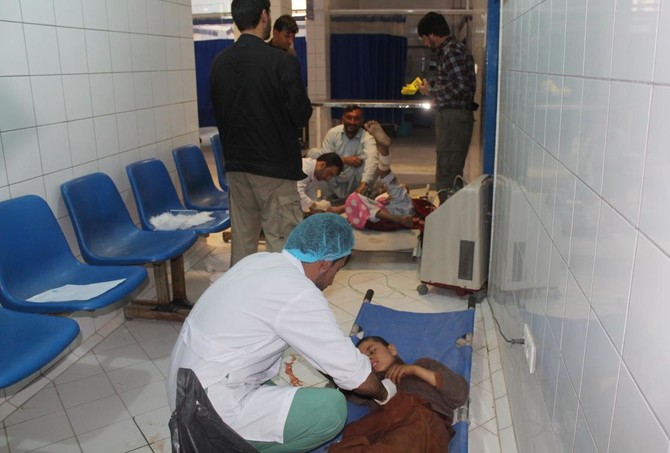
The lawmakers said several dozen people were killed, while an unconfirmed report from the province put the total number of dead and wounded at more than 150. One senator, Abdullah Qarloq, said civilians were among the victims, along with Taliban militants.
The Taliban also said a madrassa was hit, and that all the victims were civilians.
“Those responsible for killing civilians and insulting religion will be brought to justice,” said spokesman Zabihullah Mujahid in an email to Arab News.
A senior government official in Kabul denied that a religious school had been hit, and said all of the casualties were militants.
However, Patricia Gossman, a senior researcher for Human Rights Watch in Afghanistan, fears that many of those killed might have been civilians.
“Under laws of war, targeted killings must be carried out in compliance with principle of proportionality,” she wrote on Twitter. “This is latest incident in which airstrikes aimed at killing insurgent leaders may have disproportionately killed civilians.”
The attack comes a week after allegations that a group of civilian students in a seminary were killed in a similar air strike in western Farah province by an Afghan air force attack, and days after reports of civilian casualties in northeastern Badakhshan province.
Since assuming power over three years ago, President Ashraf Ghani’s government has mostly remained silent about civilian deaths in Afghanistan caused by Afghan government forces and the US-led coalition.
More than 40 patients and hospital staff were killed in sustained US air strikes on a French-run hospital in 2015 after the Taliban briefly captured Kunduz city.


Dozens killed by Afghan air strikes in northern Kunduz
Dozens killed by Afghan air strikes in northern Kunduz
- Defense Ministry chief spokesman General Mohammad Radmanesh said the army’s helicopters targeted a “concentration Taliban site”.
- The Taliban also said a madrassa was hit, and that all the victims were civilians.


UK cyclists to ride 550km in Saudi Arabia to save children with heart defects
- The H&K Cycle Club was the first team to take the Hejaz route, and their endeavour has since 2022 inspired hundreds of other cyclists to follow suit
- The cyclists expect to face scorching heat, brutal headwinds, sandstorms, and long no-U-turn stretches of roads, along with physical and mental exhaustion
LONDON: A cycling team from London set out on Sunday on a 550km journey from Makkah to Madinah in Saudi Arabia to raise funds for children in developing countries with congenital heart defects.
This is the fifth year that Shamsul Abdin, the head of the H&K Cycle Club, and 40 riders aged between 18 and 65, are taking on the challenge through the Hejaz region.
Abdin told Arab News that the “Hijrah Ride” was a replication of the journey made by Prophet Muhammad over 1,400 years ago, when he migrated from Makkah to Madinah, where he established the first city-state of Islam. This migration, known as Hijrah, also marked the beginning of the Islamic Hijri calendar.
The H&K Cycle Club has expanded from just six riders 14 years ago to more than 40 members from various cities across the UK, including London, Manchester, Oxford, and Birmingham. In November, they began their training in the freezing temperatures of the UK, aiming to cycle over 100 kilometers each day within 6 to 7 hours for a 4-day ride in Saudi Arabia. On Wednesday, they are expected to arrive in Madinah.

They have cycled throughout the UK and parts of Europe, riding from London to Istanbul to raise funds for various causes through Muntada Aid, a charity that works on projects in developing countries and organizes the “Hijrah Ride”.
They were also the first cycling team to take the Hejaz route, and their endeavour has since inspired hundreds of other cyclists to follow suit. Abdin has seen Saudi Arabia become more bike-friendly over the past five years, with cycling lanes integrated into city development, while drivers, locals, and authorities are now more aware of cyclists on the roads.
The cyclists expect to face scorching heat, brutal headwinds, sandstorms, and long no-U-turn stretches of roads, along with physical and mental exhaustion. For many riders, this will be their fifth ride in Hejaz. Some of them include Uber and bus drivers, business analysts, and even entrepreneurs, according to Abdin.
“The headwind feels like climbing a mountain; it’s a constant resistance. To overcome this challenge, we ride in a peloton, taking turns at the front. One person heads into the wind while the others line up behind, shielded from the gusts. After a while, we rotate, allowing everyone a chance to lead,” Abdin explained.
Almost £923,000 has been raised by the “Hijrah Ride” since its inception, to reach a target of one million pounds this year. Some of the money went into emergency aid programs in Gaza and Sudan. Muntada Aid aims to raise about £250,000 for its flagship project, “Little Hearts,” which will fund 150 surgeries for children with congenital heart defects in Pakistan and Bangladesh this year.
“I fell in love with this project, which gives children the opportunity to live up to their potential as adults, truly,” said Abdin, who was awarded the MBE (Member of the Order of the British Empire) in December for his contribution to charitable fundraising.

The riders will be escorted by two vehicles, one in front and one in the rear, carrying paramedics and media staff, along with food and water. They will split into two groups based on their cycling powers. Along the route, they will pass several locations, including Jeddah on the Red Sea, King Abdullah Economic City, Rabigh, Masturah, and Badr, before reaching the elevated roads of Madinah, where their journey, which started with performing Umrah in Makkah, will end.
Muntada Aid is a part of Al-Muntada Trust, which was founded in 1986 by a group of Middle Eastern students, including individuals from Qatar and Saudi Arabia, to address the famine crisis in Ethiopia. Since then, the organization has assisted children in 17 countries, including Somalia, Sudan, Chad, Kosovo, Bosnia, Bangladesh, Pakistan, Mali, and Niger. They focus on developing infrastructure in education, health, water and sanitation sectors.
Nasrun Mir, the marketing director of Muntada Aid, told Arab News that they support “Hijrah Ride” with financial backing and logistics, and that they have obtained permits through communication with the Saudi Ministry of Transport, the Ministry of Foreign Affairs, the Saudi embassy in London, and the British Consulate in Jeddah.

Mir, who is joining the journey as part of the media team this week, said that the reception in Saudi Arabia could not be friendlier.
“People offer us free food and drinks. They want to have conversations with us. They want to know what we do. In the Middle East, there is still no concept of using sports as a tool for charity. The general idea is that if I want to give money to the charity, I’ll give it to them. You don’t need to run. You don’t need to cycle,” Mir said.
In one incident, a local community prevented the riders from passing through their village unless they disembarked and sat down to eat with them. In particular sections of the road near Madinah, a Saudi police vehicle has escorted the riders for a few kilometers, he added.
“There have been incidents where people have stopped us from eating our own food during the break. They literally took our food and said, ‘No, you come to our village; you cannot eat your food. You have to have food, which we will prepare.’ This delayed ride for a couple of hours,” Mir said.


