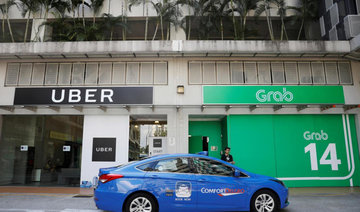
Malaysia puts Grab on anti-competition watchlist after Uber stake buy

Grab, a fast growing Southeast Asian ridesharing, food delivery and financial services business, said Monday that Uber will take a 27.5 percent stake in it and a seat on its board as part of the deal. (AP)
Updated 02 April 2018
Follow

Malaysia puts Grab on anti-competition watchlist after Uber stake buy

KUALA LUMPUR: Malaysia said on Monday that it will monitor ride-hailing firm Grab for possible anti-competitive behavior, after rival Uber Technologies Inc. offloaded its Southeast Asian operations to the Singapore-based firm.
Uber’s deal to take a 27.5 percent stake in Grab in exchange has raised a red flag with Singapore’s competition watchdog, which said on Friday it was investigating a suspected breach of competition law.
Malaysia’s Competition Commission would keep tabs on Grab, especially if the company imposed unfair practices or sudden fare increases, a government minister said.
“We won’t take it lightly. We will monitor this because it is still early days and we don’t know what will happen next,” said Nancy Shukri, whose portfolio oversees the public transport licensing authority.
“We have stressed that if there is any anti-competitive behavior, the Competition Act will come into force. We have spelt this out to them,” Nancy said, referring to a meeting with Grab representatives last Monday.
Uber and Grab announced the deal last Monday, marking the US company’s second retreat from an Asian market. It earlier sold off it’s operations in China.
Nancy said Grab, which is valued at about $6 billion, had offered assurances during their meeting last Monday that there would be no unfair pricing, nor would it increase its fares for now.
The minister said the merger, however, did not change the government’s working relationship with Grab in converting over 67,000 conventional taxi drivers nationwide to e-hailing platforms.
Nearly 14,000 taxi drivers had now either partially or fully migrated to e-hailing platforms, and the government would continue working with Grab to convince more to do the same.
“This is in the interest of the taxi industry, which has been around for a long time. At the same time, Grab needs our support, and we are there to assist them as well,” Nancy said.


Education spending surges 251% as students return from autumn break: SAMA

Updated 12 December 2025
Follow

Education spending surges 251% as students return from autumn break: SAMA

RIYADH: Education spending in Saudi Arabia surged 251.3 percent in the week ending Dec. 6, reflecting the sharp uptick in purchases as students returned from the autumn break.

According to the latest data from the Saudi Central Bank, expenditure in the sector reached SR218.73 million ($58.2 million), with the number of transactions increasing by 61 percent to 233,000.

Despite this surge, overall point-of-sale spending fell 4.3 percent to SR14.45 billion, while the number of transactions dipped 1.7 percent to 236.18 million week on week.

The week saw mixed changes between the sectors. Spending on freight transport, postal and courier services saw the second-biggest uptick at 33.3 percent to SR60.93 million, followed by medical services, which saw an 8.1 percent increase to SR505.35 million.

Expenditure on apparel and clothing saw a decrease of 16.3 percent, followed by a 2 percent reduction in spending on telecommunication.

Jewelry outlays witnessed an 8.1 percent decline to reach SR325.90 million. Data revealed decreases across many other sectors, led by hotels, which saw the largest dip at 24.5 percent to reach SR335.98 million. 

Spending on car rentals in the Kingdom fell by 12.6 percent, while airlines saw a 3.7 percent increase to SR46.28 million.

Expenditure on food and beverages saw a 1.7 percent increase to SR2.35 billion, claiming the largest share of the POS. Restaurants and cafes retained the second position despite a 12.6 percent dip to SR1.66 billion.

Saudi Arabia’s key urban centers mirrored the national decline. Riyadh, which accounted for the largest share of total POS spending, saw a 3.9 percent dip to SR4.89 billion, down from SR5.08 billion the previous week.

The number of transactions in the capital settled at 74.16 million, down 1.4 percent week on week.

In Jeddah, transaction values decreased by 5.9 percent to SR1.91 billion, while Dammam reported a 0.8 percent surge to SR713.71 million.

POS data, tracked weekly by SAMA, provides an indicator of consumer spending trends and the ongoing growth of digital payments in Saudi Arabia. 

The data also highlights the expanding reach of POS infrastructure, extending beyond major retail hubs to smaller cities and service sectors, supporting broader digital inclusion initiatives. 

The growth of digital payment technologies aligns with the Kingdom’s Vision 2030 objectives, promoting electronic transactions and contributing to the nation’s broader digital economy.