BEIRUT: Iyad Abdelaziz, a council member of the opposition-controlled town of Douma in the Eastern Ghotua suburbs of Damascus, said reports of an agreement to surrender the town to the central government are not true.
Abdelaziz said there was no agreement reached to have the Army of Islam rebel faction leave Douma for northern Syria and hand over the town to government forces.
He said, however, that “humanitarian cases” will be allowed to evacuate on Monday.
Douma has been besieged by regime forces since 2013. It was one of the earliest hubs of the Arab Spring-styled uprising against President Bashar Assad that swept through the country in 2011.
Hundreds of residents are believed to require care for war wounds and medical conditions exacerbated by the siege. The regime routinely blocks aid groups from evacuating patients from besieged areas for medical care.
An opposition official said the Army of Islam was still engaged in talks with Russia over the future of Douma. Russia is a key backer of the Syrian government.
Ahmad Ramadan said Turkey, which backs various Syrian opposition groups, and shares control over a part of opposition territory in north Syria, is also party to the talks.
The Syrian regime’s media earlier said fighters belonging to the Army of Islam group had agreed to evacuate their stronghold in the suburbs of Damascus, giving the regime complete control of the Eastern Ghouta region which has been rebel-held since 2011.
The Central Military Media outlet, which is linked to the Syrian military, said the Army of Islam had agreed to leave the town of besieged town of Douma for Jarablus, a town shared between rebel and Turkish control in north Syria.
It said a local council for Douma will be formed with the approval of the Damascus regime.
Douma was one of the earliest hubs of the uprising against President Bashar Assad in 2011. The security services responded by putting the town and other suburbs around Damascus under siege, bombing hospitals and residential areas, and blocking food and medical relief.
Douma is one of the last pockets of the opposition around the capital to hold out against the regime. The city’s fall would seal the rebels’ worst defeat since 2016.
The Britain-based Syrian Observatory for Human Rights monitoring group reported earlier in the day Russia’s military police would be deployed inside Douma to take custodianship of the town.
Opposition sources say Jaish Al-Islam officials have been desperately trying to strike a deal that would bring Russian military police into Douma, and let the group keep a role in maintaining internal security but under the state’s overall jurisdiction.
Russian military officers negotiating with Jaish Al-Islam told the group it accepted such an arrangement but the Syrian regime remained against it, a senior opposition source familiar with the talks said.
Russia was behind the main battle plan, directing elite forces and militias on the ground and calling in airstrikes from Syrian and Russian warplanes, two Western intelligence sources based in the region told Reuters this week.
The Syrian army last week warned the insurgents to surrender or face a military assault to drive them out.
The Syrian army command said on Saturday it had regained most of the towns and villages in Eastern Ghouta and was pressing its military operations in Douma.
The city’s fall would seal the rebels’ worst defeat since 2016.
The once bustling commercial hub on the outskirts of the capital was the main center of street protests in the Damascus suburbs against Assad’s rule that ignited the conflict more than seven years ago.
Defense analysts say a major goal of the regime’s campaign was to complete a security belt around the capital, where for years fighters dug into a network of tunnels and well-fortified positions resisted countless offensives to seize the enclave.
Many of the predominantly Sunni Muslim inhabitants of eastern Ghouta say they fear their displacement was part of a deliberate attempt to bring demographic changes in strategic areas that dilutes their presence in favor of Assad’s Alawite sect and other minorities.


![]()
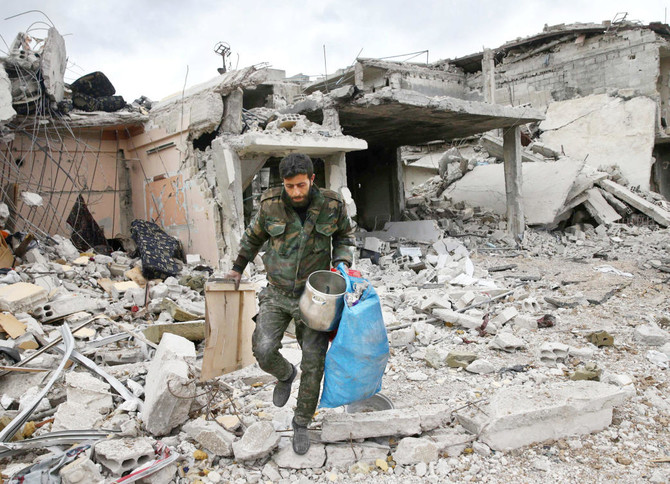
Syrian rebels deny deal over Ghouta town
Syrian rebels deny deal over Ghouta town

Latest updates


Recommended


© 2026 SAUDI RESEARCH & PUBLISHING COMPANY, All Rights Reserved And subject to Terms of Use Agreement.