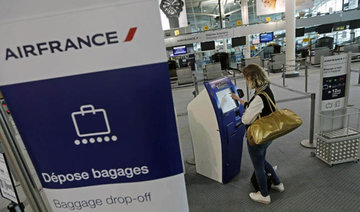
PARIS: French lawyers staged a walkout on Friday, while Air France staff went on strike over pay, adding to a growing wave of industrial unrest that threatens to slow President Emmanuel Macron’s reform drive.
Air France canceled a quarter of the day’s flights as its pilots, stewards and ground crew press for a pay rise. Courts were canceling hearings as lawyers, clerks and magistrates stopped work in protest at planned judicial reforms, among a slew of changes by the ambitious 40-year-old president angering sections of French society.
“The government’s plan at least has the benefit of being coherent — scrimping, cutting, sacrificing everything it can,” legal profession unions said in a joint statement before the protests on Friday afternoon.
Trade unions from the law profession complain that the court shake-up, which aims to streamline penal and civil proceedings and digitise the court system, will result in courts that are over-centralized and “dehumanized.”
They particularly object to the scrapping of 307 district courts and their judges, which they say will result in a judiciary that is “remote from the people.”
Meanwhile, staff at state rail operator SNCF will begin three months of rolling strikes, two days out of every five, on Monday night — just as many travelers are returning from an Easter weekend away.
The following day, refuse collectors will strike demanding the creation of a national waste service, energy workers will strike urging a new national electricity and gas service, and Air France staff will walk out again.
Various universities across the country have been disrupted for weeks by protests against Macron’s decision to introduce an element of selection to the public university admissions process.
Macron has so far avoided the mass industrial action suffered by his predecessor Francois Hollande.
But discord has been growing, with an estimated 200,000 taking to the streets last week in protests and walkouts by workers across the public sector angered by his reforms, including plans to cut 120,000 jobs.
Elected last May, the centrist former investment banker has pledged to shake up everything from France’s courts to its education system. At Air France, about 32 percent of pilots were set to join the walkout on Friday, along with 28 percent of cabin crew and 20 percent of ground staff, according to company estimates.
The French state owns 17.6 percent of the carrier as part of the Air France-KLM group, Europe’s second-biggest airline, which has been plagued by strikes and labor disputes in its French operations in recent years.
Eleven trade unions have already staged two Air France strikes on Feb. 22 and March 23 in demand of a 6 percent salary hike, with two more planned on April 3 and April 7. Unions argue the airline should share the wealth with its staff after strong results last year, but management insists it cannot offer higher salaries without jeopardizing growth in an intensely competitive sector.
“To distribute wealth we have to create it first,” chief executive Franck Terner told Le Parisien newspaper. Air France is set to bring in a 0.6 percent pay rise from April 1 and another 0.4 percent increase from Oct. 1, along with bonuses and promotions equivalent to a 1.4 percent raise for ground staff — seen by unions as inadequate.
An Air France spokesman said the airline was running 76 percent of planned flights on Friday, including 80 percent of long-haul departures. But at some French airports, such as Nice, as many as half of Air France flights were canceled.