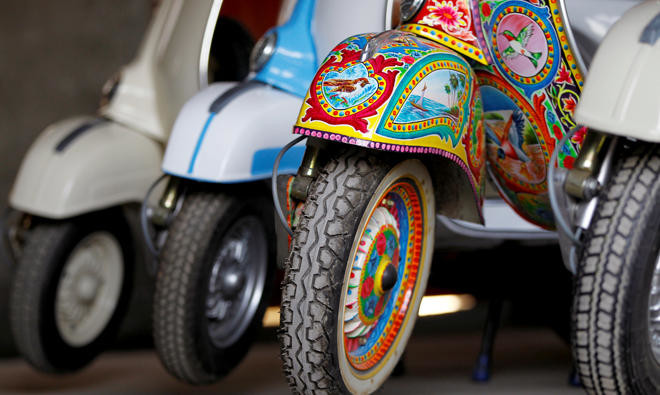
ISLAMABAD: As cheap Chinese-made motorbikes flood Pakistan's roads, fans of vintage Vespa scooters are scrambling to find spare parts and preserve models that hark back to a bygone era.
Piaggio's Italian two-wheeler was the ultimate status symbol for Pakistani bike aficionados in the 1960s and 70s, when bicycles outstripped motorbikes on the roads and only a handful of people could afford to import luxury items from
Europe.
Over the past two decades, motorbike ownership rates have skyrocketed in Pakistan, with locally assembled Chinese and Japanese bikes clogging up the roads in a country where much of the population is below the age of 30.
But for the likes of Zubair Ahmad Nagra, who runs the Vespa club in the eastern city of Lahore, new and more fuel-efficient bikes hold little allure.
He drives a Vespa, Italian for "wasp," imported into Pakistan by his father in 1974.
"It was the first motorized vehicle owned by my father," said Nagra. "I've been fond of it ever since."
Many long-term owners find that possessing a Vespa in Pakistan is a labor of love, with original spare parts scant and only a handful of mechanics skilled enough to restore the originals.
In Lahore, close to the Indian border, Vespa owners often have to settle for low quality Indian-made parts or ask for mechanics to fashion new pieces of bodywork from scratch.
Farrukh Shahbaz, who 14 years ago inherited his father's blue 1961 Vespa, has had to have the scooter repaired three times, but he cherishes the love his father had for the machine.
"My father told me it came packed in a wooden box," said Shahbaz, 50.
In the leafy capital Islamabad, once the oppressive summer heat wanes, a handful of Western diplomats can be seen buzzing around on their pastel-colored Vespas.
But they also are thin on the ground. Few expect the tide to turn, with cheap motorbike ownership transforming the lives of many poor and lower working class people in the rapidly urbanizing nation of 208 million people.
Nagra said Vespas were the second best gift Italy gave to the world - "the first being pizza" - as he recalled driving from Lahore to the Chinese border crossing at the Khunjerab Pass, some 15,397 feet (4,693 meters) above sea level in the Karakoram mountains.
"They have not let us down a single time," he said.

Labor of love: Vintage Vespa fans cling to the past in Pakistan
World of Coffee trade show capitalizes on Gulf’s strong coffee culture
DUBAI: Long regarded as the birthplace of coffee brewing, the Middle East is entering a new phase of cafe culture — and the fifth edition of World of Coffee, which takes place in Dubai from Jan. 18-20, will help drive that momentum.
Saudi Arabia alone is home to more than 5,100 branded cafes, with daily coffee consumption exceeding 36 million cups. Coffee is part of the social and cultural fabric, from traditional majlis gatherings to contemporary specialty cafes.
“Saudi Arabia’s coffee sector is evolving rapidly. There is increasing investment in quality, education, and presentation, alongside renewed interest in origin storytelling and cultural context,” said Shouq Bin Redha, exhibition manager for World of Coffee Dubai 2026, where Saudi Arabia will host a national pavilion.
“Saudi coffee has a very distinct identity rooted in heritage, ritual, and hospitality. Its profile is closely tied to traditional preparation methods and regional flavor preferences, which sets it apart on the global stage,” she told Arab News. “The national pavilion reflects this balance between tradition and modernization.”
Organized by DXB LIVE in partnership with the Specialty Coffee Association, World of Coffee Dubai has expanded dramatically, growing from 5,000 sq. meters in 2022 to more than 20,000 sq. meters in 2026. The event brings together producers, traders, roasters, cafe owners and innovators from around the world.
“At its core, the event is about bringing together the full coffee value chain in one place,” Redha said. “We want participants to leave not only having discovered new products or origins, but with stronger partnerships, clearer market insight, and a deeper understanding of how the industry is evolving.”
She added: “The Gulf has become an increasingly attractive market for producers because it combines strong consumer demand with a growing appreciation for quality, origin, and traceability.”
The UAE’s coffee market alone exceeds $3.2 billion, while Dubai continues to strengthen its position as one of the world’s most cafe-dense and diverse cities.
“Dubai, in particular, offers a unique gateway to multiple markets at once. For producers, World of Coffee Dubai provides direct access not only to local buyers, but to an international audience that uses the city as a regional and global trading hub,” Redha said.
When it comes to trends in the Gulf’s coffee scene, Redha said she expected to see “continued diversification in sourcing, with buyers exploring a broader range of origins and flavor profiles. There is also growing interest in coffees that offer greater transparency, whether through direct trade relationships, clearer traceability, or stronger sustainability credentials.”