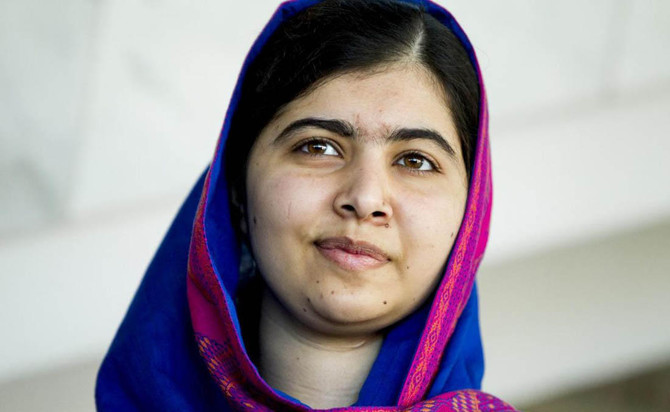
ISLAMABAD: Nobel peace laureate Malala Yousafzai returned to Pakistan on Thursday, officials said, in her first visit to her native country since she was shot in the head by a Taliban gunman for advocating education for girls in 2012.
Precize details of her itinerary have been “kept secret in view of the sensitivity surrounding the visit,” a government official said of the trip, which is expected to last four days and include a meeting with Prime Minister Shahid Khaqan Abbasi.
Accompanied by her parents, the 20-year-old Yousafzai was escorted through Islamabad’s Benazir Bhutto International Airport under tight security, according to still photographs broadcast on local television.
Malala has become a global symbol for human rights and a vocal campaigner for girls’ education since a gunman boarded her school bus in the Swat valley on October 9, 2012, asked “Who is Malala?” and shot her.
She was treated for her injuries in the British city of Birmingham, where she completed her schooling.
Winner of the Nobel Peace Prize in 2014, she has continued her campaigning while pursuing her studies at Oxford University.

Malala makes first trip to Pakistan since Taliban attack
Dozens of migrants brought to Malta after boat capsizes
- The group was rescued by Maltese armed forces boats and landed in Bugibba
- The migrants could be seen huddled in blankets
VALLETTA: Some 60 African migrants were brought to Malta on Friday after their boat capsized close to the Mediterranean island, one of the biggest groups to arrive in recent years.
The group was rescued by Maltese armed forces boats and landed in Bugibba, 10 miles north of Valletta. Eyewitnesses said several ambulances and many police were on the site.
The migrants could be seen huddled in blankets. Some were carried away on stretchers. Rescue officials said one of the arrivals was in poor medical condition.
Migrant arrivals on small boats in Malta have become relatively rare, with just over 200 coming in 2024 compared to more than 2,000 in 2020. Most leave from Libya, heading for Italy.
During a meeting in Malta on November 29, home affairs ministers from Cyprus, Greece, Italy, Spain and Malta declared that strengthening relations with countries of origin and transit was “key” to addressing irregular migration.
Maltese Home Affairs Minister Byron Camilleri said during the meeting: “Our position is to save people. If you deserve asylum, you will get it. If not, then you will be sent back.”
Most of Malta’s migrant arrivals now come to the island on flights from Italy, overstay and work irregularly.
Malta has been working with Libya to prevent migrant departures and has provided training for its coast guard. Camilleri told the ministers in November that every sea voyage taken by irregular asylum seekers carried a risk of death, thus, “by working with Libya and preventing crossings, we are also saving lives.”
“Europe must be the one to decide who comes in,” he said.