

Malala Yousafzai lauds feminism, equality at WEF in Davos

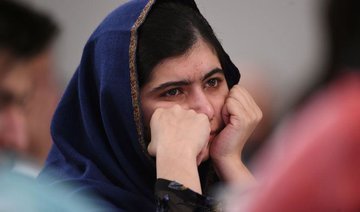
Nobel laureate Malala Yousafzai speaks during a panel discussion at the World Economic Forum in Davos. (AP)
Updated 26 January 2018
Follow

Malala Yousafzai lauds feminism, equality at WEF in Davos

DAVOS: Nobel peace laureate Malala Yousafzai on Thursday urged women to “change the world” without waiting for the help of men, as she addressed an audience of the global, and mostly male, elite at the World Economic Forum in Davos.
The 20-year-old global education campaigner spoke not long before the arrival in Davos of US President Donald Trump, who reached the White House a year ago despite revelations of inappropriate conduct toward women.
On Saturday across the United States, thousands of demonstrators took to the streets in a Women’s March to mark a year to the day since his inauguration.
The annual Davos conference, which unites the world’s business and political elite, also takes place this year in the shadow of the feminist #MeToo campaign that shook Hollywood and spread across the globe in 2017.

“We won’t ask men to change the world, we’re going to do it ourselves,” said Yousafzai.
“We’re going to stand up for ourselves, we’re going to raise our voices and we’re going to change the world,” she said.
Yousafzai, who was shot and nearly killed by the Taliban in her native Pakistan in 2012 for insisting on the right of girls to go to school, has become a global sensation, pleading for the education of women.
Winner of the Nobel Peace Prize in 2014, she has continued her campaigning while pursuing her studies at Oxford University.
“Feminism is just an other word for equality ... and no one will object to equality,” she said.
“It is very simple, it’s not as complicated as some people have made it.”

Greece seeks to toughen punishment for migrant smuggling

Updated 2 sec ago
Follow

Greece seeks to toughen punishment for migrant smuggling

ATHENS: Greece’s migration ministry on Saturday said it had submitted a new bill to parliament aimed at toughening penalties for migrant trafficking, including life sentences.
Greece was the main entry point into Europe for Syrian refugees at the height of Europe’s migration crisis in 2015.
There are several legal proceedings underway against aid workers and migrants accused of being people smugglers.
“Penalties for the illegal trafficking of migrants will be toughened at all levels,” the ministry said in a statement.
Sentences of up to life imprisonment are envisaged for smugglers, and migrants convicted of offenses may be directly expelled, it said.
Assistance provided to irregular migrants by migrants with regular status will also be criminalized, according to the proposals.
Migration Minister Thanos Plevris is a former member of a far-right party.
Penalties against NGO members prosecuted for migrant trafficking are also to be beefed up with prison sentences, the ministry said, adding that parliament will examine the bill next week.
In a joint statement, 56 NGOs, including the Greek branches of Doctors of the World and Doctors Without Borders, called for the immediate withdrawal of several articles that reclassify certain offenses as crimes, punishable by up to 10 years in prison and fines of tens of thousands of euros when a member of an organization is prosecuted.
They also decry the exorbitant power granted to the ministry, which can decide to remove an organization from the registry and end its work solely on the basis of charges brought against one of its members, without a conviction.
On January 15, 24 aid workers, including Sarah Mardini, a Syrian who, together with her Olympic swimmer sister inspired the 2022 film “The Swimmers,” were acquitted by a court on the island of Lesbos.
Charged with “forming a criminal organization” and “illegally facilitating the entry into Greece of foreign nationals from third countries,” they had faced up to 20 years in prison.
With this new law, the migration ministry aims to promote legal migration by easing hiring procedures for workers from third countries, creating a new visa for employees of high-tech companies, and issuing residence permits to students from third-world countries for the duration of their studies.
For asylum seekers and refugees, vocational training programs in sectors facing labor shortages, such as construction, agriculture, and tourism, are being introduced to support their entry into the job market.