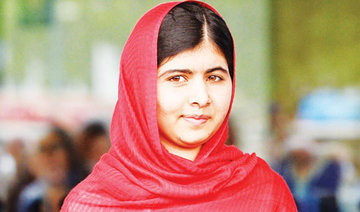
TORONTO: Nobel Peace laureate Malala Yousafzai returned to Canada on Wednesday to receive her honorary citizenship and address the country’s lawmakers after her first visit to Parliament in 2014 was put off because of a terror attack.
Prime Minister Justin Trudeau presented her with a framed certificate of citizenship. She’s only the sixth person to receive the honor and the youngest ever.
The 19-year-old Pakistani activist was 15 when she shot in the head by Taliban militants while returning from school. She was targeted for advocating women’s education.
She won world acclaim for her campaign and was awarded the Nobel Peace Prize in 2014.
Malala originally was scheduled to receive honorary citizenship in October 2014, but the Canadian Parliament was stormed by an armed terrorist that day. The gunman killed a soldier standing guard at Ottawa’s war memorial shortly before storming Parliament in an attack that was stopped cold when he was shot to death.
“The man who attacked Parliament Hill called himself a Muslim — but he did not share my faith. He did not share the faith of one and a half billion Muslims living in peace around the world. He did not share our Islam — a religion of learning, compassion and mercy,” she said to applause.
Malala also praised Canada for welcoming more than 40,000 Syrian refugees, and appeared to add an appeal to the US as well.
“I pray that you continue to open your homes and your hearts to the world’s most defenseless children and families,” she said, “and I hope your neighbors will follow your example.”
And she joked about Trudeau, Canada’s 45-year-old prime minister.
“People are always talking about how young he is. They say he is the second youngest prime minister in Canada’s history. He does yoga, he has tattoos,” she said. “When I was coming here everyone was telling me to shake his hand and let us know how he looks in reality. People were just so excited for me to meet Trudeau. I don’t think anyone cared about the Canadian honorary citizenship.”
The other five honorary citizens are the Dalai Lama, the Aga Khan, Nelson Mandela, Burmese activist Aung San Suu Kyi and Swedish diplomat Raoul Wallenberg.

Malala Yousafzai given honorary Canadian citizenship
Trump sues the BBC for defamation over editing of January 6 speech, seeks up to $10 billion in damages
- A BBC spokesperson told Reuters earlier on Monday that it had “no further contact from President Trump’s lawyers at this point
- The BBC is funded through a mandatory license fee on all TV viewers, which UK lawyers say could make any payout to Trump politically fraught
WASHING: President Donald Trump sued the BBC on Monday for defamation over edited clips of a speech that made it appear he directed supporters to storm the US Capitol, opening an international front in his fight against media coverage he deems untrue or unfair. Trump accused Britain’s publicly owned broadcaster of defaming him by splicing together parts of a January 6, 2021 speech, including one section where he told supporters to march on the Capitol and another where he said “fight like hell.” It omitted a section in which he called for peaceful protest.
Trump’s lawsuit alleges the BBC defamed him and violated a Florida law that bars deceptive and unfair trade practices. He is seeking $5 billion in damages for each of the lawsuit’s two counts. The BBC has apologized to Trump, admitted an error of judgment and acknowledged that the edit gave the mistaken impression that he had made a direct call for violent action. But it has said there is no legal basis to sue.
Trump, in his lawsuit filed Monday in Miami federal court, said the BBC despite its apology “has made no showing of actual remorse for its wrongdoing nor meaningful institutional changes to prevent future journalistic abuses.”
The BBC is funded through a mandatory license fee on all TV viewers, which UK lawyers say could make any payout to Trump politically fraught.
A spokesman for Trump’s legal team said in a statement the BBC “has a long pattern of deceiving its audience in coverage of President Trump, all in service of its own leftist political agenda.”
A BBC spokesperson told Reuters earlier on Monday that it had “no further contact from President Trump’s lawyers at this point. Our position remains the same.” The broadcaster did not immediately respond to a request for comment after the lawsuit was filed.
CRISIS LED TO RESIGNATIONS
Facing one of the biggest crises in its 103-year history, the BBC has said it has no plans to rebroadcast the documentary on any of its platforms.
The dispute over the clip, featured on the BBC’s “Panorama” documentary show shortly before the 2024 presidential election, sparked a public relations crisis for the broadcaster, leading to the resignations of its two most senior officials.
Trump’s lawyers say the BBC caused him overwhelming reputational and financial harm.
The documentary drew scrutiny after the leak of a BBC memo by an external standards adviser that raised concerns about how it was edited, part of a wider investigation of political bias at the publicly funded broadcaster.
The documentary was not broadcast in the United States.
Trump may have sued in the US because defamation claims in Britain must be brought within a year of publication, a window that has closed for the “Panorama” episode.
To overcome the US Constitution’s legal protections for free speech and the press, Trump will need to prove not only that the edit was false and defamatory but also that the BBC knowingly misled viewers or acted recklessly.
The broadcaster could argue that the documentary was substantially true and its editing decisions did not create a false impression, legal experts said. It could also claim the program did not damage Trump’s reputation.
Other media have settled with Trump, including CBS and ABC when Trump sued them following his comeback win in the November 2024 election.
Trump has filed lawsuits against the New York Times, the Wall Street Journal and a newspaper in Iowa, all three of which have denied wrongdoing. The attack on the US Capitol in January 2021 was aimed at blocking Congress from certifying Joe Biden’s presidential win over Trump in the 2020 US election.