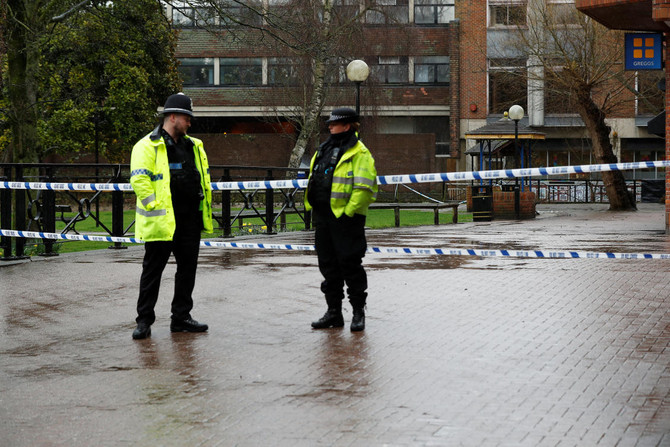
LONDON: British police said on Wednesday the former Russian double agent Sergei Skripal and his daughter may have been exposed to a suspected nerve agent at the front door of their home.
“At this point in our investigation, we believe the Skripals first came into contact with the nerve agent from their front door,” Dean Haydon, head of the Metropolitan Police’s Counter Terrorism Command. “We are therefore focusing much of our efforts in and around their address.”

British police say Russian spy may have been poisoned at home

Philippines discovers new gas deposit to boost depleted reserves
- Source near Malampaya field believed to contain 2.8 billion cubic meters of gas
- It will not take much time to access the gas, expert says, as infrastructure is ready
MANILA: The Philippines on Monday announced a new natural gas discovery, with the reservoir near the country’s largest offshore site estimated to be enough to power about 5.7 million households per year.
About 2.8 billion cubic meters (98 billion cubic feet) of gas were found 5km east of the Malampaya field near the island of Palawan, President Ferdinand Marcos Jr. said in a Facebook video.
“This is equivalent to nearly 14 billion kilowatt-hours of electricity per year. That means it could supply power to more than 5.7 million households, 9,500 buildings, or nearly 200,000 schools,” Marcos said.
“This helps Malampaya’s contribution and strengthens our domestic gas supply for many years to come. Initial testing showed that the well flowed at 60 million cubic feet (1.7 million cubic meters) per day.”
Malampaya, discovered in 1989 and operational since 2001, is the Philippines’ most important natural gas field, located off the west coast of Palawan Island. It is also a key part of the country’s energy infrastructure.
It supplies natural gas for electricity generation in Luzon, the main island of the Philippines, powering several major plants.
Prime Energy Resources Development, which manages the Malampaya project, said in a statement that the new reservoir, Malampaya East-1, was discovered by a “a fully Filipino-led team, reflecting the country’s growing capability in upstream energy development.”
Prime Energy’s well data indicate that Malampaya East-1 volumes are equivalent to about one-third of the remaining producible gas volumes at the original Malampaya.
Against the backdrop of Malampaya’s decline, it will help to secure the country’s gas supplies. It will also keep operational the expensive infrastructure that was installed to operate the legacy field.
“The original Malampaya was like 2.3 trillion cubic feet, so it’s like 4 percent of the original find. I still think that is significant in light of the decline of the Malampaya gas field,” said Alberto Dalusung III, energy transition adviser at the Institute for Climate and Sustainable Cities.
The new gas discovery benefits from ready access to processing facilities such as the 504 km undersea pipeline that was built for Malampaya, which will make it available sooner.
Dalusung estimated it would take up to two years for Filipino consumers to benefit from the new resources.
“The infrastructure is already there,” he said. “You don’t have to build the pipeline. All you have to do is find new gas resources, which we did.”