BRUSSELS: British Prime Minister Theresa May urged European Union leaders on Thursday to unite and condemn Russia for not respecting international rules or borders, while Moscow slammed the UK as untrustworthy in its investigation of the poisoning of a former spy.
Amid heated words and frosty relations between London and Moscow, May accused Russia of staging “a brazen and reckless attack against the United Kingdom” by attacking Sergei Skripal and his daughter Yulia with a nerve agent on March 4 in the English city of Salisbury.
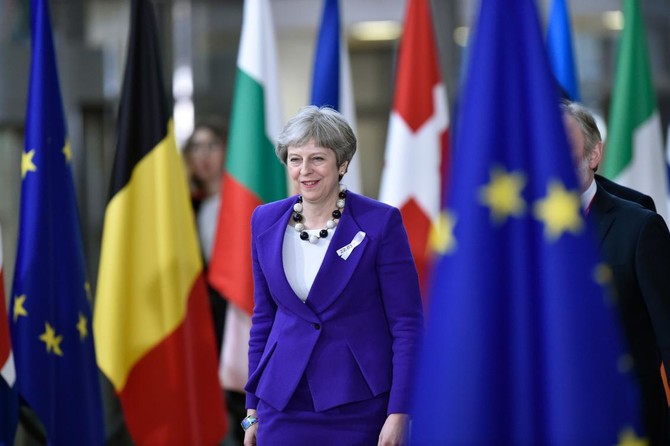
“I will be raising this issue with my counterparts today because it is clear that the Russian threat doesn’t respect borders and indeed the incident in Salisbury was part of a pattern of Russian aggression against Europe and its near neighbors, from the western Balkans to the Near East,” May said as she arrived an EU summit in Brussels.
Britain blames Moscow for the attack with a military-grade nerve agent and has called Russia a growing threat to Western democracies. Russia has fiercely denied the accusations.
Both nations have expelled 23 of each other’s diplomats in a feud that shows no signs of cooling.
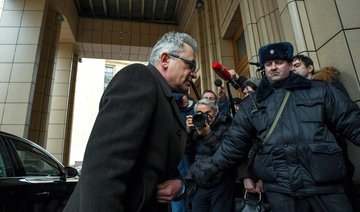
Russia’s ambassador to the UK, Alexander Yakovenko, hit back Thursday, saying his country “can’t take British words for granted,” and accusing the UK of having a “bad record of violating international law and misleading the international community.”
It is clear that the Russian threat doesn’t respect borders and indeed the incident in Salisbury was part of a pattern of Russian aggression against Europe and its near neighbors, from the western Balkans to the Near East.
Theresa May
“History shows that British statements must be verified,” he told reporters in London. “We demand full transparency of the investigation and full cooperation with Russia” and the Organization for the Prohibition of Chemical Weapons.
Britain says it is complying with the international chemical-weapons watchdog over the March 4 attack on Skripal — a former Russian intelligence officer convicted of spying for the UK — and his daughter.
Experts from the OPCW have come to Britain to take samples of the nerve agent that has left the Skripals in critical condition.
May wants nations at the EU summit in Brussels to make a strong statement against Russian President Vladimir Putin. EU foreign ministers have already expressed their “unqualified solidarity” with Britain, but May will try to swing the 27 other EU leaders behind a more strongly worded statement that explicitly condemns Russia.
European politicians and leaders vary in how far they are willing to go in blaming Putin’s Kremlin.
Lithuanian President Dalia Grybauskaite, whose former Soviet state shares a border with Russia’s Kaliningrad exclave, offered her full backing to Britain and said she was weighing whether to expel Russian diplomats from her country over the Salisbury attack.
German politician Manfred Weber, leader of the biggest group in the European Parliament, said Putin “wants to destabilize the European idea, European cooperation, and that’s why we don’t have to be naive, we have to be strong.”
Greek Prime Minister Alexis Tsiprias was more cautious. He said “we have to express our solidarity to the UK, to the British people, but at the same time we need to investigate.”
Luxembourg Prime Minister Xavier Bettel, a former criminal lawyer, said he wanted to hear what May had to say.
“I have the principle that first I listen, and then I take a decision,” he said.
EU Council President Donald Tusk is seen by the UK as supportive, saying this week that Europe must “reinforce our preparedness for future attacks.”
But British officials are irked that another EU chief, European Commission President Jean-Claude Juncker, congratulated Putin on his victory in Sunday’s presidential election in Russia. Election monitors say the Russian vote did not take place on a level playing field since state media gave so much coverage to Putin.
The Salisbury attack has sent relations between London and Moscow to Cold War-style lows.
On Wednesday, British Foreign Secretary Boris Johnson said it was “emetic” — vomit-inducing — that Putin is rejoicing over hosting the World Cup soccer tournament this summer. Russia responded that Johnson was “poisoned with venom of malice and hate.”
Johnson also said Russia’s hosting of the June 14-July 15 tournament could be compared to the 1936 Olympics, which was used as propaganda exercise by Nazi Germany.
Putin’s spokesman Dmitry Peskov called the comparison an “utterly disgusting statement which is unworthy of a foreign minister of any country.” He called Johnson’s words “insulting and unacceptable.”