E-policing gradually takes off in Khyber Pakhtunkhwa

1 / 4
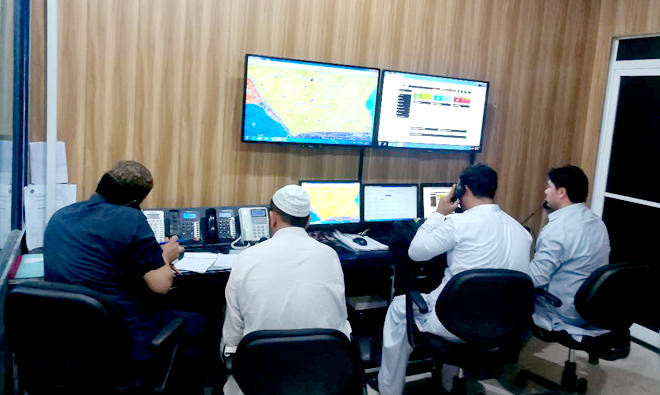
A view of the control room where staffers receive the Android-based reports and complaints from the public. (AN Photo)
2 / 4
A view of the Data Analysis Section in police lines where staffers receive the feedback from police stations after they are processed by the control room.
3 / 4
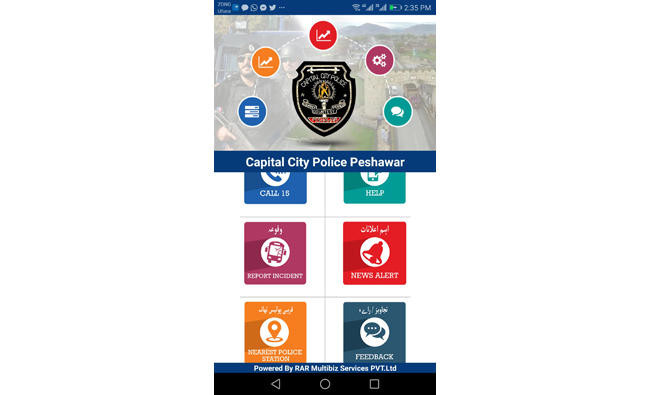
A screenshot of the police android application. (AN photo)
4 / 4
A screenshot of the police android application. (AN photo)
Updated 24 March 2018
Follow

E-policing gradually takes off in Khyber Pakhtunkhwa

PESHAWAR: Since the launch of Khyber Pakhtunkhwa police’s Android app on March 22, the law enforcement agency has received 164 public “complaints,” or calls, said Muhammad Imran, who helps to manage the app’s backend operations, on Saturday. Out of all those calls, he added, 127 were sent to the relevant police stations while 37 were still pending.
The app was launched to bridge the gap between police officials and the residents of the province. It’s available on the department’s website, and people can use it on their smartphones to report crimes and road accidents.
Superintendent Police (SP) Peshawar City Shahzada Kokab Farooq said the app had significantly improved the response time of his department.
“Depending upon the success of this app in Peshawar, we may also introduce it in other districts,” he added.
Farooq said: “It is much easier to manage 40 complaints that arrive through this app than handle 20 people who physically visit police stations with their grievances.”
The KP police have also set up a control room to deal with the public complaints arriving digitally. It consists of two big plasma screens, several computers, telephone lines and is managed by four staff members.
Imran, the control room operator, said that the app gave each complaint or report a unique ID.
“We copy the ID from one plasma screen and paste it in the search box of a map in the other. This highlights the area where the complaint or report has originated. It also reveals the contact number of the sender,” he added.
After this step, he said, the control room operators need to mark these complaints to the station house officer of the relevant police station, who directly receives the report.
Assistant Director at the Data Analysis Wing of the city’s police lines, Asfandyar Khan, told Arab News there were eight staff members managing the Android app. “Four of them receive public complaints in the control room,” he said. “The other four work in the data analysis section to monitor the process and get feedback from relevant police stations on the digitally received complaints.”


Pakistan says military operation concluded in Balochistan, 216 militants killed 

Updated 8 sec ago
Follow

Pakistan says military operation concluded in Balochistan, 216 militants killed 

  • Separatist BLA militant group claimed responsibility for coordinated attacks across Balochistan last week 
  • Military says 36 civilians, 22 law enforcement and security forces personnel have been killed in attacks 

PESHAWAR: Pakistani forces have concluded a security operation in the southwestern Balochistan province and killed 216 militants after a series of coordinated attacks by separatist militants last week, the military’s media wing said on Thursday. 

Separatist militant group Baloch Liberation Army (BLA) claimed responsibility for a series of attacks in Balochistan last Friday and Saturday in multiple districts across the province, one of the deadliest flare-ups in the area in recent years. 

Pakistan military’s media wing, the Inter-Services Public Relations (ISPR), said security forces launched operations in Panjgur and Harnai district’s outskirts on Jan. 29 based on intelligence confirming the presence of “terrorist elements,” killing 41 militants. 

It said the military launched a broader series of intelligence-based operations in multiple areas of the province after that to dismantle “terrorist sleeper cells,” referring to it as “Operation Radd-ul-Fitna-1.”

“As a result of these well-coordinated engagements and subsequent clearance operations, 216 terrorists have been sent to hell, significantly degrading the leadership, command-and-control structures and operational capabilities of terrorist networks,” the ISPR said in a statement.

The military said 36 civilians, including women and children, were killed by militants while 22 security forces and law enforcement personnel also lost their lives. 

The ISPR said a substantial cache of foreign-origin weapons, ammunition, explosives and equipment were also recovered during the counteroffensive operations. 

“Preliminary analysis indicates systematic external facilitation and logistical support to these extremist proxies,” the statement said. 

The military said Pakistan’s armed forces remain steadfast in their resolve to combat “terrorism,” vowing that counterterror operations will continue until militants are completely eliminated. 

“Operation Radd-ul-Fitna-1 stands as a testament to Pakistan’s and particularly Balochistan’s proud peoples’ unwavering commitment to always prefer peace over violence, unity over division and development over violence,” the ISPR said. 

Pakistan’s government has accused India of being behind the militant attacks in Balochistan, charges that New Delhi has rejected as “baseless.”

Balochistan, Pakistan’s largest province by land area, has long faced a separatist insurgency that has intensified in recent years. Militants frequently target security forces, government officials, infrastructure projects, foreigners and non-local workers.

The province holds vast reserves of minerals and hydrocarbons and is central to the multibillion-dollar China-Pakistan Economic Corridor (CPEC), a flagship component of China’s Belt and Road Initiative.

Separatist groups such as the BLA accuse Islamabad of exploiting Balochistan’s natural resources while denying locals a fair share. Pakistan’s civilian and military leadership reject the claim and say they are investing in the province’s development.