Riyadh, Dubai join world’s cities for Earth Hour climate campaign

1 / 7
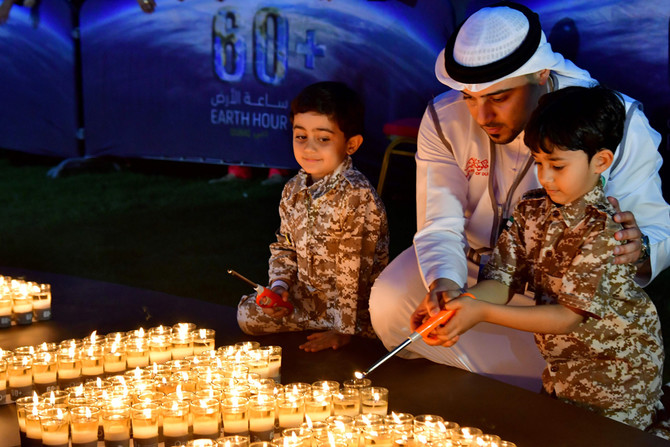
A man and two children light candles after the building lights were switched off for the Earth Hour environmental campaign in Dubai. Earth Hour, which started in Australia in 2007, is set to be observed by millions of supporters in 187 countries, who will turn off their lights at 8.30pm local time in what organizers describe as the world’s ‘largest grassroots movement for climate change.’ (AFP)
2 / 7
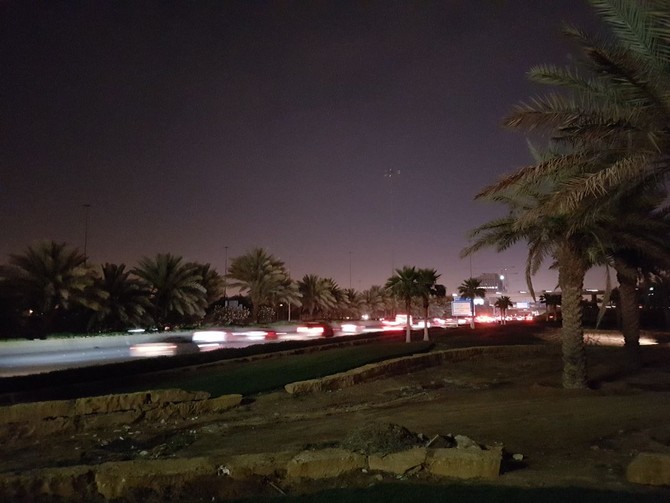
The lights go out in Riyadh for Earth Hour. Photo: Al Ekhbariya
3 / 7
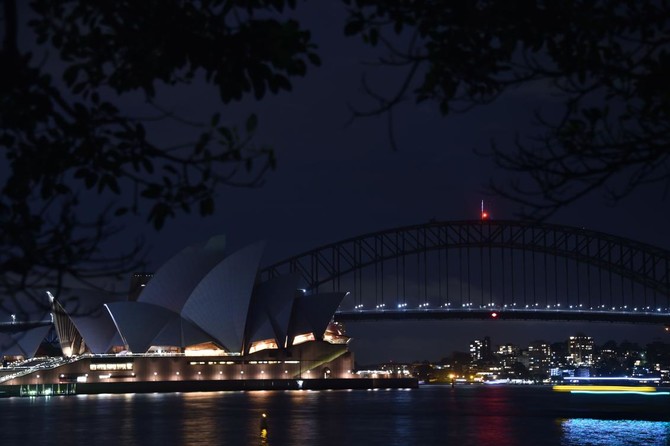
Sydney Harbor Bridge and the Opera House are plunged into darkness for Earth Hour. The lights went out on two of Australia’s most famous landmarks for the 11th anniversary of the climate change awareness campaign. (AFP)
4 / 7
The lights go out in Riyadh for Earth Hour. Photo: Al Ekhbariya
5 / 7
The lights go out in Riyadh for Earth Hour. Photo: Al Ekhbariya
6 / 7
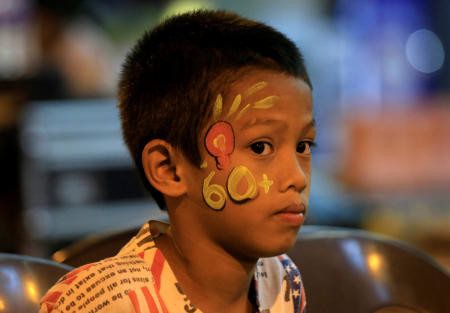
Photo of a boy with number 60 painted on his face, representing the 60 minutes of Earth Hour, is seen outside a mall in Bacoor, Philippines. (Reuters)
7 / 7
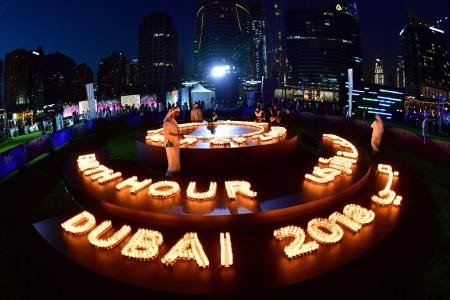
Photo showing Dubai celebration of 'Earth Hour' 2018. (Reuters)
Updated 25 March 2018
Follow

Riyadh, Dubai join world’s cities for Earth Hour climate campaign

LONDON: Dubai joined other global cities in switching off the lights to mark Earth Hour and highlight the dangers of climate change.
Participants lit candles in proximity to the Burj Khalifa, the world’s tallest building, to create some natural light as the switch was flipped in the UAE’s commercial hub.
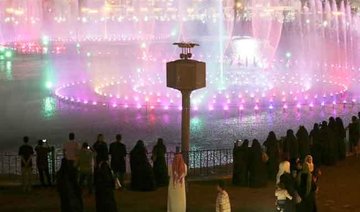
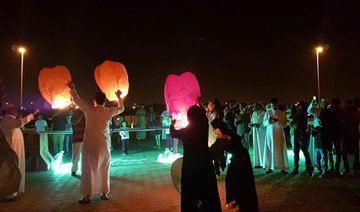
Riyadh also played its part in the campaign by switching off artificial light, where possible, right across the city.
The Sydney Opera House and Harbor Bridge kicked off the day that sees landmark buildings around the world dim their lights to raise awareness about the impacts of climate change.
Earth Hour, which started in Australia in 2007, is being observed by millions of supporters in 187 countries, who are turning off their lights at 8.30pm local time in what organizers describe as the world’s “largest grassroots movement for climate change.”
“It aims to raise awareness about the importance of protecting the environment and wildlife,” Earth Hour organizer WWF Australia chief Dermot O’Gorman told AFP.
Images from across Asia showed buildings including Kuala Lumpur’s Petronas Towers, as well as the famous harbor skylines of Hong Kong and Singapore, being plunged into darkness to mark the occasion.
Other global landmarks that will take part include Beijing’s Bird’s Nest Olympic stadium, the Eiffel Tower in Paris, the Pyramids of Egypt and New York’s Empire State Building.
With global temperatures the highest on record, O’Gorman said this year’s theme was the impact of climate change on biodiversity and plant and animal species.
“More than half of plant and animal species face local extinction in some of the world’s most naturally rich areas in biodiversity by the turn of this century if we continue along the current path that we are trending in terms of global warming,” he said.
Species at risk include Australia’s green turtles, black-flanked rock wallabies and koalas, as well as the Adelie penguin colonies in Antarctica, the conservation group said in a report it commissioned that was published in the science journal Climatic Change.
The analysis, released last week, said key biodiverse sites around the world projected to be most affected by localized extinction include the Amazon, the plant’s largest tropical rainforest, and southern Africa’s Miombo Woodlands.
While the lights-off event is a symbolic gesture, Earth Hour has led successful campaigns over the past decade to ban plastics in the Galapagos Islands and plant 17 million trees in Kazakhstan.
Sydneysider Dianna Ali, who was having dinner with family as the lights went off in the city, said the initiative had made her more aware of the impact of her lifestyle on the planet’s health.
“Since Earth Hour started, it’s made me more conscious of how much power I’m using,” she told AFP.
“I think... about how much one individual can make a difference.”


Documentary highlights Israeli brutality

Updated 5 sec ago
Follow

Documentary highlights Israeli brutality

  • ‘American Doctor’ shows bravery of men voluntarily going to work in hospitals repeatedly hit by Israeli army
  • Despite a fragile ceasefire in place since October last year, there has been continued violence between Israeli forces and Hamas, which has seen Palestinian non-combatants killed, including dozens of children

PARK CITY, US: At the start of “American Doctor,” a new documentary about US medics working in hospitals in the Gaza Strip during the Israel-Hamas war, director Poh Si Teng initially declines to film pictures of dead Palestinian children that one of the doctors is trying to show her.

Teng worries that she will have to pixelate the gruesome scene to protect the dignity of the children.
“You’re not dignifying them unless you let their memory, their bodies, tell the story of this trauma, of this genocide. You’re not doing them a service by not showing them,” Jewish-American doctor Mark Perlmutter tells her.
“This is what my tax dollars did. That’s what your tax dollars did. That’s what my neighbor’s tax dollars did. They have the right to know the truth.
“You have the responsibility, as I do, to tell the truth. 
You pixelate this, that’s journalistic malpractice.”
Teng’s unflinching film follows Perlmutter and two other American doctors — one Palestinian American and the other a non-practicing 
Zoroastrian — as they try to treat the results of the unspeakable brutality visited on a largely civilian population in Gaza since Israel launched its retaliation for Hamas’s October 2023 attack.
Alongside the severed limbs and the open wounds, the doctors labor on with their Palestinian colleagues, we also see the trio’s attempts at advocacy — in Washington’s corridors of power and in Israeli and American media.
The documentary also depicts the practical difficulties they face — the surgical scrubs and antibiotics they have to smuggle across the border 
to get around the Israeli blockade, and the last-minute refusals of Israeli authorities to let them in.
And we see the bravery of men voluntarily going to work in hospitals that are repeatedly hit by the Israeli army.
Israel rejects accusations its numerous strikes against Gaza hospitals amount to war crimes, saying it is targeting “terrorists” in these facilities and claims Hamas operatives are holed up in tunnels underneath the hospitals.
The attacks include the so-called “double tap” strike on the Nasser Hospital in Khan Younis, in the south of the Strip, in August 2025 where the three men have worked.
Emergency responders and journalists who had rushed to the scene after a first projectile hit were killed when a second was fired at the same spot.
Feroze Sidwha, perhaps the most eloquent of the three doctors, repeatedly makes the case throughout the film that he has never seen any tunnels and that, in any case, even the presence of wounded fighters in a hospital does not make it a legitimate target.
“Americans deserve the opportunity to know what’s going on, what their money is being used for, and you know, just to decide. ‘Do you really want this being done?’,” he said at the Sundance Film Festival, where the film got its premiere on Friday.
“I’m pretty sure the answer is ‘no’. I just want to keep speaking out and letting people know they don’t have to be an accessory to child murder. But we all are, right now.”
The film is dedicated to the around 1,700 healthcare workers who have been killed since Israel launched its invasion in October 2023.
UN investigators have accused Israel of committing genocide in Gaza, a charge that Israel has denied as “distorted and false,” while accusing the authors of antisemitism.
Despite a fragile ceasefire in place since October last year, there has been continued violence between Israeli forces and Hamas, which has seen Palestinian non-combatants killed, including dozens of children, according to UNICEF.
Reporters Without Borders says nearly 220 journalists have died since the start of the war, making Israel the biggest killer of journalists worldwide for three years running.
The Sundance Film Festival runs until Feb. 1.