BEIJING: China announced a $3 billion list of US goods for possible retaliation in a tariff dispute with President Donald Trump and prepared on Friday for a bigger battle over technology policy as financial markets sank on fears of global disruption. The Commerce Ministry said higher duties on pork, apples, steel pipe and other goods would offset Chinese losses due to Trump’s tariff hike on steel and aluminum imports. It urged Washington to negotiate a settlement but set no deadline. In a separate and potentially bigger dispute, the ministry criticized Trump’s decision on Thursday to approve a possible tariff hike on Chinese imports worth up to $60 billion over Beijing’s technology policy. It gave no indication of a possible response but a foreign ministry spokeswoman said Beijing was “fully prepared to defend” its interests.
“We don’t want a trade war, but we are not afraid of it,” said the spokeswoman, Hua Chunying.
Financial markets sank on concern the escalating tensions might disrupt the biggest global trading relationship or lead other nations to raise import barriers.
Tokyo’s benchmark tumbled by an unusually large 5.1 percent while the Shanghai Composite Index closed down 3.4 percent.
The dollar dipped to 104.90 yen as investors shifted into the Japanese currency, which is viewed as a “safe haven” from risk.
China’s response on Friday appeared to be aimed at increasing domestic US pressure on Trump by making clear which exporters, including farm areas that voted for him in 2016, might be hurt.
“Beijing is extending an olive branch and urging the US to resolve trade disputes through dialogue rather than tariffs,” said economist Vishnu Varathan of Mizuho Bank in a report. “Nevertheless, the first volley of shots and retaliatory response has been set off.”
The list announced on Friday was linked to Trump’s steel and aluminum tariffs, but companies already were looking ahead to a battle over complaints Beijing steals or forces companies to hand over technology.
The tensions reflect the dueling nationalistic ambitions of Trump and his Chinese counterpart, Xi Jinping.
US efforts to boost exports of technology-based goods, begun under Trump’s predecessor, Barack Obama, conflict with China’s plan for state-led development of global competitors in fields from robotics to electric cars. Foreign business groups complain Chinese regulators are trying to squeeze them out of promising industries. The Commerce Ministry announcement on Friday made no mention of jetliners, soybeans or other products that are the biggest US exports to China by value. That leaves Beijing room to take more drastic steps.
Chinese officials are trying to figure out how to address US concerns, said Jake Parker, vice president for China operations of the US-China Business Council, which represents American companies that do business with China.
“Until the Trump administration articulates those concerns and how China can address them, it’s going to be very, very difficult for China to make those changes,” said Parker.
Washington doesn’t believe it needs to give Chinese leaders another list of requests because they already know what the US wants, said a senior US official, who briefed reporters on condition he not be identified further. He said Trump and Xi agreed last year on a 100-day agenda of trade-liberalization measures but Beijing failed to act on about half of them.
Instead, the Trump administration wants Chinese leaders to address more basic structural issues that interfere with market forces, said the official.
The official cited Beijing’s “Made in China 2025” plan as “hugely problematic.” It calls for creating Chinese competitors in electric cars, robots, artificial intelligence and other fields. Business groups complain it will hamper or outright block foreign access to those industries.
The latest proposed Chinese tariffs would add a 25 percent charge on pork and aluminum scrap, mirroring Trump’s 25 percent duty on steel, according to the Commerce Ministry. A second list of goods including wine, apples, ethanol and stainless steel pipe would be charged 15 percent.
Chinese purchases of those goods last year totaled $3 billion, the ministry said.
The US steel and aluminum tariffs also have irked Japan, America’s closest ally in Asia.
“We have repeatedly told the US side that steel and aluminum imports from its ally Japan will not adversely affect America’s national security, and that Japan should be excluded,” said Chief Cabinet Secretary Yoshihide Suga.
China’s top economic official, Premier Li Keqiang, appealed to Washington on Tuesday to “act rationally” and said, “we don’t want to see a trade war.”
The US buys little Chinese steel or aluminum, but analysts have said Beijing would feel obligated to take action to avoid looking weak.
Beijing reported a trade surplus of $275.8 billion with the US last year, or two-thirds of its global total. Washington reports different figures that put the gap at a record $375.2 billion.
Trump’s technology order is in response to “unfair and harmful acquisition of US technology,” said a statement by the US Trade Representative’s office. It said USTR would pursue a World Trade Organization case against Beijing’s “discriminatory technology licensing.”
A USTR statement said possible measures include a 25 percent tariff on Chinese-made aerospace, computer and information technology and machinery but gave no details.
China is unlikely to respond until Washington acts but might launch an investigation of imports of US corn and soybeans “as a warning shot,” said Parker. He noted Beijing began a probe of US sorghum in February after Trump announced the steel and aluminum tariffs.
On Tuesday, the Chinese premier promised at a news conference Beijing will “open even wider” to imports and investment as part of efforts to make its state-dominated economy more productive.
Li said Beijing would “fully open” manufacturing, with “no mandatory requirement for technology transfers.” However, Chinese officials already insist companies are not required to hand over technology, so it was unclear how policy might change.


![]()
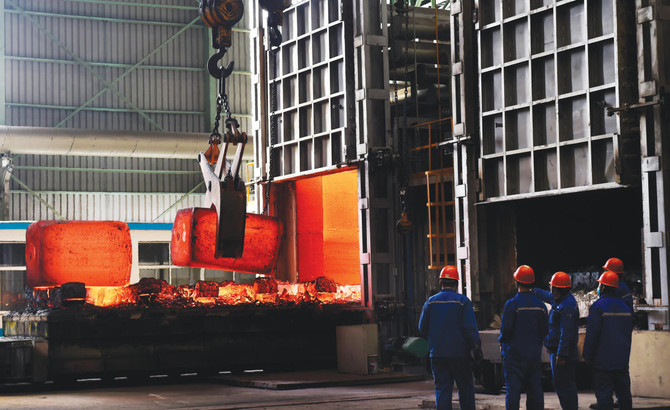
China targets $3 billion of US goods in tariff stand-off
China targets $3 billion of US goods in tariff stand-off

Latest updates


© 2026 SAUDI RESEARCH & PUBLISHING COMPANY, All Rights Reserved And subject to Terms of Use Agreement.