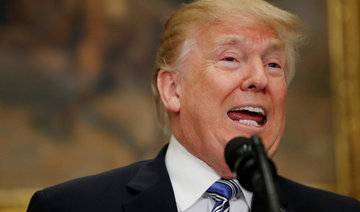
WASHINGTON: President Donald Trump is considering sweeping tariffs on imports from China, with an announcement possible as early as next week.
The move has industry groups and some lawmakers scrambling to prevent the next front in a potential trade war that could reverberate across the US economy.
Early indications from the White House have officials braced for tariffs across a wide variety of consumer goods, from apparel to electronics, and even on imported parts for products made in the US.
The size and scope of the tariffs remain under debate, but the US Chamber of Commerce is warning that annual tariffs of as much as $60 billion on Chinese goods would be “devastating.”
Trump’s focus on China could be even more consequential, both at home and abroad, than the recently announced penalty tariffs on steel and aluminum.
Amid the staff turmoil at the White House, the move is being read as a sign of rising influence for the administration’s populist economic aides, led by Commerce Secretary Wilbur Ross and adviser Peter Navarro.
Even Larry Kudlow — an avowed free trader tipped to replace Gary Cohn as director of the White House National Economic Council — has said that China deserves a “tough response” from the United States and its friends. He told CNBC this week: “The United States could lead a coalition of large trading partners and allies against China.”
But with these tariffs, the Trump administration appears to be content to go it alone.
On Friday, the National Retail Federation, which recently hosted industry groups to organize opposition to another round of tariffs, convened a conference call to update its members. “They’re all concerned about this,” said David French, vice president for government relations. “Tariffs are a tax on consumers and they’re best used sparingly as tools.”
Trade experts and economists say the tariffs could lead to rising prices for US consumers and businesses without accomplishing one of the president’s stated goals: reducing last year’s trade imbalance of $566 billion.
China, the largest source of the trade imbalance, would likely respond to any tariffs by retaliating with higher import taxes on US goods, among other possible restrictions.
“They signaled that they will aim at things that affect the United States politically as well as economically,” said Claude Barfield, a scholar at the conservative American Enterprise Institute and former consultant with the US trade representative.
“The farmer in Kansas or Iowa could feel it,” he said. “US high- tech companies could feel it because the supply chains for iPhones go through China.”
Lawmakers on Capitol Hill, who have largely been shut out of administration deliberations, fear tariffs would stunt economic benefits in the US that could be stemming from the GOP tax cuts.
Republican leaders, including House Speaker Paul Ryan of Wisconsin and Rep. Kevin Brady of Texas, chairman of the Ways and Means Committee, have urged the administration to target any proposed tariffs as narrowly as possible, away from US allies and focused on countries engaged in over-production and product dumping.
Republicans in Congress largely opposed Trump’s steel and aluminum tariffs and are working with the administration on a process for allowing waivers or carve outs for certain countries or types of metals, beyond the exemption the White House is allowing for Canada and Mexico.
The new tariffs on China would be tied to an investigation into the country’s failure to stop intellectual property theft, a probe that was launched in August as part of the rarely used Section 301 of the Trade Act of 1974.

Donald Trump raises the stakes with warning of tariffs on China
Fiscal discipline critical as high interest rates persist: Saudi finance minister
RIYADH: Saudi Arabia’s finance minister warned that both advanced and emerging economies risk long-term instability if governments rely on borrowing and optimistic assumptions instead of disciplined fiscal management, as global interest rates are likely to remain elevated for years.
Speaking during a panel at the annual AlUla Conference for Emerging Market Economies, Mohammed Al-Jadaan said countries are unlikely to see meaningful monetary easing in the near term, underscoring the need to preserve fiscal space and prioritize spending that supports sustainable growth.
“We are unlikely to see an easing in monetary policy in the few years to come,” he said, adding that while interest rates may come down from current levels, they are “not too much lower” than where they are now, reinforcing the need to focus on fiscal policy.
Al-Jadaan cautioned that some advanced economies are now repeating mistakes long associated with emerging markets. “Some advanced economies are going through the same struggles because they are falling into the same trap that emerging economies fell into, thinking they could live through it, and unfortunately, it is not sustainable,” he said.
He said that unless governments treat fiscal policy as a serious balance-sheet issue rather than a cash-flow exercise, they risk falling into the trap of spending whenever they can borrow money, noting that countries can become insolvent even while holding cash if liabilities outpace assets.
Al-Jadaan emphasized the importance of building fiscal buffers during periods of economic strength. “Where you fail is when you are in good times and fail to build the buffers,” he said, adding that inflated revenue assumptions often lead governments into debt when anticipated income does not materialize.
The importance of buffers was echoed by Pakistan’s Finance Minister Muhammad Aurangzeb, who said the issue is far from academic for Pakistan. “The bane of our country has been the twin structural deficits, so we need to religiously guard the progress we have made over the last two to three years in terms of successive primary surpluses,” Aurangzeb said.
He pointed to a sharp improvement in Pakistan’s fiscal position. “We hit about 8 percent fiscal deficit, and we are now at about 5.4 percent, and the current trajectory looks good in terms of bringing it even below 5 percent,” he said, citing gains across revenue, expenditure, and debt management.
Aurangzeb said recent climate shocks had underscored the value of fiscal space. “Three years back we had a catastrophic flood and had to go into international appeal, but with the fiscal space we had available last year, we could muster our own resources to absorb that shock,” he said, adding that buffers allow governments to respond to exogenous events without destabilizing public finances.
Both ministers warned against using borrowing as a shortcut to growth. “You don’t finance growth by throwing more money and borrowing more money,” Al-Jadaan said, calling for prioritization and efficiency in spending and treating fiscal space as a strategic asset.
Al-Jadaan also distinguished between productive and unproductive deficits, warning that “bad deficit is a deficit that is not going to yield any growth and instead yields a liability for the future,” particularly when it finances consumption or recurring operating costs. By contrast, he said investment in infrastructure such as airports, ports, and railroads can act as a catalyst for private sector investment.
Aurangzeb said Pakistan is pursuing reforms to support that approach, including expanding the tax base and reducing governance leakages. “We were below 10 percent tax to GDP and are now close to 12 percent,” he said, adding that technology and AI-led monitoring are helping curb “leakage and theft,” which he described as a euphemism for corruption.
He also pointed to progress on debt. “Our debt-to-GDP ratio was about 74 percent and is now down to 70 percent,” Aurangzeb said, noting that greater fiscal discipline could free up resources for sectors such as human capital, agriculture, and information technology.
Al-Jadaan concluded by warning that even well-intentioned borrowing carries risks. “Even on the good deficit side, markets are brutal,” he said, cautioning that excessive borrowing at a rapid pace can push up funding costs across the wider economy.