RIYADH: The top senior executives in Saudi business must work together in close coordination to better understand each other’s priorities in the current disruptive digital environment, said
Matthew Kibby, Vice President Enterprise, Africa and Middle East atthe Sage, a British multinational enterprise software company headquartered in Newcastle upon Tyne.
Digital disruption is the change that occurs when new digital technologies and business models affect the value proposition of existing goods and services.
Kibby was speaking at a round table hosted here on Wednesday by the Sage Middle East in collaboration with leading industry analyst firm IDC to discuss best practices that bridge the increasingly interrelated functions of the Chief Financial Officers (CFOs) and Chief
Investment Officers (CIOs) as organizations ramp up the adoption of digital technologies
in the Kingdom Under Saudi Vision 2030.
Significantly, digital transformation is a key pillar of the Vision 2030, the national transformation road-map to reform and diversify Saudi economy, and develop various other sectors including health, construction, tourism and education. The event titled the “CFO-CIO Exchange: Building a framework for CFO-CIO collaboration in an era of digital disruption”, explored how technologies impact the CFO’s function, and how CIOs must increasingly collaborate with CFOs to develop business cases for the quick adoption of new technologies.
Speaking at the opening session Kibby said, "Saudi’s grand reform plan targeting the post-oil age will drive digital disruption and technological evolution for all industries in the Kingdom."
" As such, it is imperative that C-Suite business leaders understand and appreciate each other’s business priorities," he said said adding, " the finance function has to embrace digital transformation through big data and artificial intelligence (AI)."
Notably, C-Suite business leader refers to the seniors who get names from the titles of top executives which tend to start with the letter C for chief, as in Chief Executive Officer (CEO), Chief Financial Officer (CFO), Chief Operating Officer (COO), and Chief Information Officer (CIO).
Later speaking to Arab News on their priority and role in line with Vision 2030, Kibby said, " a key priority for us at Sage is to equip enterprises with smarter business software solutions, capable of intuitively helping organizations boost productivity and make better decisions based on
real-time data."
"For us it is very important that we have a valuable market presence in Saudi Arabia, we have a number of customers in the region, we really want to make sure that we are aligned with Saudi Vision 2030 that technology is going to assist in the achievements of local businesses with digital
transformation playing key role in national transformation program," he added.
He further pointed that there is a log list of new technologies which various organizations have started specializing in such as mobility, cloud computing, the internet of things (IoT), robotics, these types of technologies have started to become more and more mainstream and organizations started to impress with these technologies especially what they can deliver to reach expectations in line with Vision 2030.
He added that CFO holds the budget and is basically a business leader and CIO takes the technology decisions, they need to have a collaborative engagement model to the benefit of the organizations, which we are focusing on, it will also be helpful in parting the age gap as well as technology gap between the CFOs and CIOs.
In the second session there was a presentation on the newly introduced value-added tax (VAT), its implementation in the Kingdom and the impact it has had on businesses and industries in the GCC region.
Speaking about VAT and its business implications, Mansoor Sarwar, Director for Technical Services and Pre-Sales, Sage Middle East, said, " the GCC region is still in early stages
of the VAT regime, with only Saudi Arabia and the United Arab Emirates (UAE) having implemented it this year.
The fresh introduction of duties in a region totally unfamiliar with taxes have been a challenge for CFOs, who need to balance performance, efficiency and risk, he added. Aligned with the digital transformation of the economy, CFOs should look to joint decision-making with CIOs, and use digital tools that can help automate most of the VAT process and drive productivity, he noted.
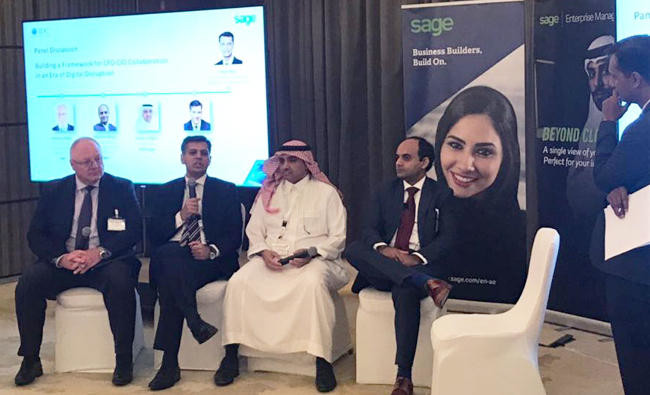
Later Kibby and Sarwar were joined by Ranjit Rajan, Associate Vice President for Research at IDC Middle East, Turkey and Africa, Moazam A Shah, CFO, Al Zamil Group and Hassan Al-Bahes, Chairman of the Institute of Management (IMA,Riyadh Chapter) in a panel that discussed best practices for CFOs and CIOs that align their functions and drive excellence in performance.
Rajan, who earlier made a presentation on navigating digital transformation, moderated the
panel discussion.
The event was attended by about 100 business executives representing various industries.
Sage is the market and technology leader for integrated cloud accounting, payroll, and payment systems, supporting the ambition of entrepreneurs and business builders.


![]()
Saudi business heads must coordinate in disruptive digital environment, says tech leader
Saudi business heads must coordinate in disruptive digital environment, says tech leader

Latest updates


Recommended


© 2026 SAUDI RESEARCH & PUBLISHING COMPANY, All Rights Reserved And subject to Terms of Use Agreement.