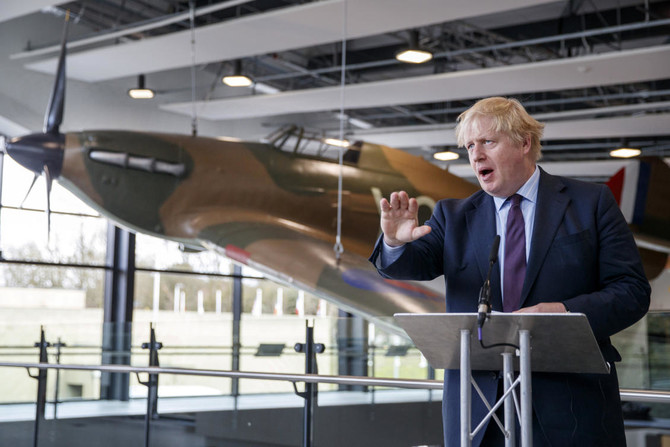
LONDON: British Foreign Secretary Boris Johnson said on Friday that it was overwhelmingly likely that Russian President Vladimir Putin himself made the decision to use a military-grade nerve toxin to strike down a former Russian agent on English soil.
“We have nothing against the Russians themselves. There is to be no Russophobia as a result of what is happening,” Johnson told reporters at the Battle of Britain bunker from which World War Two fighter operations were controlled.
“Our quarrel is with Putin’s Kremlin, and with his decision – and we think it overwhelmingly likely that it was his decision – to direct the use of a nerve agent on the streets of the UK, on the streets of Europe for the first time since the Second World War,” Johnson said.
Prime Minister Theresa May said on Wednesday that the Russian state was culpable for the attempted murder of Sergei Skripal, a former double agent who betrayed dozens of spies of Britain’s MI6 foreign intelligence service, and his daughter.
May said that it was tragic that Putin, who is likely to coast to a fourth term in a Sunday presidential election, had chosen to act in such a way.
Soon after Johnson’s comments were reported, the Kremlin said accusations that President Putin was involved in the nerve agent attack were shocking, TASS news agency reported.
“Any reference or mention of our president in this regard is a shocking and unforgivable breach of diplomatic rules of decent behavior,” Kremlin spokesman Dmitry Peskov said, according to the agency.
Russian Foreign Minister Sergei Lavrov said previously on Friday Russia will expel British diplomats in response to London’s decision to expel 23 staff at the Russian embassy in London.
Asked by a Reuters reporter, at a summit on Syria in the Kazakh capital, if Russia planned to expel British diplomats, Lavrov replied: “We will, of course.” He did not give any further details.
Russia has denied any involvement, cast Britain as a post-colonial power unsettled by Brexit, and even suggested London fabricated the attack in an attempt to whip up anti-Russian hysteria.
Relations between Britain and Russia have been strained since the murder of ex-KGB agent Alexander Litvinenko with radioactive polonium-210 in London in 2006, a killing which a British inquiry said was probably approved by Putin.
The Kremlin has repeatedly denied any involvement in the killing.

Britain says likely that Russia’s Putin made decision for nerve agent attack
Italian suspect questioned over Bosnia ‘weekend sniper’ killings
- The octogenarian former truck driver from the Friuli-Venezia Giulia region of northeast Italy, is suspected by Milan prosecutors of “voluntary homicide aggravated by abject motives,” according to Italian news agency ANSA
ROME: An 80-year-old man suspected of being a “weekend sniper” who paid the Bosnian Serb army to shoot civilians during the 1990s siege of Sarajevo was questioned Monday in Milan, media reported.
The octogenarian former truck driver from the Friuli-Venezia Giulia region of northeast Italy, is suspected by Milan prosecutors of “voluntary homicide aggravated by abject motives,” according to Italian news agency ANSA.
Lawyer Giovanni Menegon told journalists that his client had answered questions from prosecutors and police and “reaffirmed his complete innocence.”
In October, prosecutors opened an investigation into what Italian media dubbed “weekend snipers” or “war tourists“: mostly wealthy, gun-loving, far-right sympathizers who allegedly gathered in Trieste and were taken to the hills surrounding Sarajevo where they fired on civilians for sport.
During the nearly four-year siege of Sarajevo that began in April 1992 some 11,541 men, women and children were killed and more than 50,000 people wounded by Bosnian Serb forces, according to official figures.
Il Giornale newspaper reported last year that the would-be snipers paid Bosnian Serb forces up to the equivalent of €100,000 ($115,000) per day to shoot at civilians below them.
The suspect — described by the Italian press as a hunting enthusiast who is nostalgic for Fascism — is said to have boasted publicly about having gone “man hunting.”
Witness statements, particularly from residents of his village, helped investigators to track the suspect, freelance journalist Marianna Maiorino said.
“According to the testimonies, he would tell his friends at the village bar about what he did during the war in the Balkans,” said Maiorino, who researched the allegations and was herself questioned as part of the investigation.
The suspect is “described as a sniper, someone
who enjoyed going to Sarajevo to kill people,” she added.
The suspect told local newspaper Messaggero Veneto Sunday he had been to Bosnia during the war, but “for work, not for hunting.” He added that his public statements had been exaggerated and he was “not worried.”
The investigation opened last year followed a complaint filed by Italian journalist and writer Ezio Gavanezzi, based on allegations revealed in the documentary “Sarajevo Safari” by Slovenian director Miran Zupanic in 2022.
Gavanezzi was contacted in August 2025 by the former mayor of Sarajevo, Benjamina Karic, who filed a complaint in Bosnia in 2022 after the same documentary was broadcast.
The Bosnia and Herzegovina prosecutor’s office confirmed on Friday that a special war crimes department was investigating alleged foreign snipers during the siege of Sarajevo.
Bosnian prosecutors requested information from Italian counterparts at the end of last year, while also contacting the International Residual Mechanism for Criminal Tribunals in The Hague, it said. That body performs some of the functions previously carried out by the International Criminal Tribunal for the former Yugoslavia.
Sarajevo City Council adopted a decision last month authorizing the current mayor, Samir Avdic, to “join the criminal proceedings” before the Italian
courts, in order to support Italian prosecutors.