SYDNEY: The Association of Southeast Asian Nations (ASEAN) and Australia reject protectionism and embrace free trade, Australian Prime Minister Malcolm Turnbull and his Singapore counterpart Lee Hsien Loong said on Friday.
“You don’t grow stronger by closing the door to other markets. Protectionism is a dead end. It is not a ladder to get you out of the low growth trap, it is a shovel to dig it much deeper,” Turnbull told a special meeting of ASEAN in Sydney.
“We must face the world, not turn from it. Embrace free trade, not retreat from it,” Turnbull said on day one of the three-day summit.
The anti-protectionism comments come as market sentiment sours with signs of a looming trade war between the United States, China and Europe over US President Donald Trump’s plans to raise tariffs on steel and aluminum imports, and possibly up to $60 billion worth of Chinese imports, targeting technology and telecommunications sectors.
“I know the global mood may be heading in the opposite direction but within ASEAN we are working to deepen and deepen interdependence to work together to open up markets,” said Singapore’s Lee.
Australia is hosting the special ASEAN meeting, despite not being a member of the 10-nation bloc, as it seeks to deepen political and trade ties in the face of China’s rising influence in the region.
Trade is a central topic of the meeting, though human rights and Chinese assertiveness in the region are set to dominate bilateral talks among Australia and ASEAN countries.
Australian Foreign Minister Julie Bishop said she will raise human rights concerns with Myanmar and Cambodian leaders.
CHINA’S RISE DIVIDES ASEAN
Asked whether the ASEAN meeting was a direct counter to China’s growing interest in the region, Bishop said Australia believed the bloc brought it “peace, stability and security.”
“We don’t see it as having a role to balance the powers in the Indo-Pacific but rather be at the heart of the engagement collaboration with other countries,” she told Australian Broadcasting Corp. radio ahead of the opening of the summit.
China claims most of the South China Sea, an important trade route which is believed to contain large quantities of oil and natural gas, and has been building artificial islands on reefs, some with ports and air strips.
Brunei, Malaysia, Vietnam, the Philippines, all of which are members of ASEAN, and Taiwan also have claims in the sea.
Lee acknowledged China’s rise has stoked divisions within ASEAN.
“There is a shift in the global strategic balance, Chinese influence is growing with its economy and strength, and its interest in the region and beyond,” he said.
“There is a range of different perspectives and responses to this shift in the balance among different ASEAN countries.”
Indonesian Defense Minister Ryamizard Ryacudu on Friday said he had lobbied other ASEAN defense ministers to carry out maritime patrols in the South China Sea among efforts to improve regional security.
Other ASEAN countries oppose such operations.
HUMAN RIGHTS
The inclusion of Myanmar leader Aung San Suu Kyi and Cambodia Prime Minister Hun Sen in the meeting has drawn criticism, and large protests are planned against both.
Crimes verging on genocide were being committed against the Rohingya minority in Myanmar, and those crimes bore “the fingerprints of the Myanmar government and of the international community,” the United Nations special adviser on the prevention of genocide said on Tuesday.
Nearly 700,000 Rohingya fled Myanmar after militant attacks on Aug. 25 sparked a crackdown led by security forces in the western Rakhine state that the United Nations and United States have said constituted ethnic cleansing.
“It is in our interest to engage all ASEAN members including Aung San Suu Kyi at this summit because it gives us the best chance of influencing outcomes and making our concerns known, so these are matters that we would be discussing with the Myanmar delegation,” Bishop said.
The United Nations, Western nations and rights groups have decried a crackdown by Hun Sen against his critics ahead of a July general election.
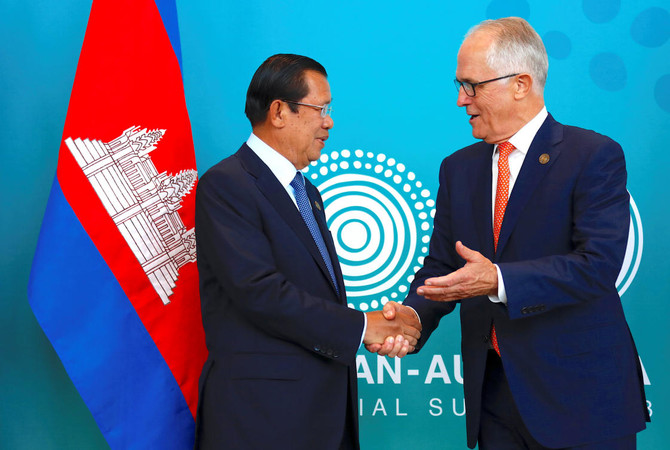
Hun Sen has warned potential protesters against burning effigies of him in Sydney, saying: “I will follow you all the way to your doorstep and beat you right there ... I can use violence against you.”
Asked about the threat, Bishop said Australia was “certainly going to raise our concerns with the Cambodian delegation.”