BEIRUT: Syria’s lacerating conflict entered its eighth year on Thursday with the country riven by international power struggles, as Turkey encircled a besieged northern Kurdish enclave, while Russian-backed regime forces pounded into shrinking opposition areas near Damascus.
The bloodshed, which has devastated huge swathes of the country since it started on March 15, 2011 when the Bashar Assad regime cracked down on mostly peaceful protests, has splintered into ever more complicated conflicts.
In the latest fighting, Ankara-backed forces launched a bombardment of Afrin and closed in on the main city, in an offensive that could redraw the map in northern Syria.
The development came as regime forces, backed by Moscow, broke into a key town in the beleaguered opposition enclave of Eastern Ghouta late Wednesday, driving further into the last opposition bastion outside Damascus.
More than 1,220 civilians — a fifth of them children — have been killed in the opposition-held enclave since the Syrian regime launched a ferocious air and ground offensive on Feb. 18.
International efforts have consistently failed to stop one of the deadliest wars of the century, with more than 350,000 people killed since the conflict first erupted, and more than half of Syria’s pre-war population of 20 million displaced.
While the past few months saw the collapse of Daesh, world powers have since sought to carve out increased influence in the region.
US-backed Kurds hold oil-rich territory in northeastern Syria covering 30 percent of the country and a motley assortment of Turkey-backed Arab fighters are cutting a third haven in the northwest.
Ankara, which launched a deadly ground and air offensive against the Kurdish-majority enclave of Afrin on Jan. 20, vowed on Wednesday that its encirclement of the main city “will have been completed by the evening,” a Turkish presidency source said.
The claim was laughed off by a top official in the Kurdish People’s Protection Units (YPG), which controls Afrin.
“It sounds like Turkish President Recep Tayyip Erdogan is daydreaming when he says Afrin will fall tonight,” Redur Khalil told AFP.
On Wednesday, Turkish bombing raids killed 10 fighters loyal to the Syrian regime, which has deployed pro-government forces to the fray after the Kurds asked for help.
Shells rained down on Afrin city, killing 10 civilians including four children.
Displaced families have swelled the city’s population to around 350,000, and officials feared a humanitarian crisis should Turkish forces draw closer.
The Britain-based Syrian Observatory for Human Rights said on Wednesday that Turkey-led forces controlled 70 percent of the wider Kurdish enclave, after seizing several villages. On the outskirts of Damascus, hundreds of kilometers south of Afrin, another humanitarian emergency was unfolding in Eastern Ghouta.
The Observatory said regime forces had penetrated into the town of Hammuriyeh in the enclave and were able to take control of parts of it amid heavy bombardment.
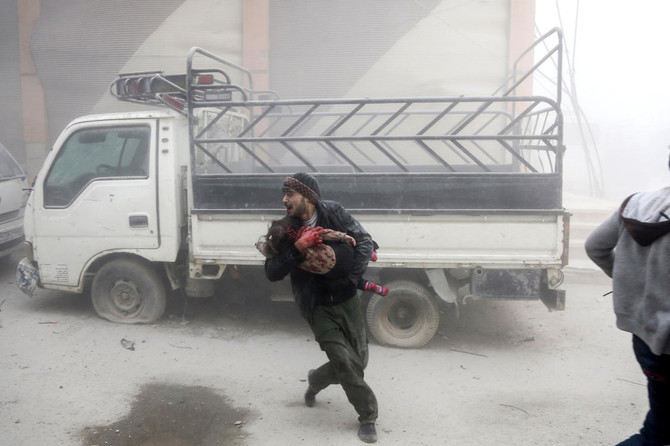
On Wednesday, an AFP correspondent saw a man in the doorway of a building holding the bodies of his two dead children.
A doctor in the area said rescue teams could not get to victims because of the intensity of the bombardment.
“The wounded are on the roads. We can’t move them. The war planes are targeting anything that moves,” Ismail Al-Khateeb said.
The UN has called for urgent medical evacuations for more than 1,000 people who desperately need medical treatment outside the besieged area.
A trickle of evacuations from Ghouta’s largest town Douma began Tuesday under a deal with opposition fighters, and more patients were allowed out Wednesday.
At a Red Crescent center in Douma on Wednesday morning, people crowded around buses and ambulances to be evacuated.
Among them, 18-year-old Omran stood leaning on crutches. Badly wounded two years ago in bombardment on Ghouta, he was missing his left leg, right arm, and left eye.
“We haven’t been able to treat some of these cases for more than a year,” said Mohammed Al-Marhum, a doctor.
The patients were transported to the government-controlled Wafideen checkpoint on the edges of Ghouta.
The Observatory said more than 220 people including 60 patients had left the rebel enclave in two days of evacuations.
The UN Security Council demanded a 30-day truce last month to allow for aid deliveries and medical evacuations from Ghouta.
Such evacuations in Syria typically see people taken out of a besieged area for care, and then transported back in after treatment.
The Syrian regime’s assault on Ghouta has split the enclave into three sections, each controlled by different rebels.
The regime has reportedly been pursuing separate tracks of negotiations to secure local truces or evacuations from each zone.
The Russian military said the situation in Douma had “significantly stabilized” and an aid convoy of 20 vehicles was planned to enter the enclave on Thursday.
Fresh regime and Russian bombardment Wednesday killed at least 31 civilians in an isolated southern zone of Ghouta, the Observatory said.
State news agency SANA said five civilians died of their wounds after shelling on Damascus.
Moscow’s strikes also killed a dozen rebels from the Faylaq Al-Rahman faction controlling the area, including two top commanders, the monitor said.
Russian Foreign Minister Sergei Lavrov said Wednesday Ghouta fighters were planning to stage a chemical attack to give the US-led coalition the pretext to strike Damascus.
His comments came as his Turkish counterpart visited Moscow for talks.


![]()
Syria conflict rages as war enters 8th year
Syria conflict rages as war enters 8th year

Latest updates


Recommended


© 2026 SAUDI RESEARCH & PUBLISHING COMPANY, All Rights Reserved And subject to Terms of Use Agreement.