

UN Security Council statement condemns Houthis for endangering civilians in Yemen

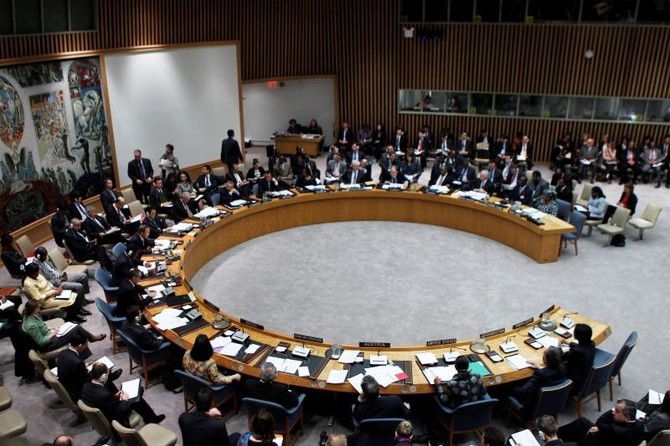
A general view shows a meeting of the UN Security Council at the UN headquarters in New York. (Reuters)
Updated 15 March 2018
Follow

UN Security Council statement condemns Houthis for endangering civilians in Yemen

NEW YORK: A UN Security Council presidential statement has condemned Houthi militia for endangering civilians in Yemen.
In its statement, the Security Council also called on the Houthi militants to stop targeting Saudi Arabia. 
The statement welcomed pledges made by Saudi Arabia and the UAE to support UN humanitarian efforts in Yemen. Riyadh and Abu Dhabi have pledged to pay $1 billion in support of UN efforts in Yemen. 
The UN statement also welcomed efforts by the coalition led by Saudi Arabia to re-supply the Maarib province with food aid. 
Saudi Arabia’s permanent representative at the UN welcomed the Security Council presidential statement praising Arab Coalition efforts in Yemen. In his speech to the council, Abdallah Al-Moallimi said that the US, the international community support the coalition's efforts in Yemen. The Saudi representative added that the Security Council statement on Yemen clearly condemned Houthi militia’s attacks on Yemenis. Al-Moallimi reiterated his country's position that Yemeni suffering is caused by Houthis militants coup and their militia's take over of the Capital Sana'a  in Sep 2014. The Houthis have controlled illigaly the country and its international airport which had derailed humanitarian efforts reaching the needy in the country.
The Saudi representative ended his statement warning the international community about Iran’s cyber space terrorism which is part and Parcel of "Iran’s terrorist threat to the region", he said. 
The British-drafted statement was the product of weeks of negotiations with Saudi Arabia, diplomats said.
The statement required the unanimous approval of the council's 15 members, unlike a resolution, which can be passed by a simple majority if it is not vetoed by one of its five permanent members.
It called on all parties to "respect and protect schools, medical facilities, and personnel."
The United Nations also has denounced the use of schools by the Houthi militia, often as arms depots.
The Security Council condemned "in the strongest possible terms" ballistic missile attacks in November and December on Saudi Arabia by Iranian-backed Houthi rebels.
The United States had accused Iran of supplying the missiles used in the attacks on Saudi Arabia, but the statement made no mention of Tehran.
Tehran has denied the accusations and Russia recently vetoed a US-drafted resolution that sought to condemn Iran for violating a UN arms embargo imposed on Yemen.
"The Security Council calls on all member states to fully implement the arms embargo as required by the relevant Security Council resolutions," he statement said.


Islamophobic attacks on public transport growing in UK

Updated 5 sec ago
Follow

Islamophobic attacks on public transport growing in UK

  • Muslim travelers restricting journeys over fear of abuse and assault, community groups warn
  • Authorities must ‘take urgent and meaningful action,’ says British Muslim Trust CEO

LONDON: Islamophobic attacks are on the rise on public transport across Britain, according to new information revealed by The Guardian, as community organizations warn that Muslims are restricting their journeys over fear of abuse and assault.

A freedom of information request showed that racial hate crimes recorded by British Transport Police across England, Wales and Scotland grew from 2,827 cases in 2019-2020 to 3,258 in 2024-25.

The environment of public transport “creates a particular dynamic where aggressors are often emboldened by alcohol, can isolate their targets and then exit at the next stop,” The Guardian reported.

Hate crimes of a religious nature climbed from 343 cases in 2019-20 to 419 in 2023-24.

Akeela Ahmed, CEO of the British Muslim Trust, said the data reflects the stories her organization has collected from Muslims across the country.

She urged local authorities, transport operators and community safety groups to “take urgent and meaningful action” to address the issue.

“For visible Muslims in particular, the top deck of a bus or a half-empty train carriage can mean threatening behaviour, verbal abuse or even violent attack simply because of their faith,” Ahmed said, adding that Islamophobic attacks on public transport reported to the BMT are “some of the most complex and distressing cases we have handled to date.

“Many Muslims now feel compelled to micro-analyse every movement, expression or gesture out of fear that it may be misinterpreted, recorded and weaponised against them.”

A significant number of physical and verbal attacks against Muslims target children traveling to and from school, Ahmed said, describing this trend as the “most alarming” of all.

“The lack of CCTV coverage on buses and at many stops means perpetrators routinely evade accountability,” she added.

Carol Young, deputy director of the Coalition for Racial Equality, said the recorded figures cited by The Guardian “are probably the tip of the iceberg,” adding: “Anecdotally, we know that using public transport may not feel safe for everyone and some people may avoid using it or restrict their use to certain times of day.”

In response to a request by The Guardian for comment, a spokesperson for British Transport Police said: “Abuse, intimidation and violence — especially that which is motivated by hate — will never be tolerated, and we have acted swiftly and decisively when we receive reports of hate crimes on the rail network.

“If you are a victim of hate crime, or if you witness an incident that makes you feel uncomfortable, please do not suffer in silence.”