Car costs make Singapore world’s priciest city. Again.

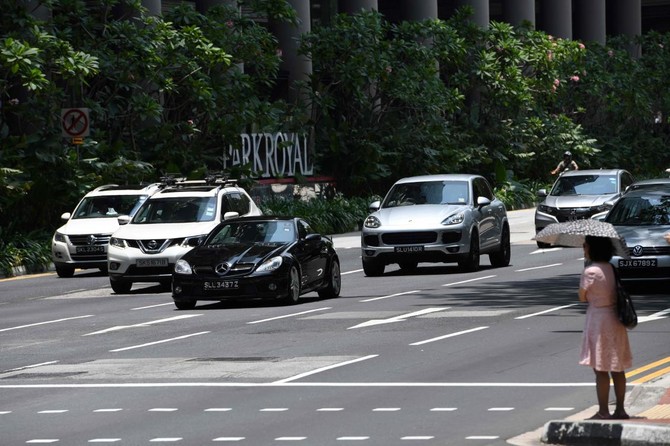
Singapore controls vehicle ownership through a quota system under which a buyer must pay for a Certificate of Entitlement — currently nearly S$40,000 — on top of the vehicle’s actual price. (AFP)
Updated 15 March 2018
Follow

Car costs make Singapore world’s priciest city. Again.

SINGAPORE: The eye-watering cost of owning a car in space-starved Singapore means the city state is the world’s most expensive place to live, for the fifth year in a row, a survey said Thursday.
The Asian financial hub — where owning a no-frills sedan can set you back $76,000 — beat global capitals to the dubious title, despite stiff competition from resurgent European cities.
Pricey perennials Tokyo and New York did not even make the top 10 in the annual list by the Economist Intelligence Unit (EIU), beaten out by Paris, Zurich (joint second) Hong Kong (fourth) and Oslo (fifth).
Seoul and Geneva shared sixth place, while Copenhagen, Tel Aviv and Sydney rounded out the rankings
Despite some perks to domestic life in Singapore — home help is cheap — the former British colony “remains the most expensive place in the world to buy and run a car,” EIU said.
Singapore has avoided Asia’s massive traffic jams by controling vehicle ownership through a quota system under which a buyer must pay for a Certificate of Entitlement — currently nearly S$40,000 ($30,500) — on top of the vehicle’s actual price.
That means a basic sedan comes with a S$100,000 price tag.
Asian cities tend to be most expensive for grocery shopping, while Europe comes out tops in household, personal care, recreation and entertainment, the survey said.
Currency fluctuations remain a major cause for the changes in the rankings, with the weaker US dollar keeping American cities out of the top 10.
War-wracked Damascus, the troubled Venezuelan capital Caracas, Lagos in Nigeria and the Pakistani city of Karachi are among the world’s cheapest cities, the survey showed.
“Put simply, cheaper cities also tend to be less liveable,” it said.


Not Italy’s Devil’s Island: Sardinia bristles at mafia inmate plan

Updated 07 February 2026
Follow

Not Italy’s Devil’s Island: Sardinia bristles at mafia inmate plan

  • A third of top-risk mafia prisoners could go to Sardinia
  • Officials say clans may follow relatives and infiltrate economy

NUORO: In Nuoro, a remote city on the Italian island of Sardinia, a high stone wall rings the local prison, a fortress-like complex once renowned for holding high-profile mobsters and convicted terrorists far from the mainland.

Only a handful of top mafiosi remain detained there and Sardinia is no longer seen as a dumping ground for criminals, instead building an international reputation around tourism.

But that could change under a plan of Prime Minister Giorgia Meloni’s government which has alarmed residents. In December, a justice undersecretary said about 750 prisoners held under the rigid “41bis” regime would be concentrated in just a few dedicated facilities across Italy, overseen by special guard units to improve security.

Sardinia has been told it may get nearly a third of them, split between Sassari in the north, already housing about 90, the capital Cagliari, where around 90 are due to arrive this month, and Nuoro — reviving old stigma concerns.

“Sardinia does not deserve to be seen as Italy’s Cayenne,” said Governor Alessandra Todde, invoking the notorious former French Guiana penal colony on Devil’s Island.

Worries of Mafia infiltration

Italy’s 41bis regime, named after the law that regulates it, is among the most restrictive in Europe. Introduced in 1992 after the murder of anti-mafia ‌judge Giovanni Falcone, ‌it imposes near-total isolation on prisoners and was designed to stop bosses running their operations from behind ‌bars.

The ⁠law says it should “preferably” ‌be enforced on Italy’s islands. The late boss of the Sicilian mafia, Salvatore “Toto” Riina, was among those once held in Sardinia.

Locals and authorities fear the government plan could prompt mafia clans to move from mainland Italy to be near jailed relatives, creating opportunities to launder illicit money and infiltrate business, particularly in less developed areas, such as Nuoro, a city of 30,000 people.

Silvio Lai, a Sardinian lawmaker with the opposition Democratic Party, visited the city prison last month and said renovation work was already ongoing, potentially making room for at least 30 new maximum-security inmates.

“Weak economies can be infiltrated easily, and Nuoro is about an hour’s drive from the Costa Smeralda,” Lai said, suggesting a mafia foothold in the city could swiftly spread to the island’s luxurious tourist resort.

The Justice Ministry did not respond to a request to comment on the work.

Improving ⁠national security

Autonomous mafia groups have never emerged in sparsely populated Sardinia, but magistrates say investigations have been opened into alleged clan penetration in the north of the island, possibly encouraged by the presence of detained ‌mobsters.

“Prosecutors are keeping a close watch on the phenomenon of Camorra (a mafia group based around Naples) ‍investments... especially in the tourism, hospitality and restaurant sectors,” said Cagliari chief prosecutor ‍Luigi Patronaggio.

At a December meeting with regional officials, Justice Undersecretary Andrea Delmastro Delle Vedove downplayed the risk of a mass move to Sardinia, minutes show, ‍arguing that families of 41bis detainees do not typically leave clan-controlled areas.

“This (plan) will ensure greater national security... will make individual prisons safer because only specialized prison guard units will be deployed,” Delmastro said.

However, Maria Cristina Ornano, head of the sentence enforcement tribunal in Cagliari, said police and the judiciary will need increased security resources if more mobsters arrive.

“Once organized crime takes root here, we will not be able to get rid of it. We can see it in parts of southern Italy, which are among the most