PARIS: In his final years, the only thing connecting the brilliant physicist to the outside world was a couple of inches of frayed nerve in his cheek.
As slowly as a word per minute, Stephen Hawking used the twitching of the muscle under his right eye to grind out his thoughts on a custom-built computer, painstakingly outlining his vision of time, the universe, and humanity’s place within it.
What he produced was a masterwork of popular science, one that guided a generation of enthusiasts through the esoteric world of anti-particles, quarks, and quantum theory. His success, in turn, transformed him into a massively popular scientist, one as familiar to the wider world through his appearances on prime time television shows as his work on cosmology and black holes. 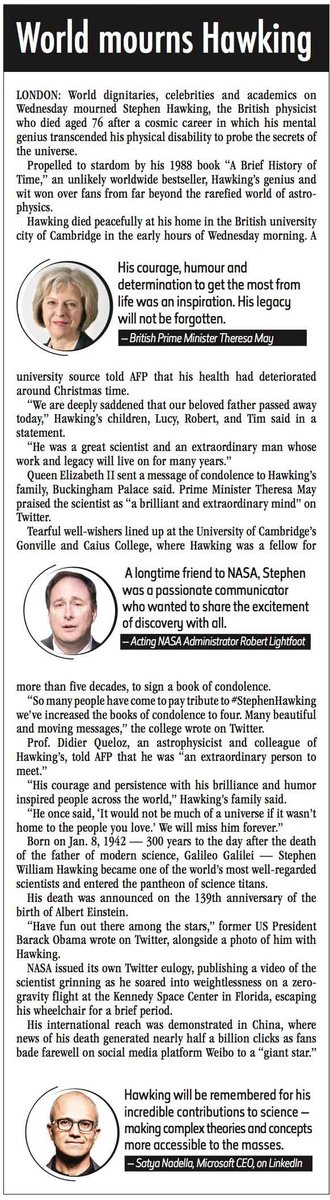
Hawking owed one part of his fame to his triumph over amyotrophic lateral sclerosis, or ALS, a degenerative disease that eats away at the nervous system. When he was diagnosed, aged only 21, he was given only a few years to live.
But Hawking defied the normally fatal illness for more than 50 years, pursuing a brilliant career that stunned doctors and thrilled his fans. Even though a severe attack of pneumonia left him breathing through a tube, an electronic voice synthesizer allowed him to continue speaking, albeit in a robotic monotone that became one of his trademarks.
He carried on working into his 70s, spinning theories, teaching students, and writing “A Brief History of Time,” an accessible exploration of the mechanics of the universe that sold millions of copies.
By the time he died on Wednesday at 76, Hawking was among the most recognizable faces in science, on a par with Albert Einstein.
As one of Isaac Newton’s successors as Lucasian Professor of Mathematics at Cambridge University, Hawking was involved in the search for the great goal of physics — a “unified theory.”
Such a theory would resolve the contradictions between Einstein’s General Theory of Relativity, which describes the laws of gravity that govern the motion of large objects such as planets, and the Theory of Quantum Mechanics, which deals with the world of subatomic particles.
For Hawking, the search was almost a religious quest. “A complete, consistent unified theory is only the first step: Our goal is a complete understanding of the events around us, and of our own existence,” he wrote in “A Brief History of Time.”
In later years, though, he suggested a unified theory might not exist.
He followed up “A Brief History of Time” in 2001 with the sequel, “The Universe in a Nutshell,” which updated readers on concepts like supergravity, naked singularities and the possibility of an 11-dimensional universe.
Hawking often credited humor with helping him deal with his disability, and it was his sense of mischief that made him game for a series of stunts.
He made cameo television appearances in “The Simpsons,” “'Star Trek: The Next Generation,” and the “The Big Bang Theory” and counted among his fans U2 guitarist The Edge, who attended a January 2002 celebration of Hawking’s 60th birthday.
His early life was chronicled in the 2014 film “The Theory of Everything,” with Eddie Redmayne winning the best actor Academy Award for his portrayal of Hawking. Some colleagues credited that celebrity with generating new enthusiasm for science.
His near-total paralysis certainly did little to dampen his ambition to physically experience space: Hawking savored small bursts of weightlessness in 2007 when he was flown aboard a jet that made repeated dives to simulate zero-gravity.
Hawking had hoped to leave Earth’s atmosphere altogether someday, a trip he often recommended to the rest of the planet’s inhabitants.
“In the long run the human race should not have all its eggs in one basket, or on one planet,” Hawking said in 2008. “I just hope we can avoid dropping the basket until then.”
Hawking first earned prominence for his theoretical work on black holes. Disproving the belief that black holes are so dense that nothing could escape their gravitational pull, he showed that black holes leak a tiny bit of light and other types of radiation, now known as “Hawking radiation.”
“It came as a complete surprise,” said Gary Horowitz, a theoretical physicist at the University of California, Santa Barbara. “It really was quite revolutionary.”
Horowitz said the find helped move scientists one step closer to cracking the unified theory.
Hawking’s other major scientific contribution was to cosmology, the study of the universe’s origin and evolution. In 2004, he announced that he had revised his previous view that objects sucked into black holes simply disappeared, perhaps to enter an alternate universe. Instead, he said he believed objects could be spit out of black holes in a mangled form.
That new theory capped his three-decade struggle to explain a paradox in scientific thinking: How can objects really “disappear” inside a black hole and leave no trace when subatomic theory says matter can be transformed but never fully destroyed?
Hawking was born Jan. 8, 1942, in Oxford, and grew up in London and St. Albans, northwest of the capital. In 1959, he entered Oxford University and then went on to graduate work at Cambridge.
Hawking married Jane Wilde in 1965 and they had three children, Robert, Lucy and Timothy. Jane cared for Hawking for 20 years, until a grant from the US paid for the 24-hour care he required.
He was inducted into the Royal Society in 1974 and received the Albert Einstein Award in 1978. In 1989, Queen Elizabeth II made him a Companion of Honor, one of the highest distinctions she can bestow.
He whizzed about Cambridge at surprising speed — usually with nurses or teaching assistants in his wake — traveled and lectured widely, and appeared to enjoy his fame. He retired from his chair as Lucasian Professor in 2009 and took up a research position with the Perimeter Institute for Theoretical Physics in Waterloo, Ontario.


![]()
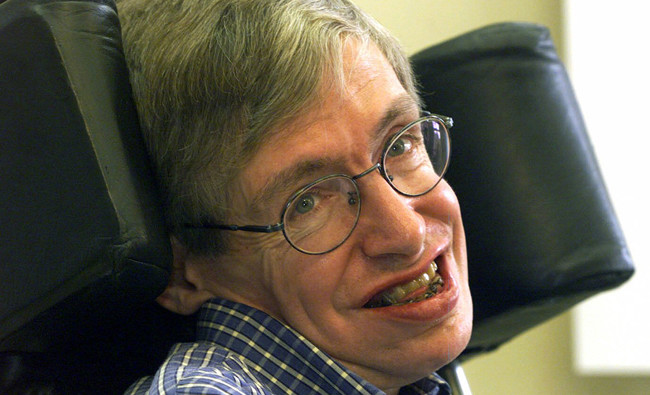
Stephen Hawking: Extraordinary life of the man who explained the universe
Stephen Hawking: Extraordinary life of the man who explained the universe

Latest updates


© 2026 SAUDI RESEARCH & PUBLISHING COMPANY, All Rights Reserved And subject to Terms of Use Agreement.