TOKYO: The name of Japanese Prime Minister Shinzo Abe’s wife was removed from documents regarding a suspected cronyism scandal, media said on Monday, as pressure mounted on the premier and his ally Finance Minister Taro Aso over a possible cover-up.
Abe, now in his sixth year in office, had tried to put behind him questions over the sale of state-owned land at a huge discount to a school operator with ties to his wife, Akie.
The issue last year sharply eroded Abe’s popularity. His ratings rebounded thereafter, but doubts over Abe and his cabinet have been revived with a series of fresh revelations.
Abe has repeatedly denied he or his wife did favors for school operator Moritomo Gakuen, which bought the land, and has said he would resign if evidence were found that they had.
Former Moritomo Gakuen head Yasunori Kagoike and his wife were arrested in July on suspicion of illegally receiving subsidies.
Suspicions of a cover-up could slash Abe’s ratings and dash his hopes of a third term as leader of the ruling Liberal Democratic Party (LDP). Victory in the LDP September leadership vote would put him on track to become Japan’s longest-serving premier. The doubts have also sparked calls for Aso to quit, but the finance minister has said he will not step down.
LDP parliamentary affairs official Hiroshi Moriyama told reporters on Monday that he had been briefed by finance ministry officials that documents related to the land sale had been altered but did not comment on the content.
Media have said the alterations were made after February last year — when the suspected scandal broke — and that words describing the “special nature” of the deal were excised along with the names of several politicians. Broadcaster TV Asahi also said Akie Abe’s name had been removed.
Chief Cabinet Secretary Yoshihide Suga on Monday did not directly respond to a question by reporters about Akie Abe but said that the finance minister Aso should investigate the facts.
“What is important is to make everything clear,” he said.
Opposition politicians have called for Aso to resign.
The backing of Aso, 77, who doubles as deputy premier, is vital to Abe’s bid for a third term and a key factor in the stability of his administration.
“This is a deep-seated political problem,” said Yasunari Ueno, chief market economist at Mizuho Securities. “Financial markets must be aware of the risk of Aso resigning.”
On Friday, National Tax Agency chief Nobuhisa Sagawa abruptly resigned over his remarks in parliament about the case.
“If Minister Aso signed off on National Tax Agency chief Sagawa’s resignation knowing about the falsified documents, moves seeking his resignation are inevitable,” Yuichiro Tamaki, leader of the opposition Democratic Party, said on Sunday.
Sagawa headed the ministry division that submitted the documents before he was tapped as tax agency chief in July, an appointment critics saw as a reward for his efforts to diffuse the issue with his statements to parliament last year.
Some LDP members said the saga could undermine the party.
“It is inconceivable that the bureaucrats on the spot had such authority (to alter the documents),” media quoted Shigeru Ishiba, an LDP lawmaker who has made no secret of his desire to challenge Abe in the party race, as saying on the weekend. “If we don’t make clear who did this, trust in the LDP will waver.”
Abe, 63, swept back to power in December 2012 promising to revive the economy and bolster its defense. It was a rare comeback for the conservative lawmaker, who quit abruptly in 2007 after a year in office marked by scandals in his cabinet, a deadlocked parliament and ill health.
His ruling bloc won a two-thirds “super majority” in an October lower house poll, helped by opposition disarray.
A March 9-11 survey by the Yomiuri newspaper showed support for Abe’s cabinet has now fallen to 48 percent, down six points from a month earlier. Non-support rose to 42 percent and 80 percent said that the matter had not been handled appropriately.


![]()
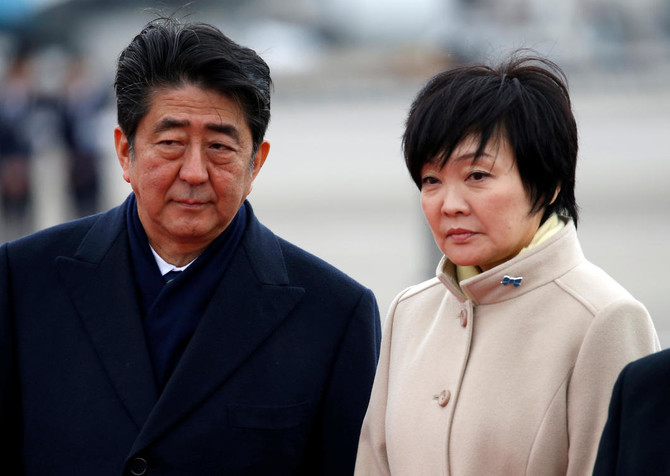
Japan PM wife’s name removed from documents in suspected cronyism scandal
Japan PM wife’s name removed from documents in suspected cronyism scandal


Latest updates


© 2026 SAUDI RESEARCH & PUBLISHING COMPANY, All Rights Reserved And subject to Terms of Use Agreement.