Saudi stocks surge to multi-year high on foreign fund hopes

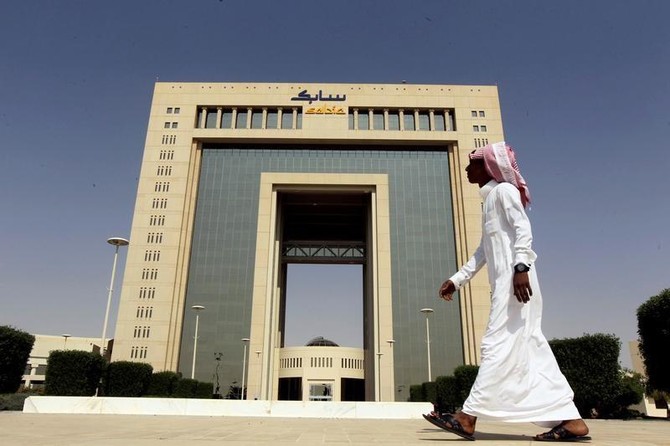
Petrochemicals giant Sabic was among the gainers on the Tadawul stock exchange yesterday which rose to its highest level since November 2015. (Reuters)
Updated 11 March 2018
Follow

Saudi stocks surge to multi-year high on foreign fund hopes

DUBAI: Expectations for inflows of foreign funds in coming months boosted Saudi Arabia’s stock market to a multi-year high on Sunday.
The Saudi index surged 1.8 percent, its biggest daily gain since last June, to 7,696 points, its highest finish since November 2015.
Investors expect a positive decision by index compiler FTSE at the end of March on whether to upgrade Riyadh to emerging market status, and a similar decision by MSCI in June. Together, the decisions could attract tens of billions of dollars of new foreign money to the market in the next 18 months.
Inflows have started in the past few months in anticipation of positive index decisions, and exchange data released after the close on Sunday showed foreign investors were net buyers of Saudi stocks last week to the tune of $115 million.
Petrochemical producers and banks, where most of the foreign funds would focus, were heavily bought on Sunday. Riyad Bank jumped 3.5 percent after its investment banking arm, Riyad Capital, announced a plan to boost the capital of Riyad REIT to SR1.63 billion ($435 million) from SR500 million.
National Petrochemical jumped 9.9 percent after proposing a 0.5 riyal per share annual dividend, in line with the previous year’s, and Saudi Industrial Investment Group gained by the same margin after reporting annual profit increased more than ten-fold.
The Dubai index, which had been languishing at two-year lows, climbed 1.0 percent as ENBD, which is usually very thinly traded, soared 13.6 percent to 10 dirhams in its heaviest volume ever. It broke major technical resistance around 9 dirhams, where it had peaked several times since mid-2016.
The bank, majority owned by government, said it would ask shareholders on March 27 to approve a capital increase through the issuance of up to 7.35 billion dirhams ($2.0 billion) of new shares at a discount of at least 10 percent to the prevailing market price, with preference to existing shareholders. It currently has about 5.5 billion shares.
ENBD said in January it had started strategic discussions with Russia’s Sberbank about a possible purchase of Sberbank’s stake in Turkey’s Denizbank, and analysts think the capital increase is a signal that the acquisition will go ahead.
Chiradeep Ghosh, research manager at SICO Bahrain, said ENBD shares were reacting positively to the capital increase plan because to raise so much new capital, the bank would probably have to raise its 5 percent ceiling for foreign ownership of the shares. Actual foreign ownership is currently at 5 percent.
“The stock trades at a deep discount to its peers due to the low foreign ownership limit. We have a ‘Buy’ recommendation on the stock with a target price of 12 dirhams per share,” he said.
Most of the rest of Dubai’s market remained sluggish, however, partly because of signs that money is flowing out to catch the bull run in Saudi Arabia. Twenty-two Dubai stocks fell and nine rose.
In Abu Dhabi, Dana Gas climbed 2.7 percent after saying it would hold a board meeting on Wednesday. There has been speculation that it could reach an agreement with holders of its $700 million of sukuk on restructuring the instruments, although the nature of any deal remains unknown.
Qatar’s index fell 0.7 percent as Doha Bank lost 4.9 percent, dropping sharply for a second straight day after going ex-dividend.

- Reuters

Saudi non-oil exports jump 21% as trade balance improves: GASTAT 

Updated 5 sec ago
Follow

Saudi non-oil exports jump 21% as trade balance improves: GASTAT 

RIYADH: Saudi Arabia’s non-oil exports, including re-exports, rose 20.7 percent year on year in November to SR32.69 billion ($8.72 billion), official data showed. 

According to preliminary figures released by the General Authority for Statistics, national non-oil exports, excluding re-exports, increased by 4.7 percent in November compared with the same month in 2024. 

The strong performance highlights progress under the Kingdom’s Vision 2030 strategy, which aims to diversify the economy and reduce its long-standing dependence on crude oil revenues. 

In its latest report, GASTAT stated: “The ratio of non-oil exports, including re-exports, to imports increased in November 2025, reaching 42.2 percent, compared with 34.9 percent in November 2024. This increase was driven by a 20.7 percent rise in non-oil exports, alongside a 0.2 percent decline in imports over the same period.”  

It added: “The value of re-exported goods increased by 53.1 percent during the same period, driven by an 81.9 percent increase in ‘machinery, electrical equipment and parts’, which accounted for 51.5 percent of total re-exports.”  

Machinery, electrical equipment and parts also led the non-oil export basket, making up 24.2 percent of outbound shipments and recording an 81.5 percent annual increase. This was followed by products of the chemical industries, which represented 20.3 percent of total non-oil exports and rose 0.5 percent year on year. 

The data adds to signs of resilience in Saudi Arabia’s non-oil economy, with S&P Global’s Purchasing Managers’ Index at 57.4 in December, well above the 50 threshold that separates expansion from contraction. 

Top non-oil destinations 

The UAE was the leading destination for Saudi non-oil exports in November, with shipments valued at SR10.48 billion. 

India ranked second at SR3.01 billion, followed by China at SR2.32 billion, Singapore at SR1.76 billion and Bahrain at SR900.7 million. 

Exports to Egypt totaled SR815.5 million during the month, while Turkiye and Jordan received goods worth SR799.1 million and SR773.3 million, respectively. 

GASTAT said ports and airports played a central role in facilitating non-oil shipments in November. 

By sea, Jeddah Islamic Seaport handled the largest volume of non-oil exports at SR3.57 billion, followed by King Fahad Industrial Seaport in Jubail at SR3.51 billion. 

Ras Al-Khair Seaport was the exit point for non-oil goods valued at SR2.66 billion, while Jubail Seaport and King Abdulaziz Seaport in Dammam handled outbound shipments worth SR2.32 billion and SR2.14 billion, respectively. 

By air, King Abdulaziz International Airport handled goods worth SR5.60 billion, while King Khalid International Airport in Riyadh processed exports valued at SR3.53 billion. 

Exports and imports 

Saudi Arabia’s total merchandise exports reached SR99.73 billion in November, representing a 10 percent increase compared with the same month in 2024. 

“Merchandise exports in November 2025 increased by 10.0 percent compared to November 2024, and oil exports increased by 5.4 percent. The percentage of oil exports in total exports declined from 70.1 percent in November 2024 to 67.2 percent in November 2025,” GASTAT added.  

China remained the Kingdom’s largest export destination, accounting for 13.5 percent of total exports, followed by the UAE at 11.7 percent and Japan at 9.9 percent. India, South Korea, the US, Egypt, Singapore, Bahrain and Poland were also among the top 10 destinations, which together accounted for 71.4 percent of total exports. 

Imports declined by 0.2 percent year on year in November to SR77.38 billion, while the merchandise trade surplus surged by 70.2 percent, the report showed. 

China was the Kingdom’s largest source of imports, accounting for 26.7 percent of inbound shipments, followed by the US at 10.2 percent and the UAE at 6.2 percent.  

“Germany, Japan, India, Italy, France, Switzerland, and Egypt were also among the top ten import sources, with total imports from these ten countries representing 68.6 percent of Saudi Arabia’s overall imports,” added GASTAT.  

King Abdulaziz Port in Dammam was the leading entry point for goods, handling 22.8 percent of imports in November. Jeddah Islamic Port followed with 22.6 percent, ahead of King Khalid International Airport in Riyadh at 17 percent and King Abdulaziz International Airport in Jeddah at 11.9 percent.