LAHORE: Sana Safinaz, one of Pakistan’s most recognizable design houses, has apologized after being criticized for a fashion campaign that has been described as “not thought through” and “wilfully offensive.”
Its summer collection was shot against the backdrop of the Masai Mara National Reserve in Kenya, and included members of the Masai tribe, which calls the region home. Social media users in Pakistan have accused the brand of using the tribespeople as props.

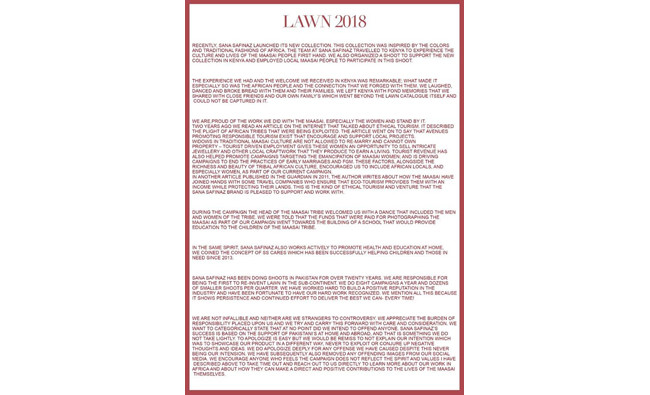
Then the designer duo stayed silent, this time they chose to respond with an explanation behind their campaign concept, their relationship to the Masaai people and also an apology to their consumers and the number of people who took issue with the editorial.
“We do apologise deeply for any offence we have caused, despite this never being our intention." An official statement by Sana Safinaz reads.



Sana Safinaz apologizes after social media backlash




Sana Safinaz apologizes after social media backlash

Pakistan says it seized 32 square kilometers inside Afghanistan as border clashes escalate
- Security official describes ‘limited tactical action’ in Gudwana after Afghan assaults
- Islamabad accuses Kabul of sheltering militants as UN, China and Russia urge restraint
ISLAMABAD: Pakistan has seized a 32-square-kilometer area inside Afghanistan following overnight fighting, a security official said on Saturday, as cross-border clashes between the two countries escalated sharply.
A Pakistani security official, speaking on condition of anonymity, said troops carried out a “limited tactical action” in the Gudwana area opposite the Zhob sector along the frontier, capturing Afghan territory after responding to attacks on Pakistani positions.
“On the night of Feb. 26/27, posts opposite the Zhob sector launched anticipated physical attacks on multiple Pakistani positions,” the official said, referring to fighters linked to Afghanistan’s Taliban authorities, whom Islamabad identifies as Tehreek-e-Taliban Afghanistan (TTA).
“In response to aggressive unprovoked fire and physical attacks, Pakistan security forces launched a limited tactical action on the night of Feb. 27/28 in the general area of Gudwana with a view to capture TTA Tahir Post,” he continued, adding that 32 square kilometers of Afghan territory were seized.
The official said special combat teams crossed the border after preparatory bombardment, supported by intelligence, surveillance and reconnaissance assets providing “real-time battlefield awareness.”
He said 24 Afghan Taliban fighters were killed and 37 wounded, with no Pakistani casualties reported.
The claims could not be independently verified, and there was no immediate confirmation from Taliban authorities in Kabul of any territorial loss in the Gudwana area.
The latest clashes erupted after Pakistani airstrikes targeted what Islamabad described as militant hideouts inside Afghanistan over the weekend, triggering retaliatory fire along the frontier and sharply escalating long-running tensions. Islamabad accuses Kabul of sheltering Pakistani Taliban militants responsible for attacks inside Pakistan, an allegation that Afghanistan denies.
Pakistan’s Information Minister Attaullah Tarar said on Saturday evening that 352 Afghan Taliban fighters had been killed and more than 535 wounded since the latest phase of hostilities began.
Tarar said Pakistani strikes had destroyed 130 check posts, 171 tanks and armored vehicles and targeted 41 locations across Afghanistan by air. Those figures could not be independently verified.
The United Nations, as well as China and Russia, have called for restraint.
The United States said Pakistan has the right to defend itself against cross-border militancy.