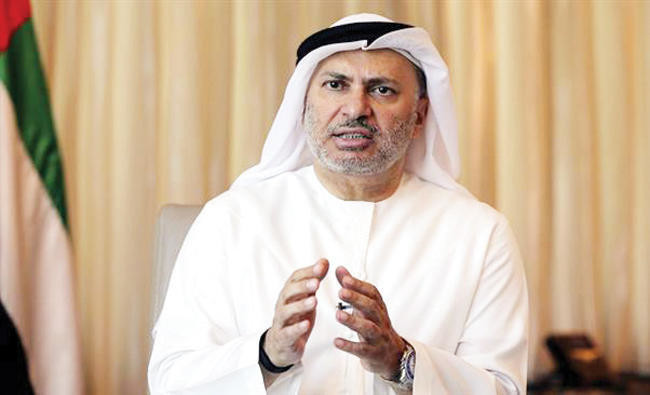
DUBAI: A senior United Arab Emirates official said on Saturday Turkey's policy towards Arab states was not reasonable and advised it to respect their sovereignty.
Relations between the two countries have been strained by Ankara’s support for Qatar after Saudi Arabia, the UAE, Bahrain and Egypt imposed sanctions on Doha last year over its alleged support for extremist groups.
"It is no secret that Arab-Turkish relations aren't in their best state," UAE Minister of State for Foreign Affairs Anwar Gargash tweeted.
"In order to return to balance, Ankara has to respect Arab sovereignty and deal with its neighbors with wisdom and rationality," he said.
The UAE sees itself as a bulwark against extremist groups like the Muslim Brotherhood. Abu Dhabi has long been uneasy with Turkish President Recep Tayyip Erdogan's ruling AK party and its support for such groups.
The two countries were drawn into a quarrel in December over a retweet by the Emirati foreign minister that Erdogan called an insult.
UAE Foreign Minister Sheikh Abdullah bin Zayed shared a tweet at the time that accused Turkish troops of looting the holy city of Medina a century ago, prompting Erdogan to lash out saying that the minister had been spoiled by oil money.
Turkey then renamed the street in Ankara where the UAE Embassy is located after the Ottoman military commander who Sheikh Abdullah had appeared to criticize.

UAE asks Turkey to respect Arab states’ sovereignty
Israel army says striking Hezbollah targets in Lebanon
- More than 340 people have been killed by Israeli fire in Lebanon since the ceasefire, according to an AFP tally of Lebanese health ministry reports
JERUSALEM: The Israeli military announced a series of strikes on Hezbollah targets in Lebanon on Friday, including weapons depots and a training complex.
“A number of weapons storage facilities and terrorist infrastructure sites were struck, which were used by Hezbollah to advance terror attacks against the state of Israel,” a military statement said.
Despite a November 2024 ceasefire that was supposed to end more than a year of hostilities between Israel and the Iran-backed Hezbollah group, Israel has continued to strike in Lebanon and has maintained troops in five areas it deems strategic.
More than 340 people have been killed by Israeli fire in Lebanon since the ceasefire, according to an AFP tally of Lebanese health ministry reports.
The strikes on Friday come a day after similar Israeli attacks near the Syrian border and in southern Lebanon left three people dead.
The Israeli military had reported on Thursday it had killed a member of arch-foe Iran’s elite Quds Force in a strike in Lebanon.
On Friday, the military said it had struck several military structures of Hezbollah, warning it would “remove any threat posed to the state of Israel.”
Under heavy US pressure and fears of expanded Israeli strikes, Lebanon has committed to disarming Hezbollah, starting in the south of the country near the frontier.
Lebanon’s army plans to complete the disarmament south of the Litani River — about 30 kilometers (19 miles) from the border with Israel — by year’s end.
Israel has questioned the Lebanese military’s effectiveness and has accused Hezbollah of rearming, while the group itself has rejected calls to surrender its weapons.