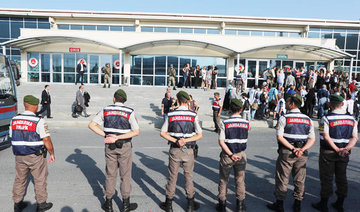
SILIVRI, Turkey: The trial resumed on Friday of staff from Turkey’s opposition Cumhuriyet newspaper seen as a test of press freedom under President Recep Tayyip Erdogan, with two suspects now approaching their 500th day behind bars.
A total of 17 staff from Cumhuriyet (Republic) face terror charges in the case, with most now free pending the conclusion of the trial after a number of conditional releases.
However, three senior members of staff — chairman Akin Atalay, editor-in-chief Murat Sabuncu and investigative reporter Ahmet Sik — remain in detention to the outrage of supporters.
Sabuncu and Atalay have now spent the last 495 days in jail and Sik, who was detained a little after the initial wave of arrests, 434 days.
“End this persecution,” said Cumhuriyet in its front-page headline.
All three jailed suspects were present as the trial resumed at the courthouse in Silivri outside Istanbul, part of a complex that also contains the prison where they are held.
Also present were the defendants who were released last year after long stints in jail but remain charged, including cartoonist Musa Kart and columnist Kadri Gursel.
There was tension ahead of the opening of the hearing as anti-riot police with shields prevented supporters from giving statements to media in front of the courthouse.
In the end, some managed to read brief statements in front of the line of police calling for the release of the staff, an AFP correspondent said.
“It is unacceptable for journalists to stay in prison that long just because they express their thoughts or publish headlines,” Utku Cakirozer, an MP for the opposition Republican People’s Party (CHP), said.
Unable to read his statement closer to the courthouse, fellow CHP MP Sezgin Tanrikulu added: “Justice cannot emerge out of this place but we are still here for our friends.”
The latest hearing comes a day after an Istanbul court sentenced 25 journalists to prison terms of up to seven and a half years over links to the group of US-based preacher Fethullah Gulen blamed by Turkey for the 2016 failed coup against Erdogan.
The Cumhuriyet staff are charged with supporting through their coverage three organizations Turkey views as terror groups — the Kurdistan Workers’ Party, the ultra-left Revolutionary People’s Liberation Party-Front, and the Gulen movement.
They face up to 43 years in prison if convicted. Supporters say the charges are absurd, noting that the outlawed groups cited in the indictment are themselves at odds with each other. Dozens of journalists have been detained in the crackdown that followed the failed coup.

Staff at Turkey’s Cumhuriyet newspaper back on trial after almost 500 days jail

Israeli journalists warn of media crackdown as UK billionaire prepares Channel 13 sale
- The Union of Journalists in Israel has condemned the transaction as “an unlawful deal”
LONDON: Israeli journalists and media unions have voiced serious concern over a proposed sale of a major stake in Israel’s Channel 13, warning that the move could deal a devastating blow to independent journalism in the country amid a broader campaign to reshape the media landscape ahead of elections.
According to The Guardian, British billionaire Sir Leonard Blavatnik is preparing to sell a 15 percent stake in Channel 13, one of Israel’s few mainstream channels critical of Prime Minister Benjamin Netanyahu, to telecom tycoon Patrick Drahi, a French-Israeli businessman who already owns media outlets perceived as sympathetic to the current government.
Journalists and free press advocates said the sale risked consolidating pro-government influence in a media environment already under pressure from financial sanctions, lawsuits, and regulatory threats.
The Union of Journalists in Israel has condemned the transaction as “an unlawful deal,” describing it as part of a broader “master plan to capture the media” ahead of the country’s scheduled elections.
Channel 13 has aired critical coverage of Netanyahu in recent years, including reporting on his corruption cases.
Drahi’s reported acquisition would make him a significant stakeholder at a time when Blavatnik is pulling back after years of financial losses, reported The Guardian.
Although the stake falls within the legal threshold for media ownership, critics argued that Drahi’s financial power as the only investor currently willing to inject funds would give him de facto control of editorial direction.
“While Patrick Drahi is only buying 15 percent, our fear is that by buying 15 percent, he gets 100 percent hold of the policy of the channel,” Anat Saragusti, a senior official at the Union of Journalists, told The Guardian. “It’s a lose-lose for the Israeli public, in terms of freedom of speech and diversity of opinions.”
A separate offer from a group of liberal Israeli tech entrepreneurs, reportedly valued at up to $120 million over three years, was also on the table, but ultimately rejected. A spokesperson for Blavatnik’s Access Industries insisted there was no political influence behind the deal and that Drahi’s bid was “the stronger, faster option” of the two.
“Any suggestion that the preferred offer has been selected for political reasons is entirely false,” the spokesperson said, adding that the transaction would allow Channel 13 to invest in high-quality content and digital innovation.
The Netanyahu government has come under growing scrutiny for actions seen as hostile to independent media, including imposing sanctions on the newspaper Haaretz and initiating defamation lawsuits against investigative reporters. The prime minister is also on trial for alleged efforts to trade regulatory favors for favorable press coverage, one of several corruption charges he faces.
“If Channel 13 falls, this would be the end of the free press in Israel,” Saragusti warned. “It’s the tipping point.”